26 Smart Walk-In Closet Layout Ideas That Maximize Every Inch
For years my closet was a single rod, one sad shelf, and a floor covered in shoes I could never find in pairs. Getting dressed felt like a daily treasure hunt, and I usually lost. Then a friend with the tiniest bedroom showed me her walk-in closet, and it changed everything I believed about storage. It was not big at all, but every inch had a job. Shirts hung at one height, pants at another, shoes lined up like a little store, and she could see everything she owned in one glance. That is the real secret of a great walk-in closet. It is not the size of the room, it is the smartness of the layout. Whether your closet is a compact nook or a full dressing room, these 26 walk-in closet layout ideas will help you plan zones, store shoes, light the space properly, and squeeze function out of every corner.
1. Double-Hang Zones for Everyday Clothes
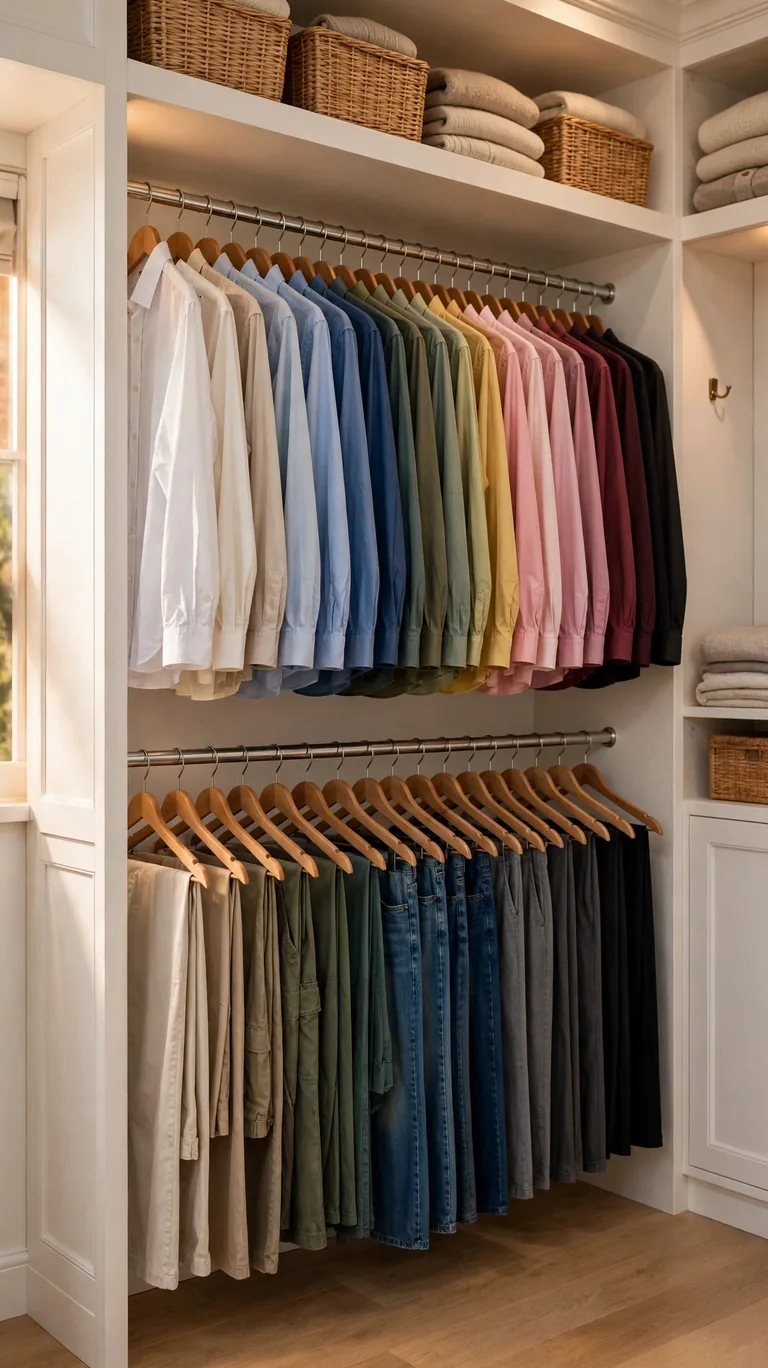
The single biggest upgrade for most closets is splitting one tall hanging section into two stacked rods. Shirts, blouses, and folded pants are short, so they only need about half the height of a full rod. Two rods stacked one above the other instantly double your hanging space for everyday pieces, and it works in closets of any size. Put your most worn shirts on the upper rod and pants or skirts on the lower one, or split by person if you share the closet. The change takes an afternoon and a second rod, and it feels like you gained a whole new closet.
Here is the detail that makes it work. Keep one section of full-height hanging space somewhere for dresses, long coats, and jumpsuits, because those pieces need the length. Everything else can live happily in double-hang zones. When you shop, hang new items straight into their zone instead of draping them over a chair, and the system maintains itself. This is the backbone of nearly every smart walk-in closet layout, and it is the first thing professional organizers recommend for a reason.
2. The L-Shaped Layout for Awkward Spaces
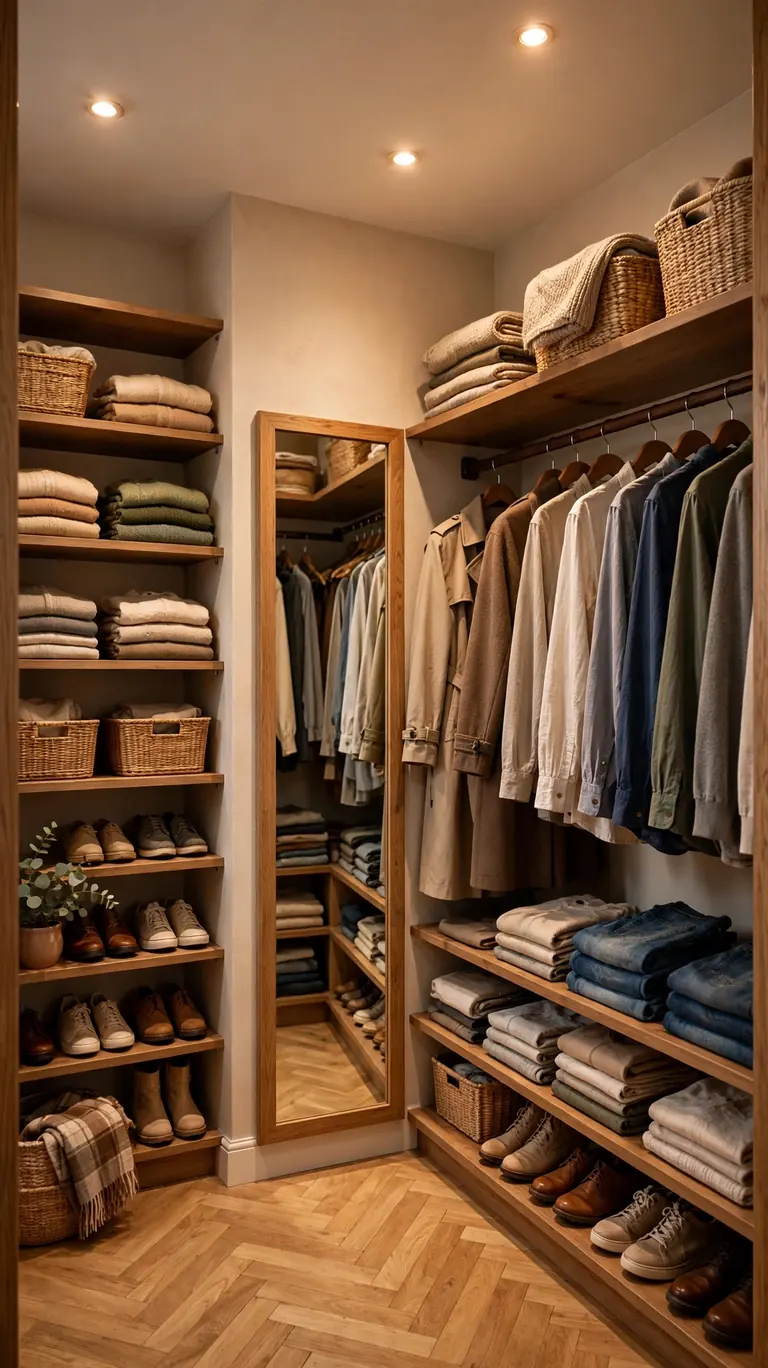
Not every closet is a perfect square. Many walk-ins are long and narrow, or tucked into an L-shaped corner of the bedroom. Instead of fighting the shape, run your storage along both walls of the L. Hanging goes on the long wall, and shelving or drawers take the short wall at the end. You walk in, turn the corner, and everything is within reach. The L shape actually helps because it naturally separates zones, daily clothes on one arm, shoes and accessories on the other.
If your closet is very narrow, keep the shelving shallow on one side so the walkway stays comfortable. You need enough room to turn around and pull things off rods without bumping into the opposite wall. A full-length mirror on the inside of the door or at the end of the L makes the space feel twice as big and gives you a place to check your outfit. Small and awkward beats big and messy every time, as long as the layout respects the room you have.
3. The U-Shaped Full Walk-In
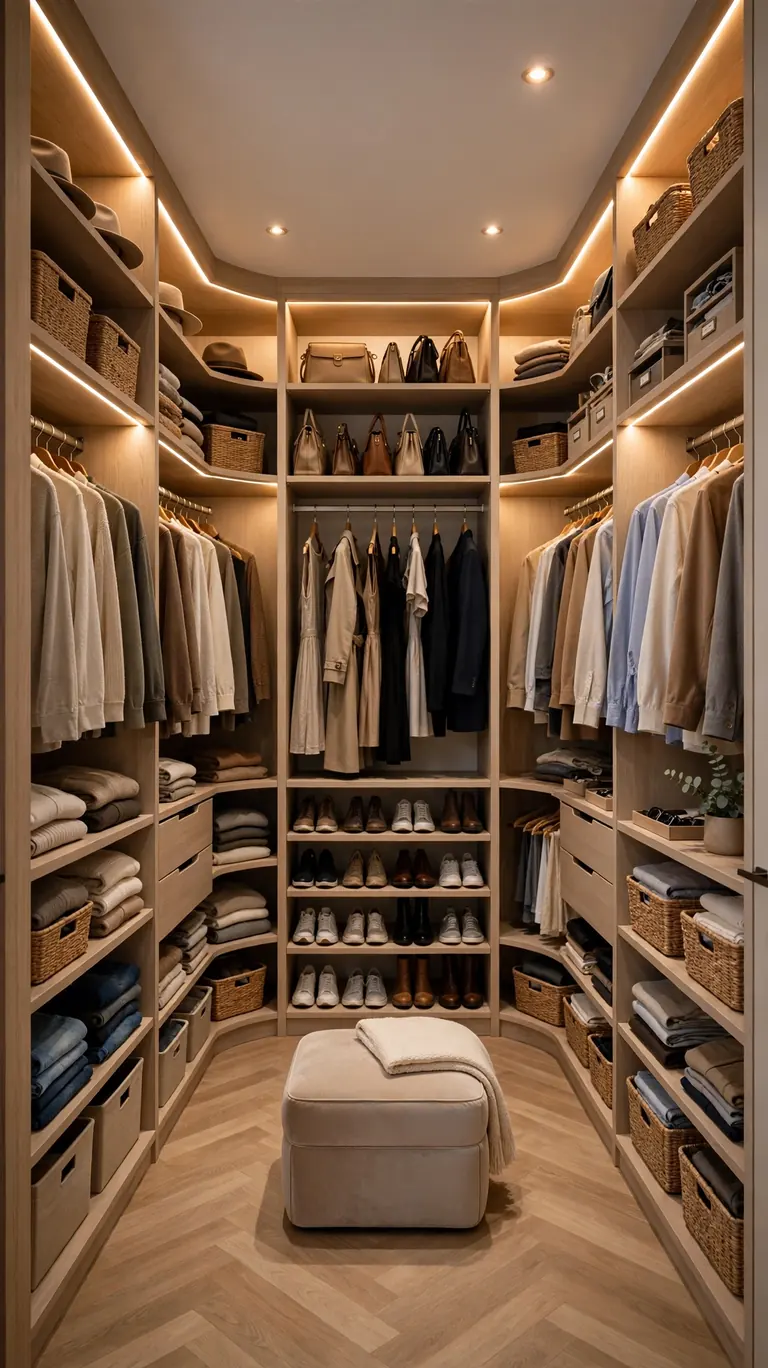
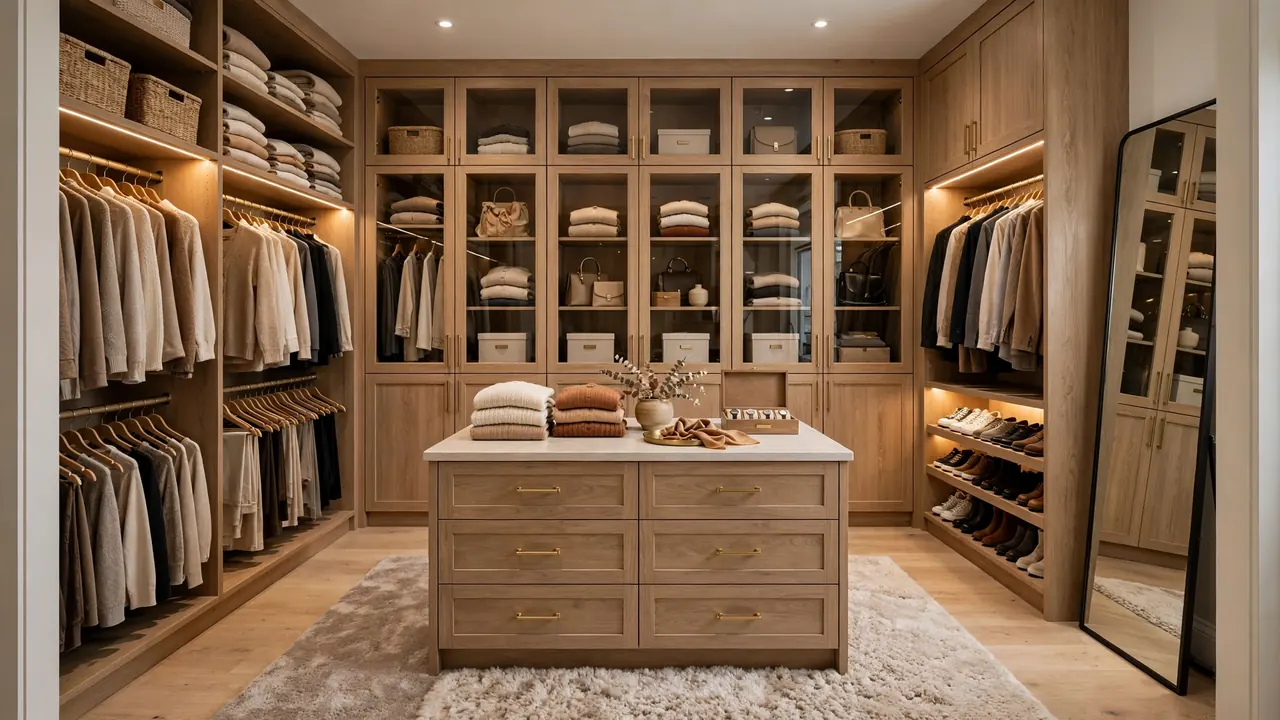
If you have a roomy square closet, the U-shaped layout is the dream. Storage runs along three walls, and you stand in the middle like the captain of a very well-dressed ship. Hanging fills two walls, and the third holds shelving, drawers, or a shoe display. Everything is visible at once, which means you actually wear what you own instead of forgetting about half of it. The center stays open for moving around, and a small rug or ottoman in the middle makes it feel like a boutique.
The trick with a U shape is keeping the middle clear. It is tempting to add an island or a bench, and those can work, but only if you can still walk comfortably all the way around. Leave generous walking room before you add any center furniture. If the room is generous enough, a low island with drawers in the center becomes the perfect home for folded items and accessories, and it gives you a surface for laying out tomorrow’s outfit.
4. Single-Wall Gallery for Narrow Closets
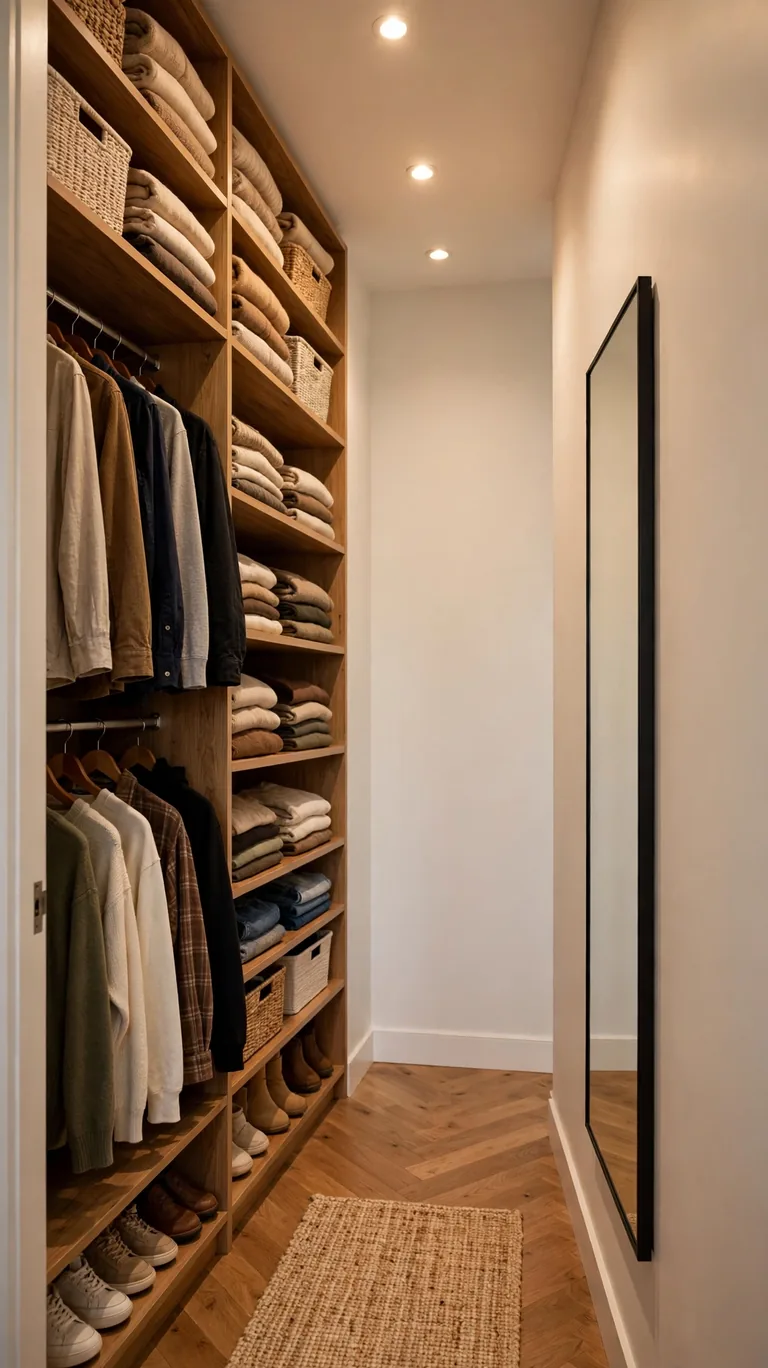
Some walk-ins are really just deep reach-in closets with a door you can step through. For these, a single-wall gallery layout is the smartest move. Put all your storage on one wall, floor to ceiling, and keep the opposite wall mostly clear. Double-hang rods on one side, shelves on the other end, shoes along the bottom. The clear wall keeps the space feeling open instead of tunnel-like, and it gives you room to stand back and actually see your options.
To make one wall do the work of three, go vertical. Use the full height from floor to ceiling, with daily items at eye level, less-used things up high, and shoes down low. A slim full-length mirror on the clear wall is perfect here, since it bounces light and makes the narrow room feel wider. This layout proves that walk-in closet ideas for small spaces are about discipline, not square footage. One great wall beats three cluttered ones.
5. An Island Dresser in the Center
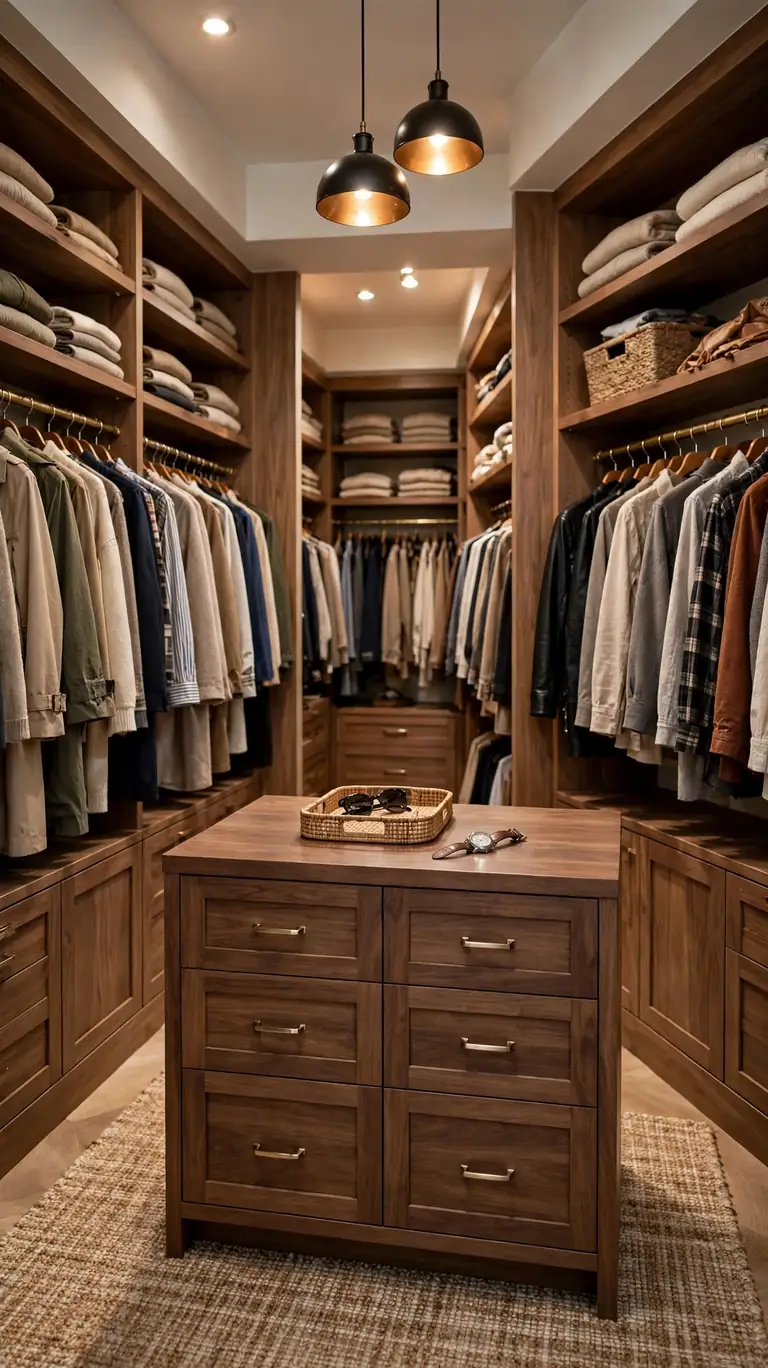
In a large walk-in, a low island in the center changes the whole room. It holds drawers for folded clothes, jewelry, and accessories, and its top becomes a staging area for planning outfits or packing for trips. Choose an island with drawers on both sides so it works from every angle. A glass or light-colored top keeps it from feeling heavy in the middle of the room, and a small tray on top corrals the daily items like a watch, sunglasses, and the perfume you reach for most.
Before you commit to an island, tape its outline on the floor and live with it for a few days. Walk around it the way you would on a busy morning. If you find yourself squeezing past it, it is too big for your space. The island should make the room feel more functional, not more crowded. When the size is right, it becomes the hardest-working piece in the closet and the spot where getting dressed starts to feel like fun.
6. Floor-to-Ceiling Shelving Walls
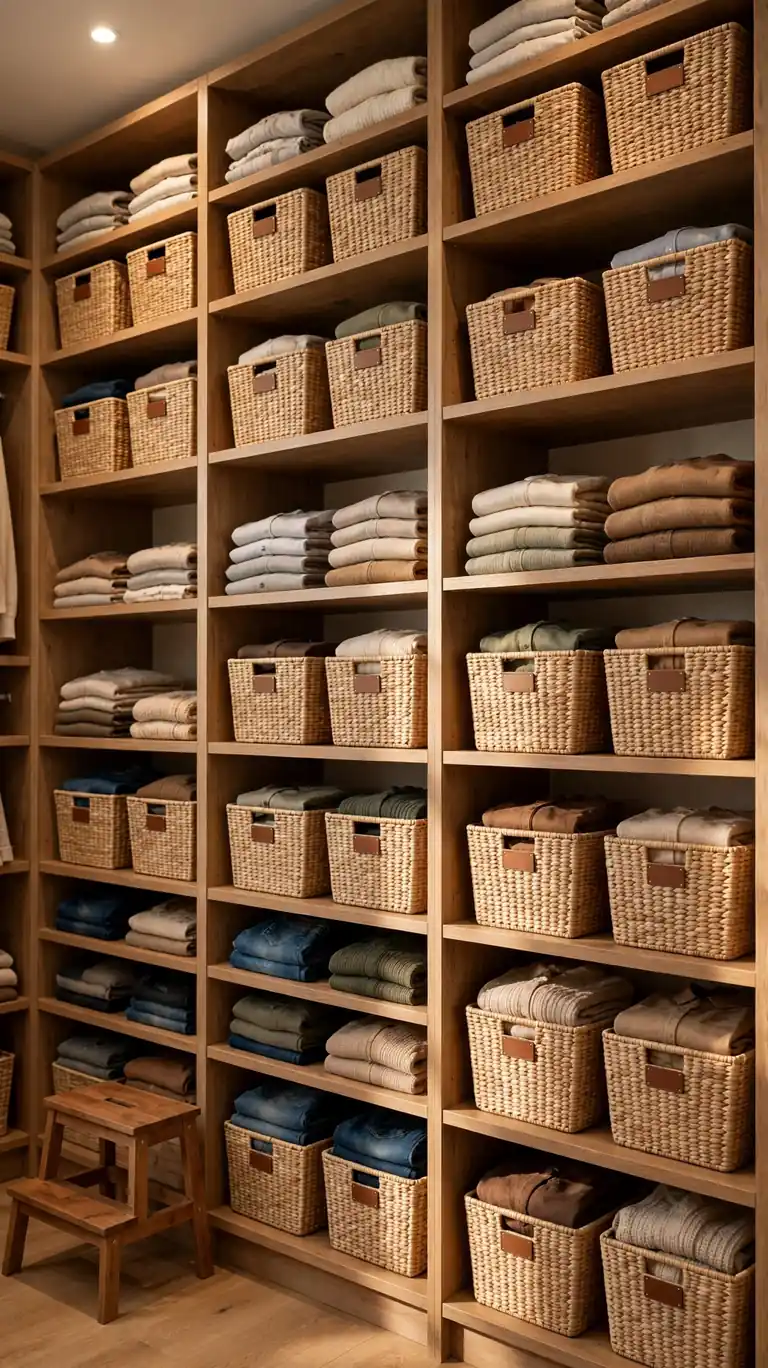
The most wasted space in most closets is the top third. High shelves feel out of reach, so they become graveyards for forgotten boxes. A floor-to-ceiling shelving wall fixes this by making every level intentional. Daily items live between knee and eye height, where they are easiest to grab. The middle-high shelves hold folded sweaters and bags you rotate. The very top holds labeled bins for seasonal or rarely used things, and a small step stool kept in the closet makes them reachable.
The actionable step is to actually use matching bins or baskets on the high shelves instead of loose piles. Piles up high are impossible to maintain, but a bin you can pull down, use, and slide back stays tidy with almost no effort. Label each bin with what is inside, because you will not remember in six months. When the whole wall works from floor to ceiling, even a modest closet holds a surprising amount, and nothing is truly out of reach.
7. A Dedicated Shoe Wall
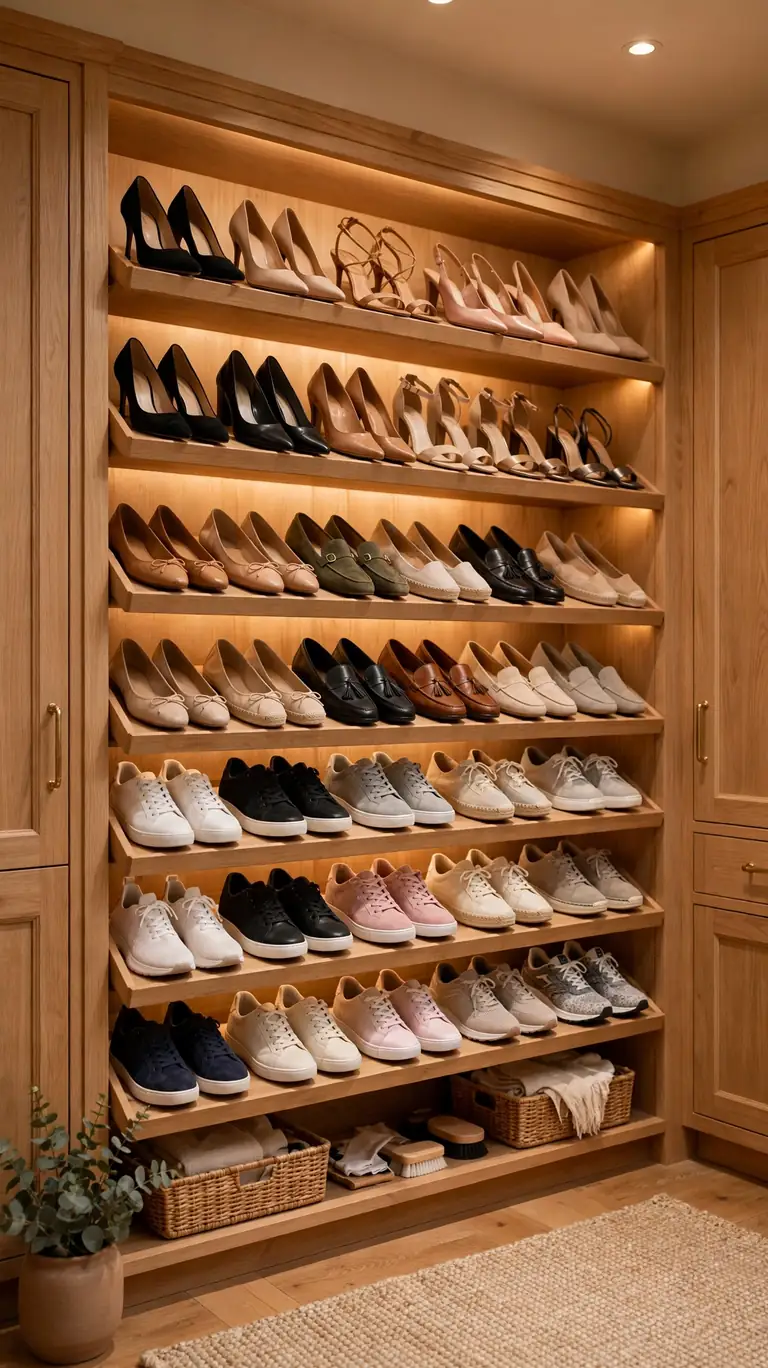
Shoes eat floor space and create chaos faster than anything else in a closet. A dedicated shoe wall solves both problems by getting every pair up off the floor and into view. Slanted shelves work beautifully because you can see each pair at a glance, and they hold more pairs per shelf than flat stacking. Arrange shoes with the toe facing out, one pair per slot, and suddenly your collection looks like a store display instead of a pile.
Start by counting your shoes honestly, because most people underestimate by a lot. Pull every pair out, count them, and plan shelf space for that number plus a little room to grow. Heels, flats, and sneakers all sit happily on slanted shelves, while tall boots need a taller section or a boot rack that keeps them upright. When every shoe has a visible home, you stop buying duplicates of things you already own, which is a nice bonus.
8. Tilted Shelves for Maximum Shoe Visibility
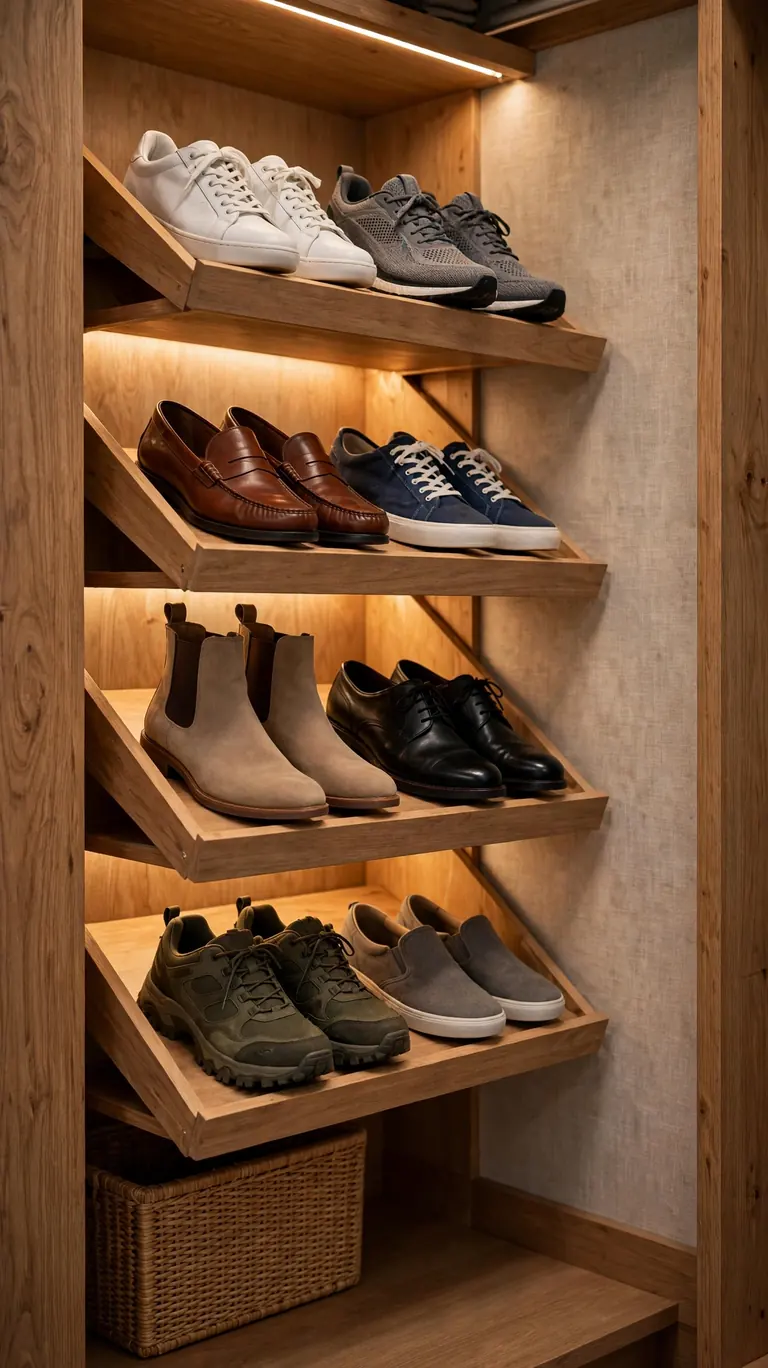
If a full shoe wall feels like too much, tilted shelves inside a regular shelving section give you most of the benefit in less space. A slight forward tilt lets you see each pair without pulling shoes out, and the tilt keeps pairs from sliding into each other. Two or three tilted shelves can hold a whole everyday rotation, with the rest of the collection stored higher up or in clear boxes. This is one of the best small walk-in closet layout ideas because it turns a single shelf column into a proper shoe station.
You can buy angled shelf inserts that sit on flat shelves, or look for a small tilted shoe rack that fits inside your existing shelving. Keep the pairs you wear weekly on the tilted shelves and store occasion shoes above. The real win is mornings. When you can see every everyday option in one glance, choosing shoes takes seconds instead of a dig through a dark pile. Visibility is the whole game with shoes.
9. Glass-Front Cabinets for Dust-Free Display
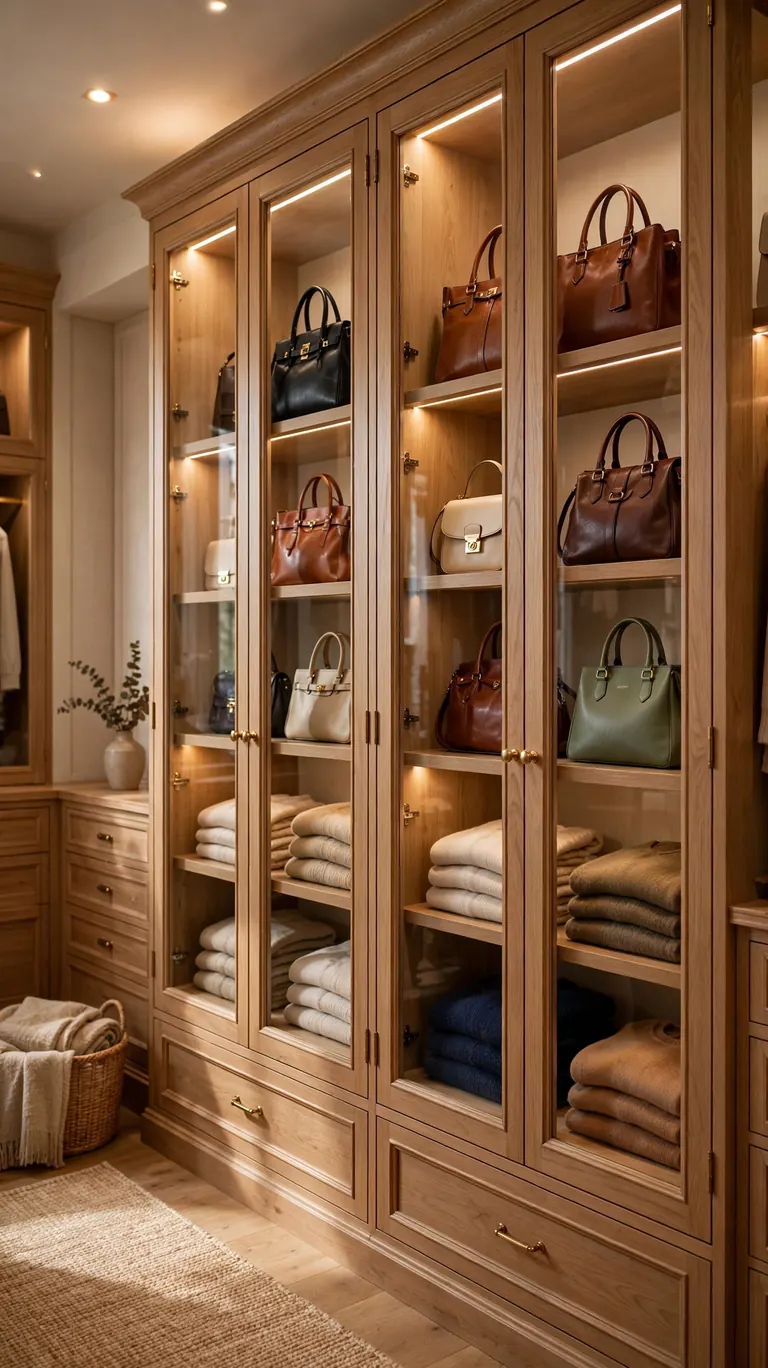
Open shelving looks great in photos, but in real life it collects dust on everything, especially bags and folded items you do not touch daily. Glass-front cabinets give you the pretty display look with a door between your things and the dust. They work beautifully for handbags, folded sweaters, and accessories you want to see but not clean constantly. The glass keeps the room feeling open and airy, unlike solid doors that can make a small closet feel boxy.
Use glass cabinets for the items you reach for less often, and keep daily things on open rods and shelves where speed matters. A glass cabinet at the end of a shelving run makes a natural focal point, almost like a shop window for your favorite pieces. If you are worried about fingerprints, frosted or ribbed glass hides smudges much better than clear glass and still lets you see shapes and colors inside. Pretty and practical is a rare combination, and this nails it.
10. Open Shelving with Matching Bins
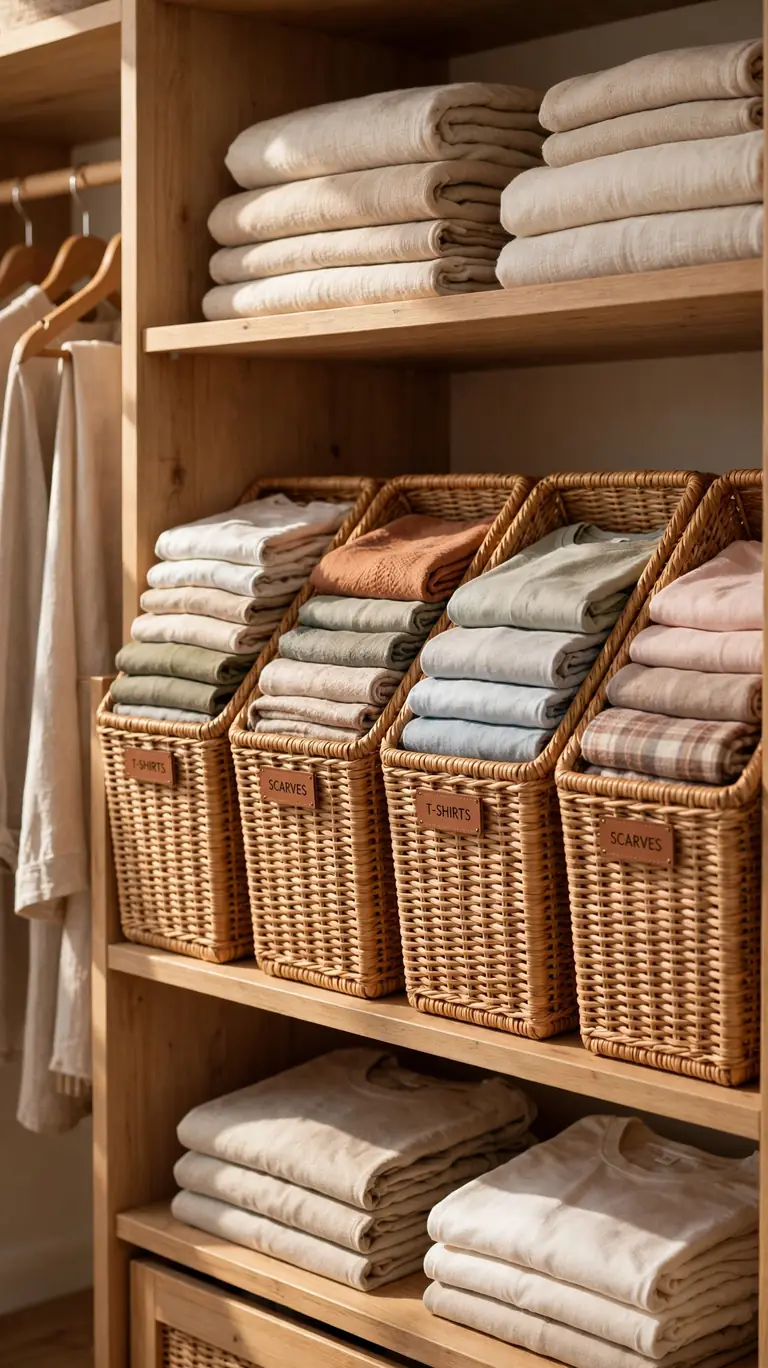
For a budget-friendly approach that still looks pulled together, open shelving with matching bins is hard to beat. The shelves themselves are simple, and the bins do the organizing work. Folded t-shirts, workout clothes, scarves, and all the soft items that do not hang well get their own bin. Because the bins match, the whole wall looks calm and intentional even when the contents are just everyday basics. This is the system that works best for people who are not naturally tidy, because tossing something into its bin takes two seconds.
The key is giving every bin a category and actually sticking to it. One bin for gym clothes, one for pajamas, one for scarves, and so on. When a bin starts overflowing, that is your signal to declutter, not to buy a bigger bin. Clear bins or bins with labels save you from the open-every-bin hunt. This layout is forgiving, flexible, and easy to rearrange as your wardrobe changes, which makes it perfect for renters and anyone whose style is still evolving.
11. The His-and-Hers Split
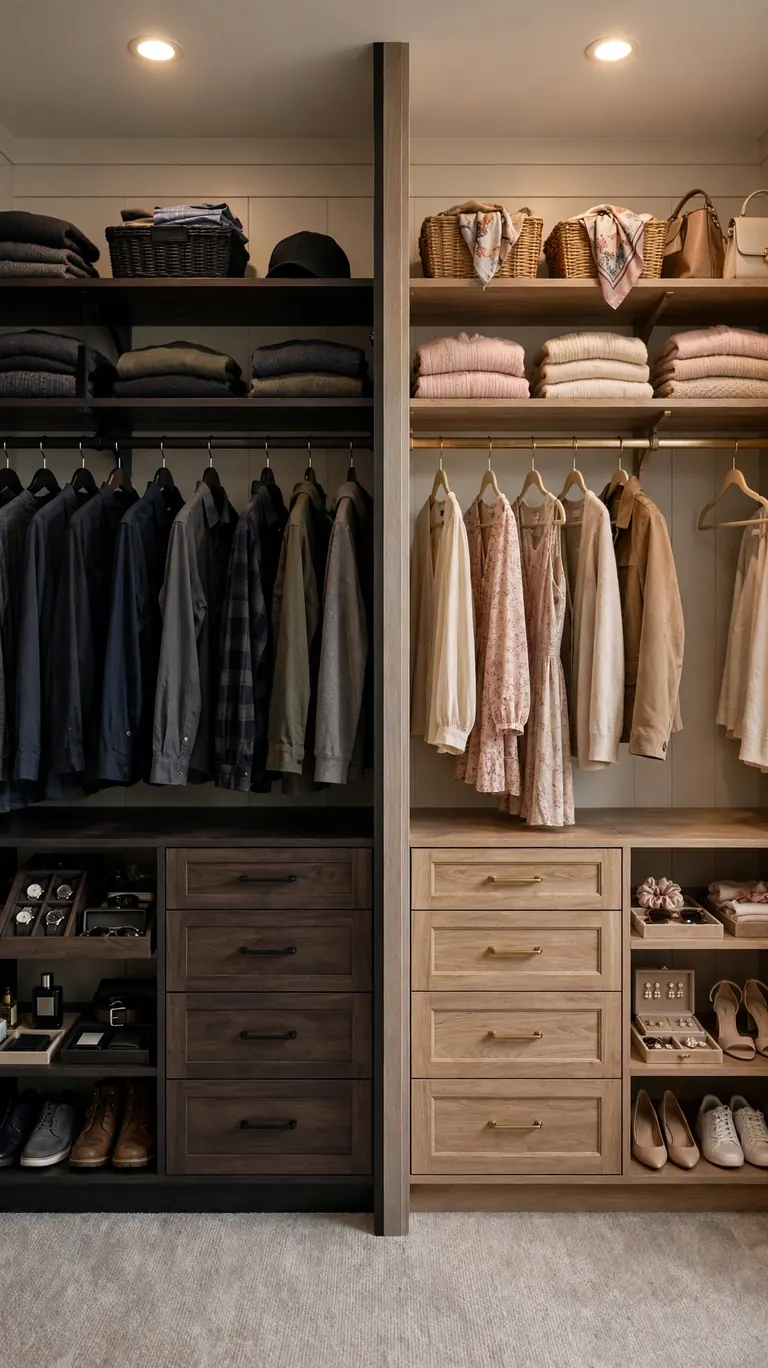
Sharing a walk-in closet only works when both people have clearly defined territory. The his-and-hers split divides the closet down the middle or into two zones, each with its own hanging, shelving, and drawer space. It does not have to be perfectly equal, since wardrobes differ, but it should be clearly agreed. When each person owns their zone, nobody borrows space from the other, and the mysterious migration of one person’s stuff into the other’s section finally stops.
Sit down together and divide based on what you actually own, not on a strict half-and-half. If one of you has forty pairs of shoes and the other has six, the shoe wall should reflect that. A shared middle zone can hold things like the ironing board, the step stool, or seasonal bins that belong to both of you. The goal is not perfect fairness, it is zero friction. A closet with clear ownership is a closet where both people can find their things on a rushed morning.
12. A Seasonal Rotation Zone
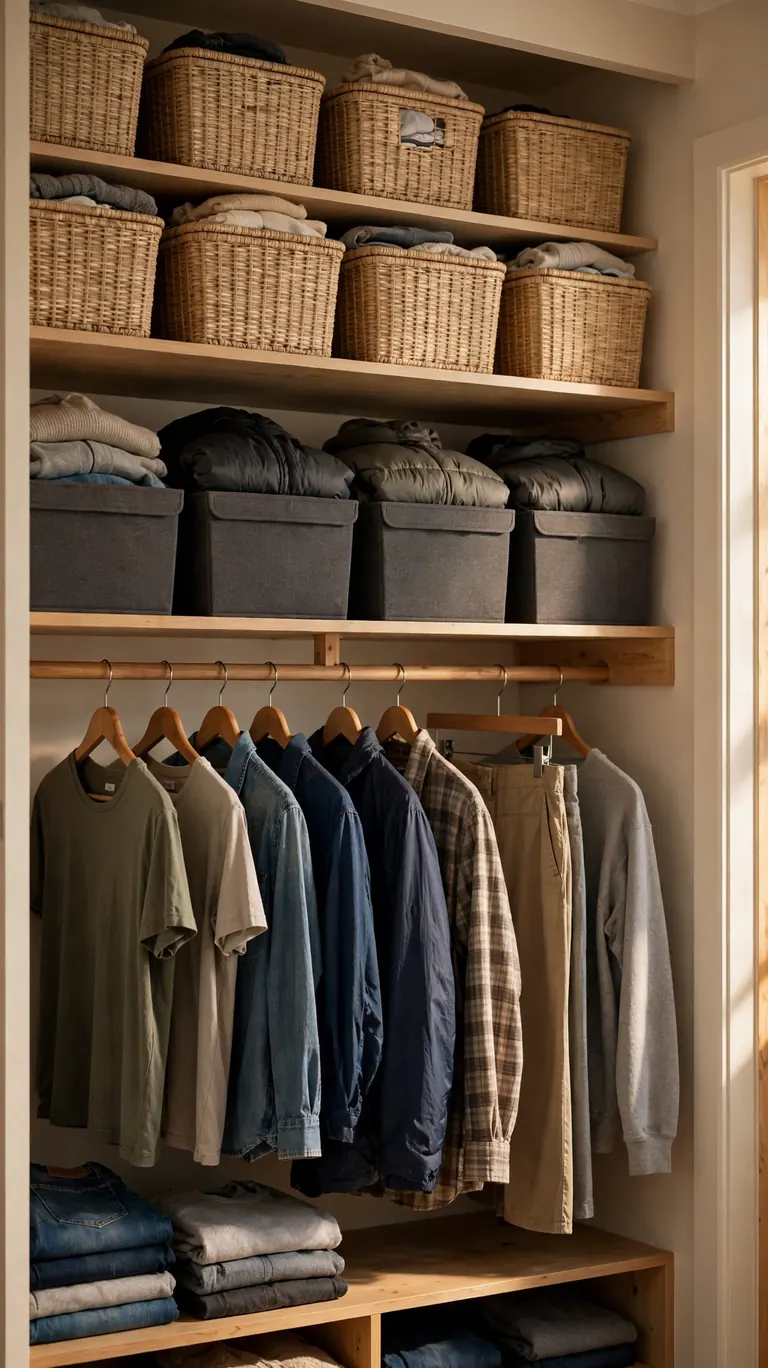
Most closets are stuffed because they are holding two wardrobes at once, summer and winter. A seasonal rotation zone fixes this by giving off-season clothes a dedicated home. The top shelves or a far section hold labeled bins with the clothes you will not need for months. When the weather turns, you swap the bins and the current season moves into prime real estate. Your daily closet instantly feels twice as big because it is only holding what you actually wear right now.
Make the swap a real ritual twice a year, and use it as a decluttering moment. When you pack away winter coats, notice which ones you never wore and let them go. Store off-season clothes clean and fully dry, in bins that close properly, so nothing comes back smelling musty. This system is especially powerful in small walk-in closets, where every rod inch counts. Your closet should dress for the weather you have, not the weather you had three months ago.
13. A Jewelry and Accessories Drawer
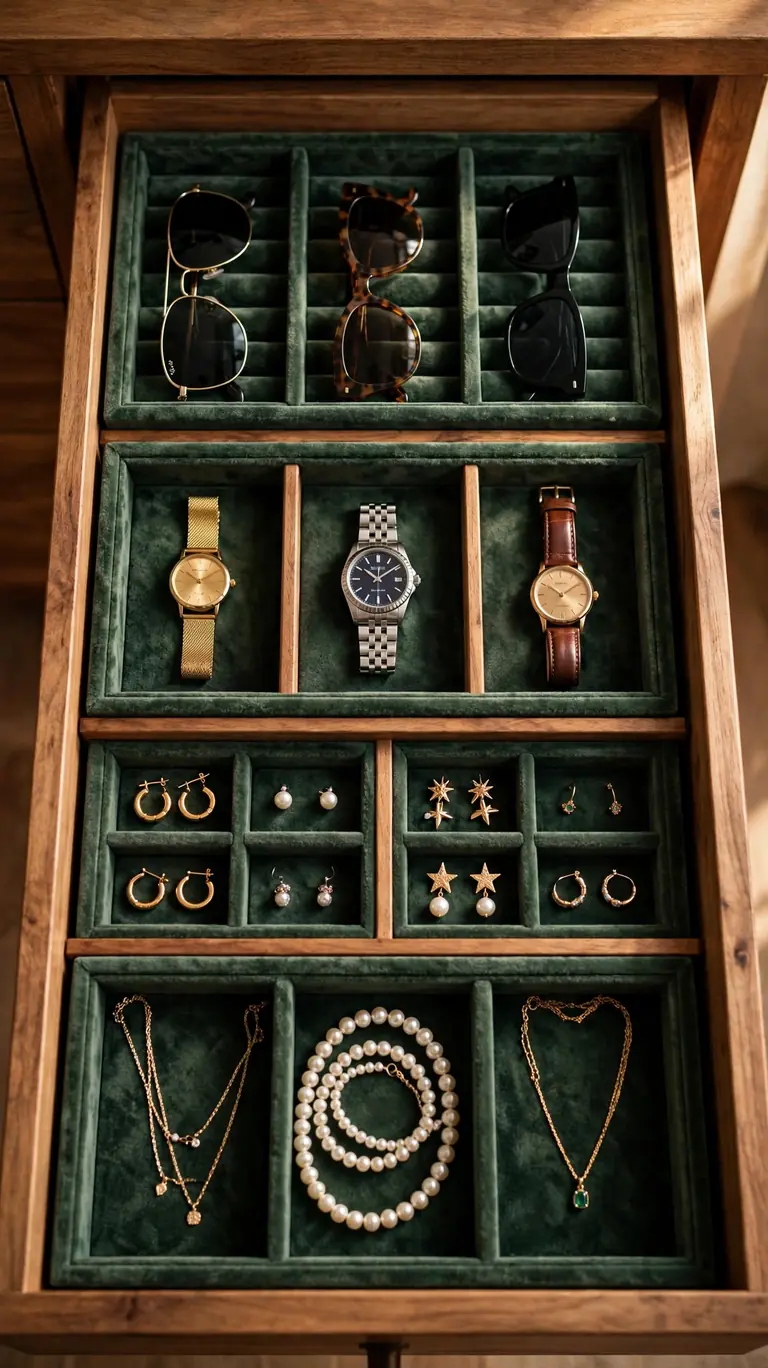
Small items cause big messes. Jewelry tangles, belts curl, sunglasses scratch, and watches disappear into drawers never to be seen again. A dedicated accessories drawer with dividers or small trays gives every little thing a visible home. Velvet-lined trays keep necklaces from tangling, small compartments sort earrings by pair, and a watch roll or stand keeps timepieces safe. When accessories are organized, you actually wear them instead of grabbing the same two pieces every day.
You do not need a custom built drawer to start. A shallow desk organizer or a cutlery tray inside any drawer creates instant compartments for almost nothing. Keep the drawer near your mirror or in the island if you have one, so accessories are part of the getting-dressed flow. The daily habit that keeps it working is putting things back in their exact spot, which takes seconds when every item has a labeled home. Small things, big difference.
14. A Full-Length Mirror Moment
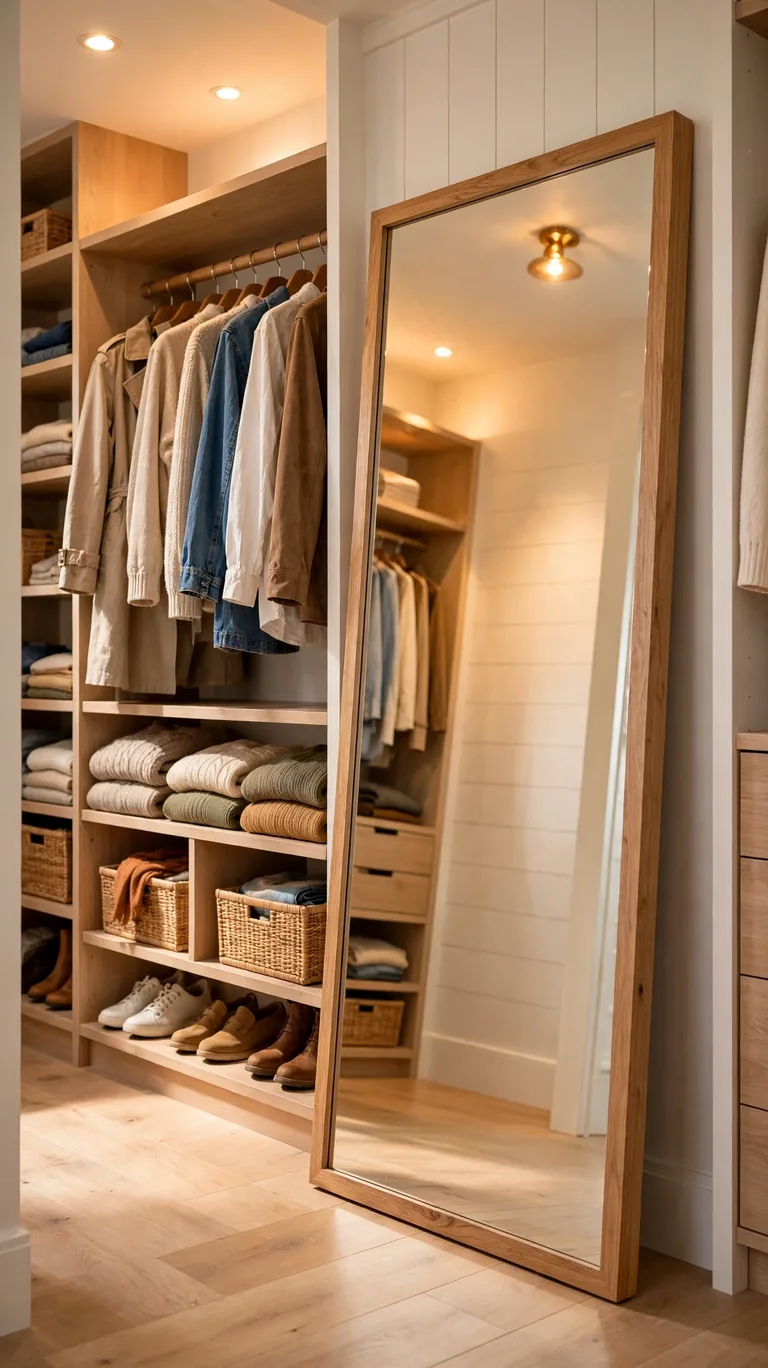
Every walk-in closet needs a proper mirror, because checking your outfit should not require a trip back to the bedroom. A full-length mirror on the wall or the back of the door is the minimum. If you have the space, a large leaning mirror makes the closet feel bigger and brighter while giving you a head-to-toe view. Good lighting near the mirror matters as much as the mirror itself, since a mirror in a dark corner just shows you shadows.
Place the mirror where it catches natural or warm artificial light, and where you have enough floor space to step back a few feet. A mirror you have to stand six inches from is not useful. If wall space is tight, the inside of the closet door is prime real estate for a slim full-length mirror. This is one of those walk-in closet organization ideas that feels obvious once you have it and baffling that you lived without it. Getting dressed is a visual task, and the closet is where the mirror belongs.
15. LED Lighting in Every Section
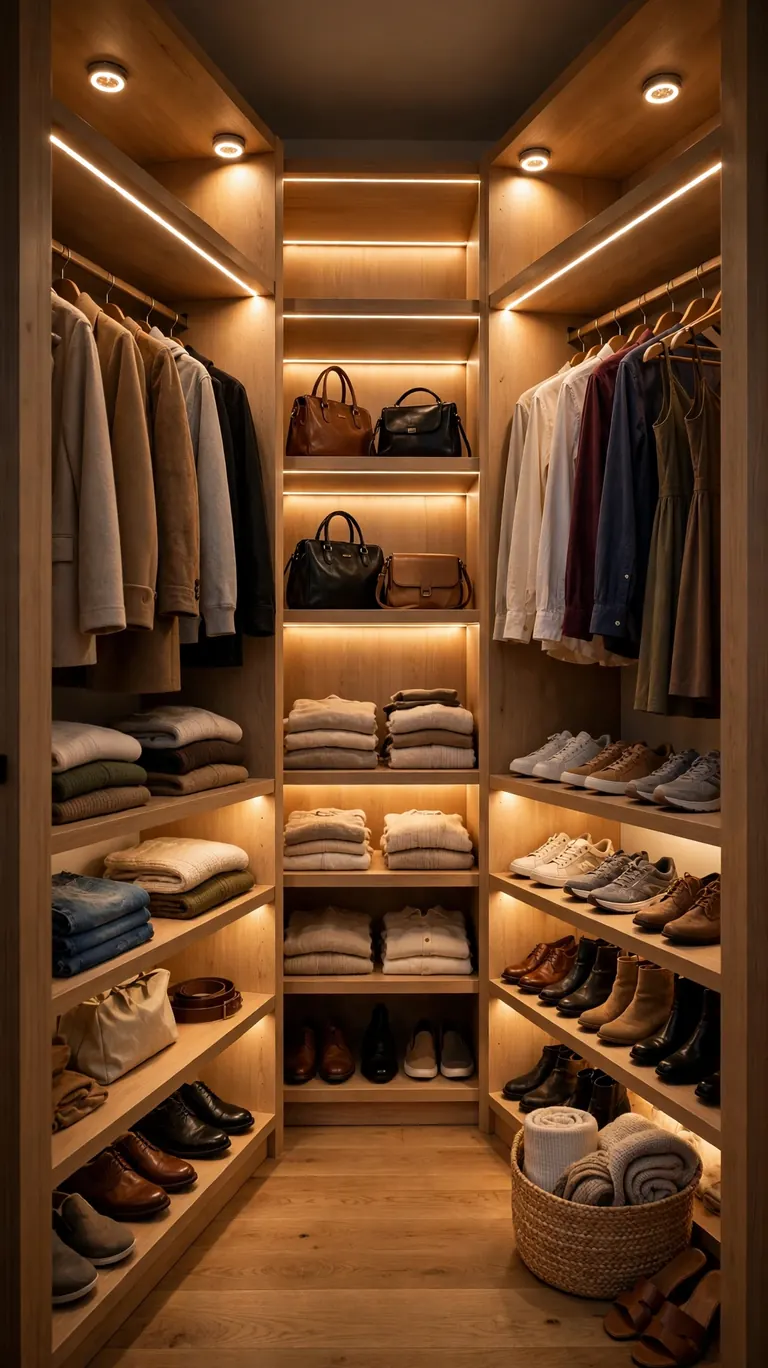
Closets are notoriously badly lit, and bad lighting makes everything harder, from telling navy from black to finding the right pair of shoes. LED strip lighting or small puck lights in every section changes the room completely. Stick-on LED strips under each shelf wash the shelf below in light, battery puck lights brighten dark corners, and a brighter overhead fixture lifts the whole room. Warm white light flatters both clothes and skin, while cool light can make colors look wrong.
Start with the darkest spots first, usually the shelves and the shoe area. Motion-sensor lights are wonderful in closets because your hands are always full when you walk in. If you can only do one lighting upgrade, make the main ceiling light brighter and warmer before adding accent strips. A well-lit closet feels bigger, cleaner, and more luxurious, and it ends the era of pulling three almost-identical black tops out to the bedroom window to compare them.
16. A Small Seat for Dressing
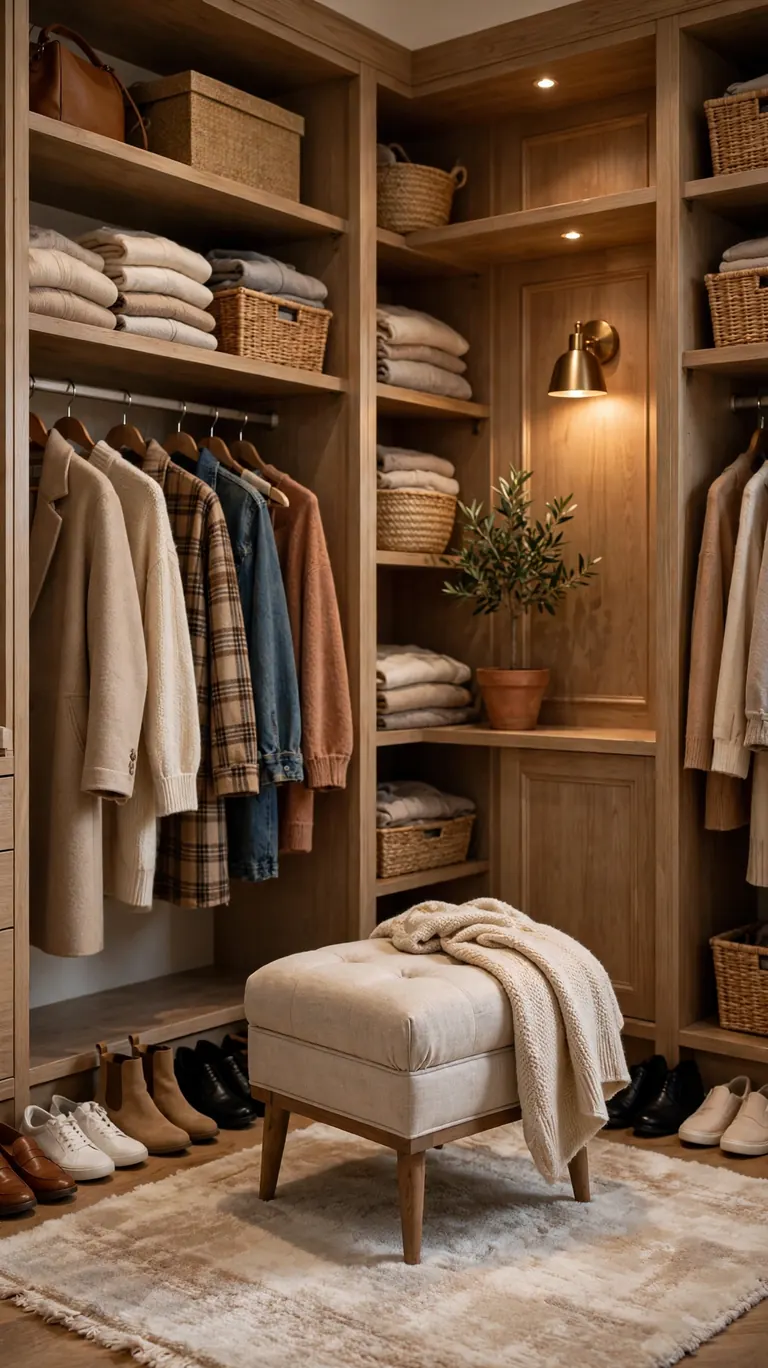
A place to sit in the closet sounds like a luxury, but it is deeply practical. Pulling on shoes, tights, or boots is so much easier sitting down, and a seat gives you a surface for laying out clothes while you decide. A small ottoman, a compact bench, or even a sturdy pouf fits in most walk-ins. If the ottoman has storage inside, it doubles as a home for out-of-season accessories or gift wrap, which is a lovely bonus.
Choose a seat that fits your walkway. Tape the footprint on the floor and make sure you can still move around it comfortably on a busy morning. Upholstered seats in a wipeable fabric hold up best, since closet seating gets daily use. This is one of those ideas that turns a closet from pure storage into a real dressing room. Sitting down to put on shoes instead of hopping on one foot is a small daily luxury that never gets old.
17. The Vanity Corner
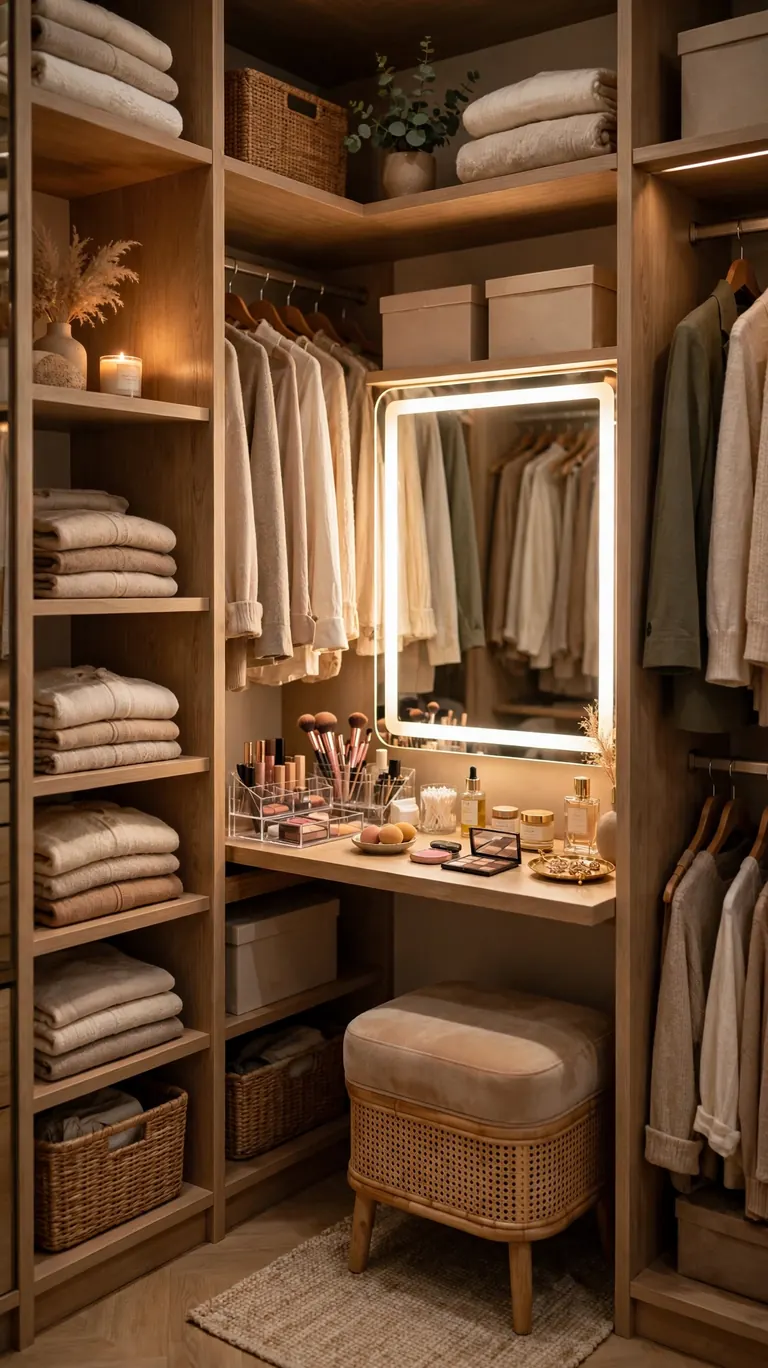
If your walk-in is generous, a small vanity corner turns it into a complete getting-ready station. A narrow desk or wall-mounted shelf with a mirror, good lighting, and a few organizers holds makeup, hair tools, and daily skincare. Doing your routine in the closet means you never have to carry armloads of clothes back to the bathroom, and everything you need for the day lives in one room. A stool that tucks under the desk keeps the corner compact.
Lighting is everything at a vanity. A mirror with lights around it, or a pair of small lamps on either side, gives you the even illumination that overhead lights cannot. Keep the surface minimal, with only daily items out and the rest in drawers, so the corner stays calm instead of cluttered. Even a tiny vanity, just a shelf and a mirror, earns its place. It is the difference between a closet you store things in and a room you actually get ready in.
18. Pull-Out Racks for Trousers and Skirts
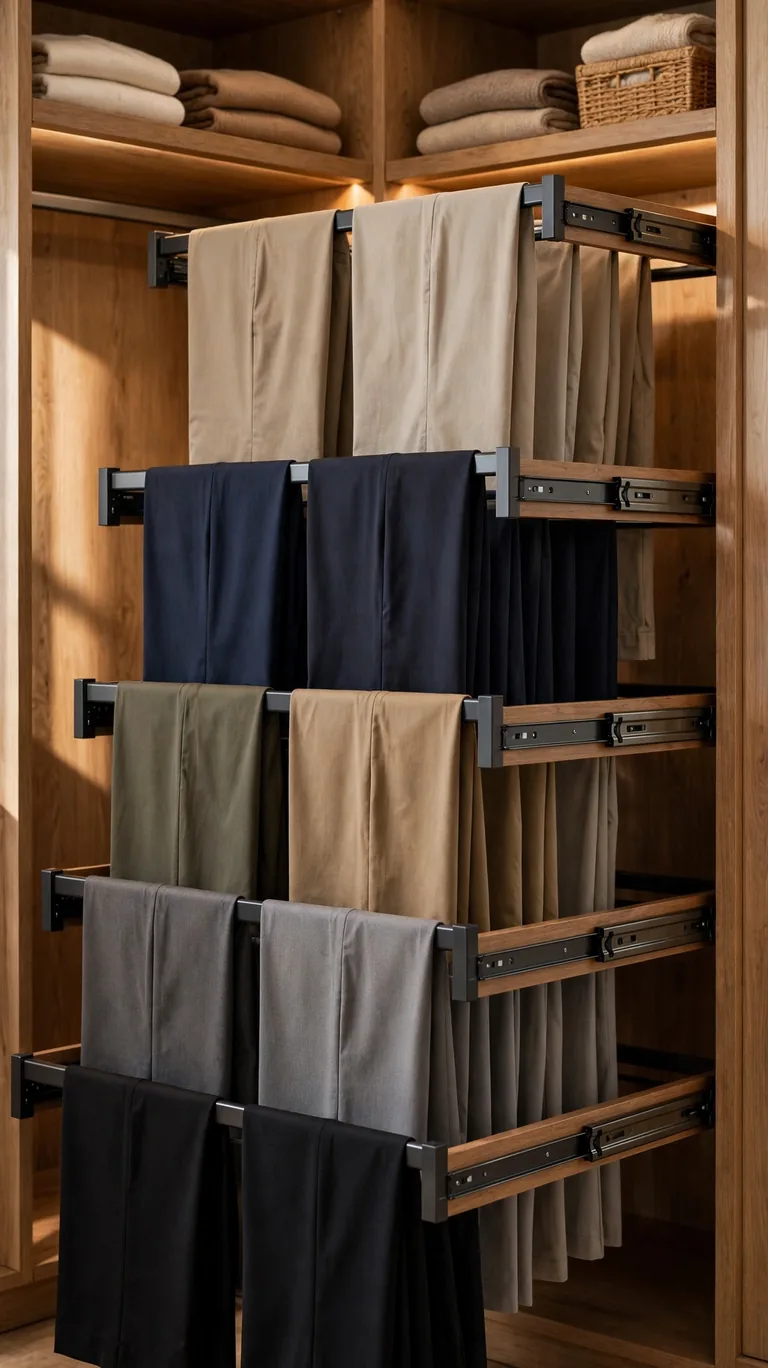
Hanging trousers on regular hangers eats rod space and lets them slide into wrinkled heaps. Pull-out trouser racks, the kind that slide out like a drawer with multiple bars, store a dozen pairs in the space of a few hangers. Each pair hangs flat over its own bar, which means fewer creases and no more digging. Skirts hang just as well on the same bars. These racks fit into narrow sections that are too slim for full hanging, which makes them perfect for filling awkward gaps.
If built-in racks are not in the budget, multi-bar trouser hangers give you a similar effect on a regular rod, with several pairs per hanger. The habit that keeps this working is hanging trousers up the moment they come off, while they are still warm from wearing, since that is when wrinkles fall out most easily. Dedicated trouser storage is one of those upgrades that feels small but changes your mornings. Everything is visible, everything is smooth, and nothing is on the floor.
19. Back-of-Door and Wall Racks for Belts and Ties
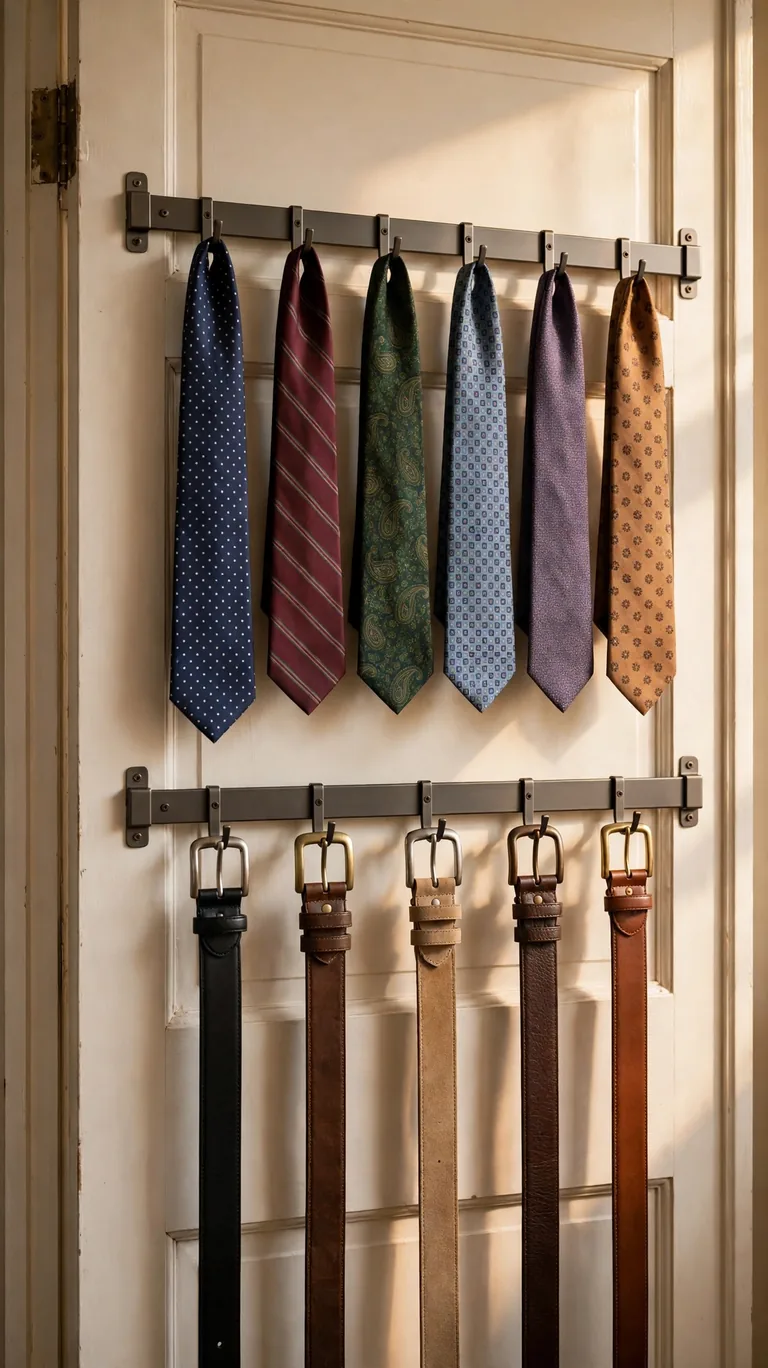
Belts and ties are long, floppy, and annoying to store, which is why they end up in drawers in tangled piles. Wall-mounted racks or back-of-door organizers with individual hooks give each belt and tie its own spot. You can see every option at a glance, nothing gets creased from being folded, and the whole collection takes up almost no space. The back of the closet door is ideal, since it is otherwise completely wasted.
Group ties by color family on the rack so you can find the right one quickly, and hang belts by their buckle end so they stay straight. If you share the closet, give each person their own rack to avoid the tangle wars. This is a five-minute install that solves a daily annoyance. When small accessories have visible homes, getting dressed gets faster, and the drawers stay free for things that actually belong in drawers.
20. Dividers That Keep Folded Stacks Neat
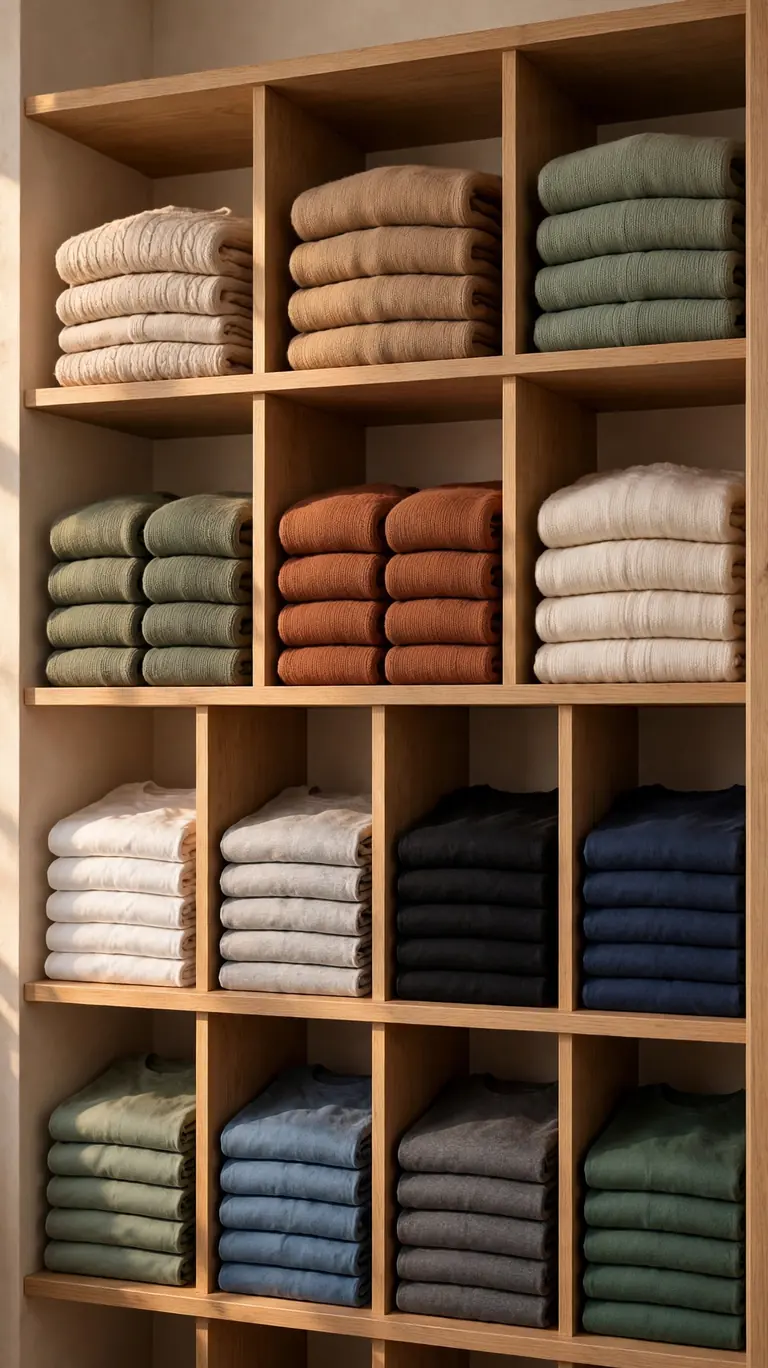
Folded clothes on open shelves have one fatal flaw. The moment you pull out the middle sweater, the whole stack collapses. Shelf dividers, simple upright panels that slot onto the shelf, keep each stack standing on its own. T-shirts in one section, sweaters in another, jeans in a third, and each stack stays neat even when the one next to it gets disturbed. Acrylic dividers disappear visually, while wood or metal ones add a finished look.
The folding method matters as much as the dividers. Fold items to roughly the same width so the stacks look uniform and the dividers actually contain them. The file-fold method, where clothes stand upright in rows like files, works brilliantly with dividers because you can see every item without unstacking. This combo is the secret behind those impossibly neat closet photos. It is not that those people never touch their clothes, it is that the system forgives touching.
21. High Shelves for Luggage and Keepsakes
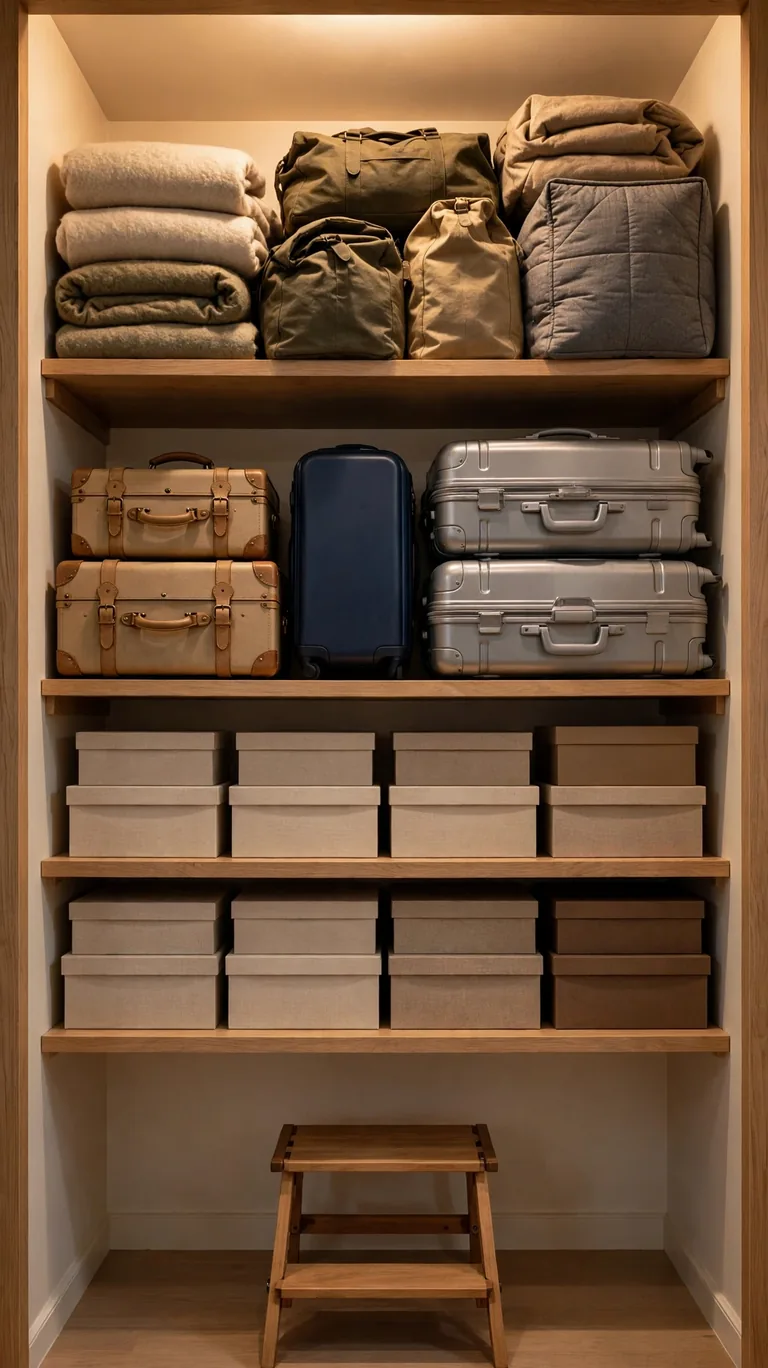
Every home has bulky things that do not belong in daily circulation but still need a home. Suitcases, duffel bags, keepsake boxes, and the holiday gift wrap all fit perfectly on the highest closet shelves. They are light enough to lift down occasionally, bulky enough to waste prime space if stored lower, and you only need them a few times a year. Giving them the top shelf keeps them out of the way but still findable, which beats the attic or the garage.
Keep a small folding step stool in the closet permanently, because a high shelf you cannot reach is just decoration. Store luggage empty and open if possible, so it airs out instead of going musty, and tuck smaller bags inside larger ones to save space. Label any keepsake boxes so future you knows what is inside without opening everything. The top of the closet is not dead space, it is just space with a different job.
22. Hooks for Tomorrow’s Outfit
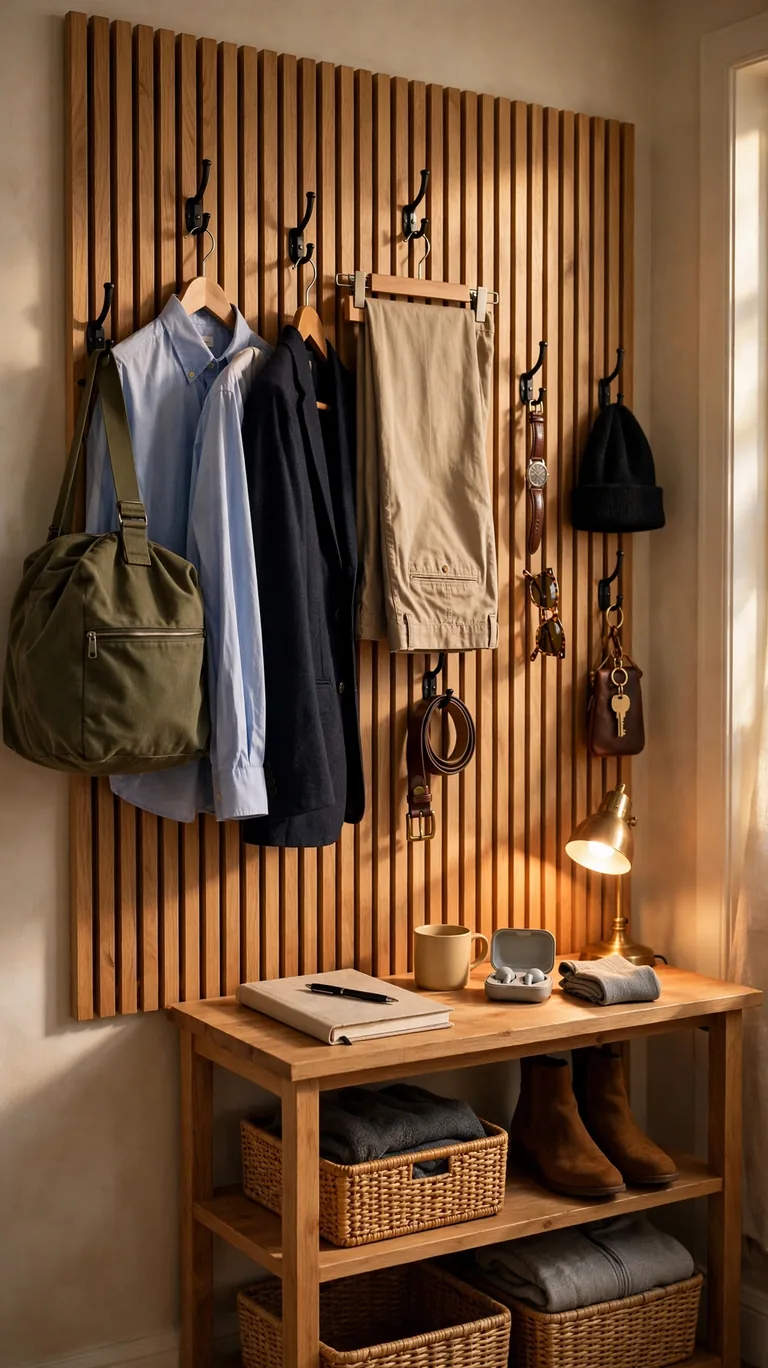
The simplest idea on this list might also be the most life-changing. A few sturdy hooks on the wall or the back of the door become your outfit-planning station. Each evening, hang tomorrow’s full outfit, clothes, and even the bag and accessories, on the hooks. Mornings become grab-and-go instead of stand-and-stare. This one habit does more for peaceful mornings than any amount of organizing, because the decision is already made.
Make it a five-minute evening ritual while you wind down. Check the weather, pick the outfit, hang it up, and walk away. If you plan workouts or have kids to dress too, add a hook or two for those. The hooks also work as a holding zone for the jacket you wore today that is not dirty enough to wash but too worn to put back with clean clothes. Planning beats searching, every single time, and your future self will thank you at 7 a.m.
23. A Built-In Hamper Nook
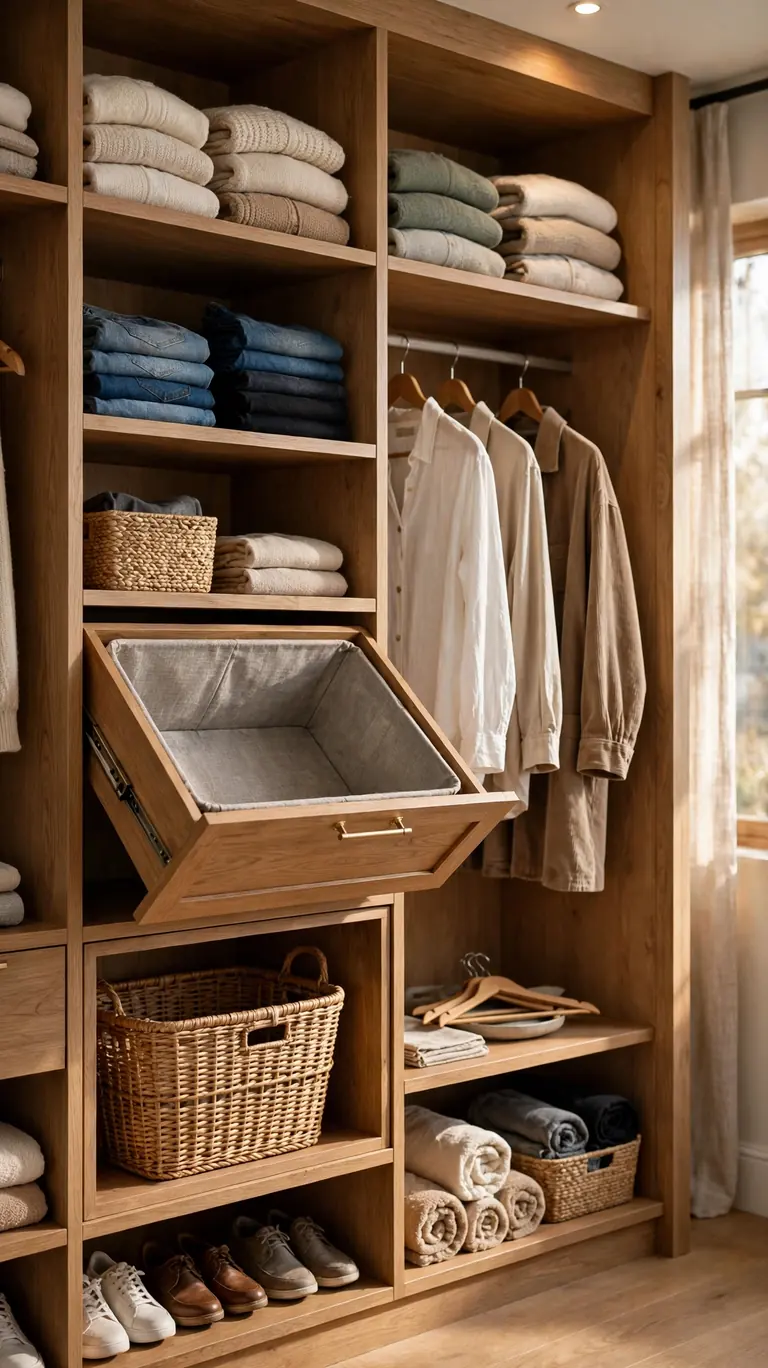
Dirty laundry is the enemy of a tidy closet, because it has nowhere to go and ends up on the floor. A built-in hamper nook, a pull-out bin or a dedicated basket tucked into the shelving, gives dirty clothes an immediate home. Tilt-out hampers that look like drawers are especially neat, and a simple lidded basket in a cubby works just as well. When the hamper lives in the closet, undressing and sorting happen in one step.
If you sort laundry, use a divided hamper or two side-by-side baskets for lights and darks, so wash day starts already sorted. Keep the hamper ventilated rather than sealed tight, since airflow prevents that stale laundry smell. The rule that keeps this working is simple. Clothes go in the hamper or back on a hanger, never on the floor, and never on the chair. A closet with a hamper nook stays tidy almost by itself.
24. A Window Nook for Natural Light
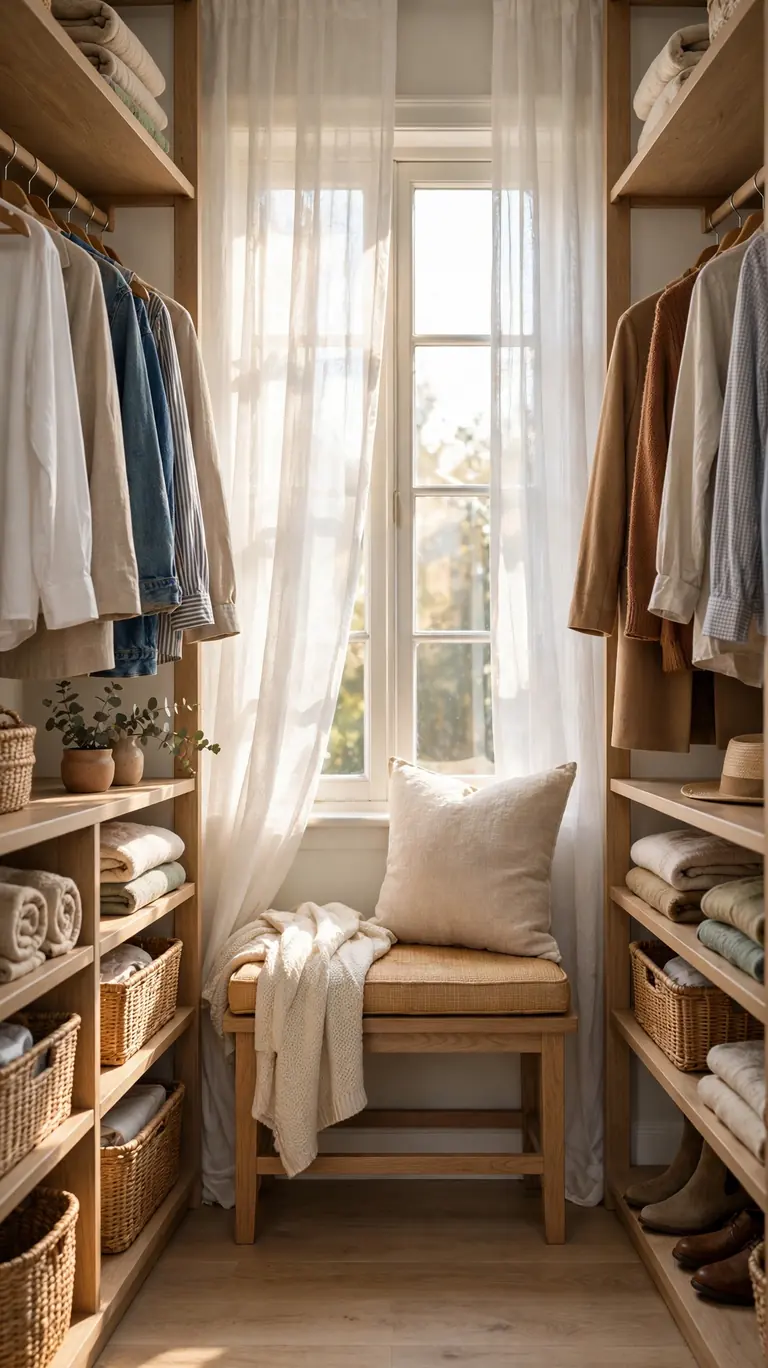
If your walk-in closet has a window, treat it like the gift it is. Natural light makes colors true, which means no more navy-or-black guessing games, and it makes the whole room feel like a boutique instead of a cave. Arrange a small seating spot or a low dresser under the window, and keep the glass clean so the light pours in. Sheer curtains give you privacy without blocking the daylight that makes this corner so useful.
Protect your clothes from direct sun, though, because strong sunlight fades fabrics over time. Keep hanging clothes out of the direct sunbeam, or use the sheer curtain during the brightest hours. A plant that tolerates indoor light thrives in a closet window and makes the room feel alive. Not every closet gets natural light, so if yours does, build the layout around it. It is the one feature money cannot easily add later.
25. A Corner Carousel for Dead Corners
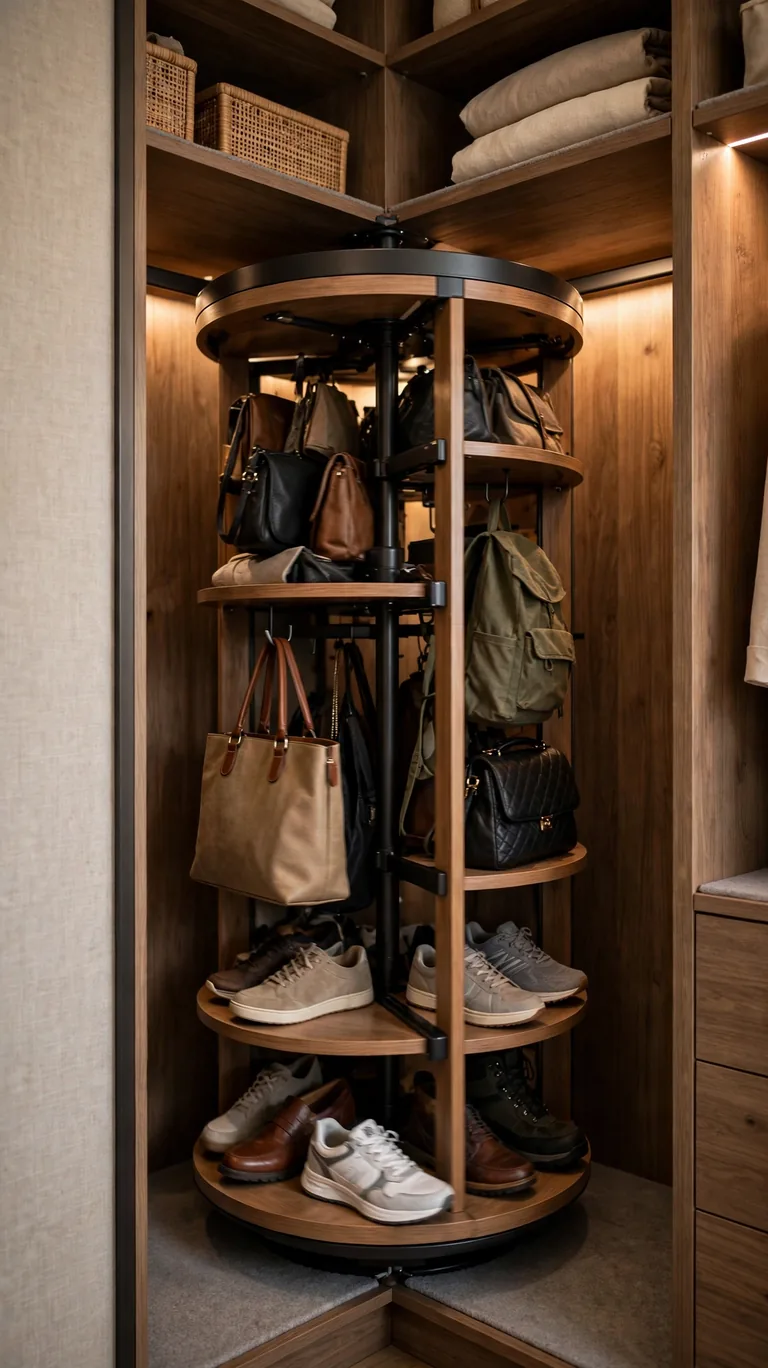
Deep corners in L-shaped or U-shaped closets are where things go to disappear. A corner carousel, a rotating unit like a lazy Susan for closets, brings the back of the corner to you with a spin. They work wonderfully for shoes, bags, or folded items that would otherwise be buried. Instead of crawling into the corner, you rotate the carousel and everything comes to the front. Dead space becomes useful space.
Measure your corner carefully before buying, since carousels need clearance to spin without hitting adjacent shelving. They work best for items you use regularly but not daily, like the bag rotation or occasion shoes. If a carousel feels like too much, a simple turntable tray on a corner shelf gives you a smaller version of the same idea for almost nothing. Corners are only dead if you let them be, so give yours a job.
26. A Color-Coded Arrangement System
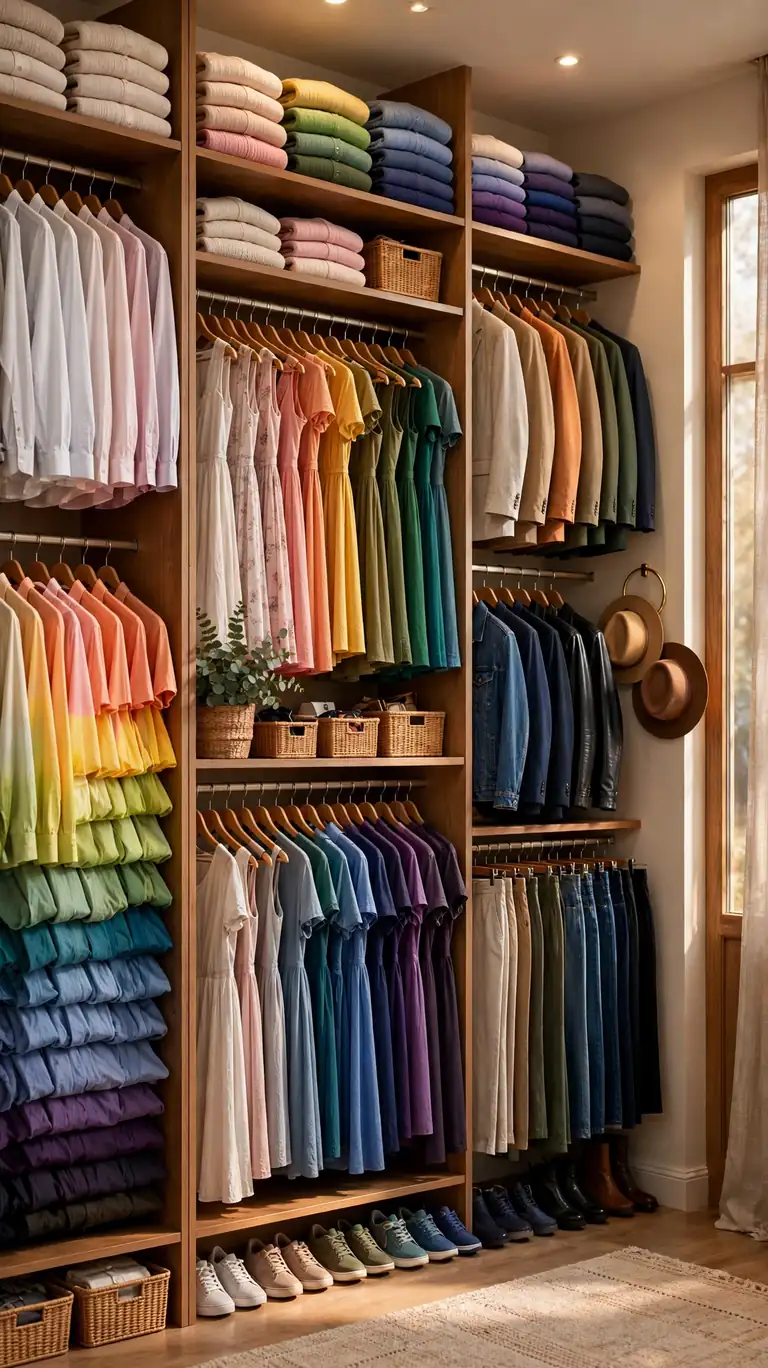
The final layer of a truly smart closet is not furniture, it is a system. Arranging hanging clothes by color, from light to dark within each category, turns your closet into a visual map. You can find the white blouse or the black blazer instantly because you know exactly where its color lives. Within each color, arrange from sleeveless to long-sleeved so silhouettes flow logically too. It sounds fussy, but it takes no extra time once it is set up, since you just return each item to its color zone.
Do the initial sort in one focused session, and keep a small donation bag in the closet permanently for the pieces you notice you never reach for. The color system also exposes your buying patterns, which is genuinely useful. If you own fourteen black tops and zero white ones, you will see it immediately. A closet arranged by color looks beautiful, works fast on busy mornings, and quietly makes you a smarter shopper. That is a lot of payoff from simply hanging things in rainbow order.
Frequently Asked Questions
How do I plan a walk-in closet layout for a small space?
Start by measuring your walls and listing what you actually own, because the layout should fit your wardrobe, not an imaginary one. Prioritize double-hang rods for everyday clothes, since they give you the most storage per inch. Use the full wall height with daily items at eye level and seasonal things up high. Keep one walkway clear and resist filling every wall, because a closet you cannot move in is a closet you will not use. Small closets reward discipline, so give every category a defined home and keep the floor as clear as possible.
What is the best way to organize shoes in a walk-in closet?
Get them off the floor and into view. Slanted or tilted shelves let you see every pair at a glance and hold more pairs per shelf than flat stacking. Count your shoes first so you plan enough space, then keep everyday pairs at easy reach and occasion shoes higher up. Tall boots need a taller section or a boot rack to stay upright. When every pair has a visible spot, you stop digging through piles and stop buying duplicates of shoes you already own.
How much hanging space versus shelving do I need?
It depends on your wardrobe. If you live in shirts, blouses, and dresses, lean heavily on hanging space with double-hang zones for short items and one full-length section for long pieces. If you wear a lot of knits, denim, and t-shirts, you need more shelving with dividers to keep folded stacks neat. A good starting split for most people is roughly two-thirds hanging and one-third shelving, then adjust after living with it for a month. Watch which areas overflow and which sit empty, and rebalance accordingly.
How can I make a dark closet feel brighter?
Upgrade the lighting first, since it makes the biggest difference. Stick-on LED strips under each shelf wash the shelves below in light, and a brighter warm-white ceiling fixture lifts the whole room. Light-colored walls, shelving, and bins reflect whatever light you have, so avoid dark finishes in a windowless closet. A large mirror bounces light around and makes the space feel bigger. Good lighting also ends the era of dragging clothes to a window to check their true color.
Should I hire a professional or DIY my closet layout?
It depends on your budget and how handy you are. Modular closet systems from home stores are genuinely good now and work well for straightforward layouts, especially if you measure carefully first. A professional makes sense for awkward spaces, built-in cabinetry, or when you want a fully custom look with features like islands and glass cabinets. Either way, plan the layout on paper before buying anything, listing your zones and what goes where. The planning matters more than who installs it.
Conclusion
A walk-in closet earns its keep every single morning. You do not need a huge room or a luxury renovation to get the boutique feeling, you need a layout where every inch has a job. Double-hang your everyday clothes, get shoes up off the floor and into view, light every section properly, and give small things like jewelry and belts a visible home. Start with the zones that frustrate you most. Maybe it is the shoe pile, maybe it is the dark corner where clothes disappear, maybe it is simply never being able to find the right black top. Fix one zone this weekend and notice how getting dressed feels on Monday. Then fix the next one. Before long, your closet will work the way you always wished it would, calm, visible, and fast on busy mornings. The best closet is not the biggest one. It is the one where everything has a place and you can find it in the dark.