22 Organized Laundry Room Ideas for Small Spaces
A small laundry room does not get messy slowly. One week of detergent bottles on the machine, a basket on the floor, cleaning sprays wherever they fit, and clothes waiting in piles, and the smallest room in the house becomes the one you dread opening. The machines fit. Nothing else seems to.
The honest truth is that the room is rarely too small. It is just unplanned. These small laundry room organization ideas give every bottle, basket, and shirt a fixed home, using walls, gaps, and doors you already have. No renovation, no big spend, and nothing that blocks a machine door, a vent, or an outlet.
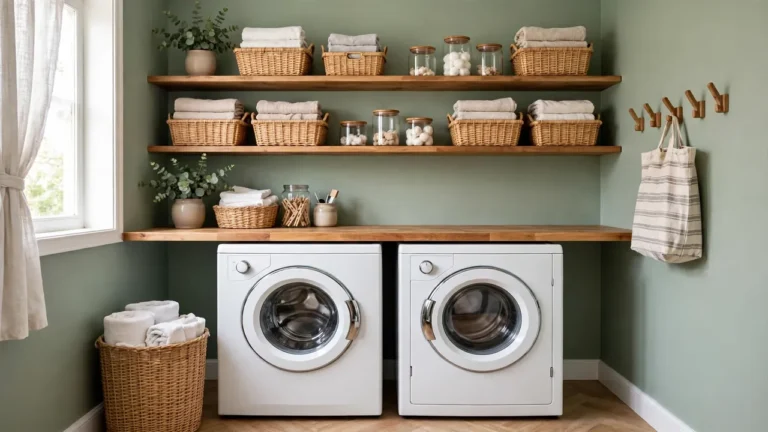
1. Add Shelves Above the Washer and Dryer
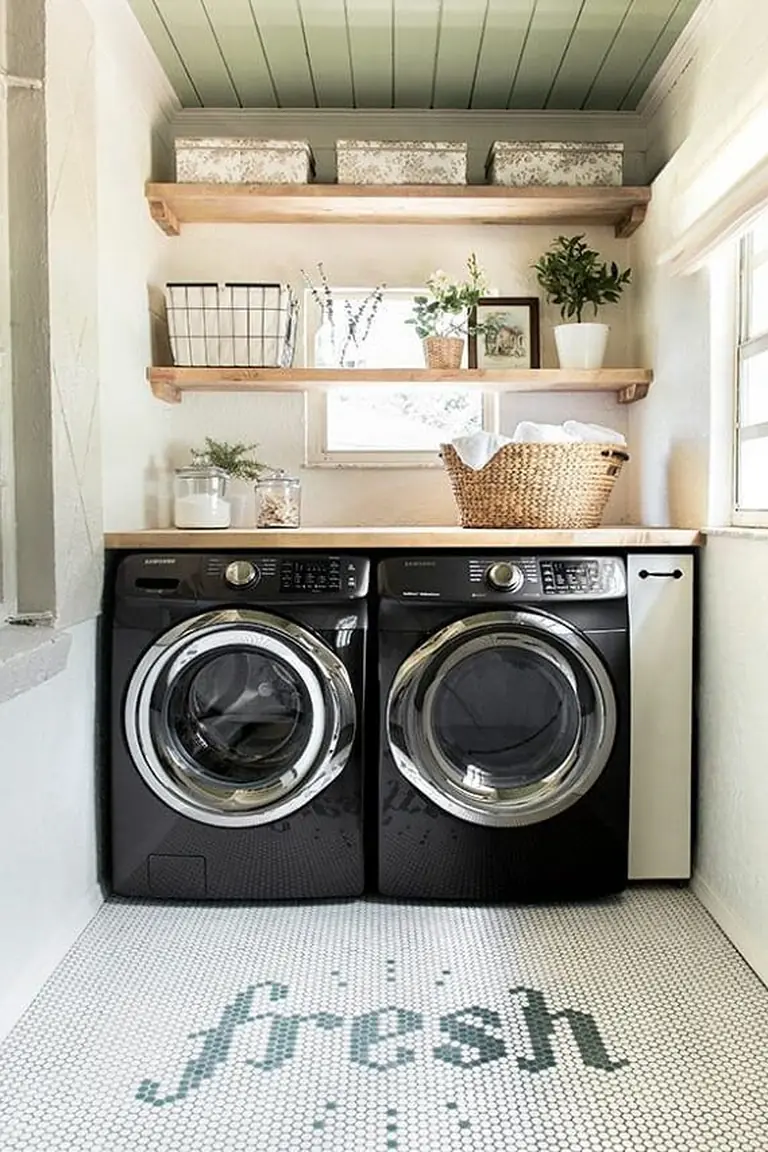
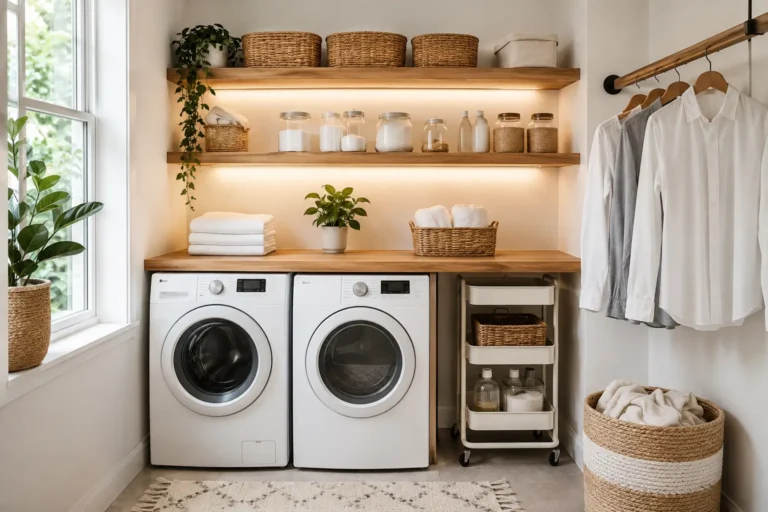
The wall above the machines is the most wasted space in a small laundry room. Two sturdy shelves there hold everything that currently lives on the machine tops, and the machines stay clear for folding and sorting.
Shelf one, within reach: the detergents and stain removers you use every wash.
Shelf two, higher: refills, bulk packs, and the rarely used extras.
Brackets: fixed into studs or strong anchors, level with the machine doors’ swing.
Keep the heaviest bottles on the lowest shelf, always.
2. Slide a Slim Rolling Cart Into the Gap
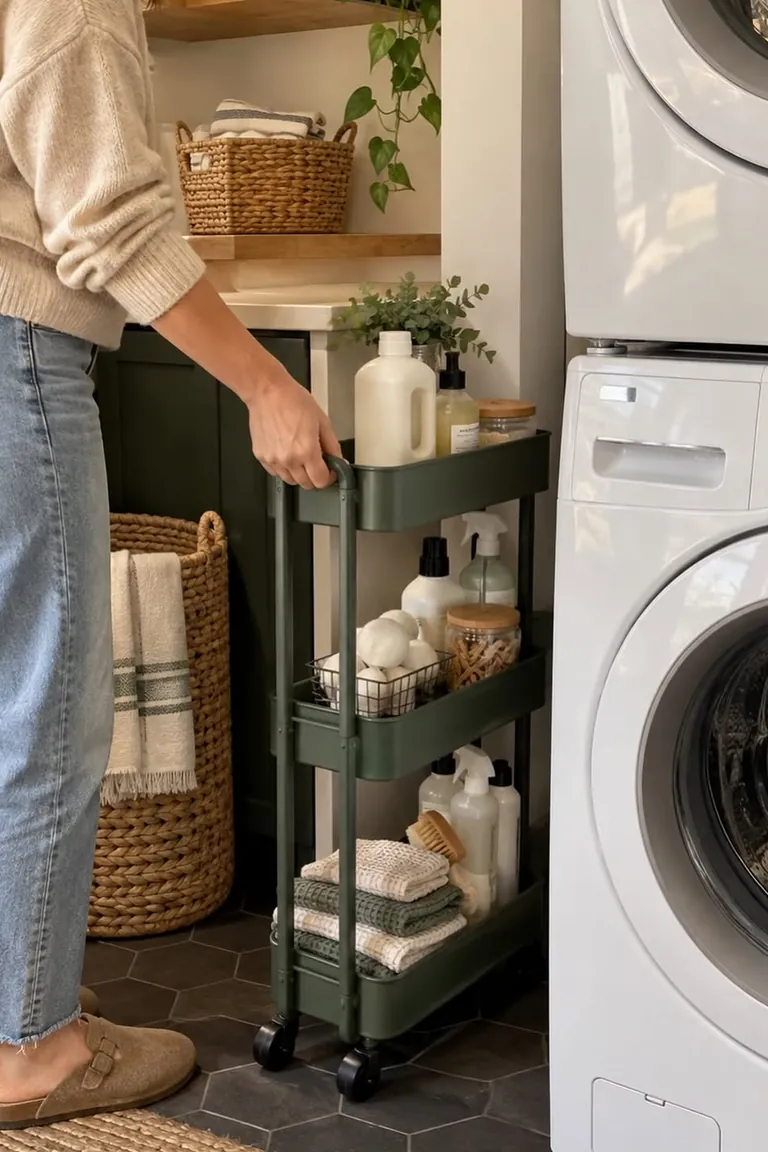
Measure the gap between your machines, or between a machine and the wall. In many laundry rooms it is 15 to 25 centimeters of pure waste.
A slim rolling cart turns that gap into storage: detergent, pegs, stain spray, and the lint roller, stacked on three or four narrow tiers. It rolls out when you need it and disappears when you do not.
Choose a cart with a handle and smooth wheels, and load the heaviest bottle on the bottom tier so it never tips.
Tip: Leave the cart’s top tier empty. It becomes the landing spot for the bottle in your hand mid wash.
3. Mount a Folding Drying Rack on the Wall
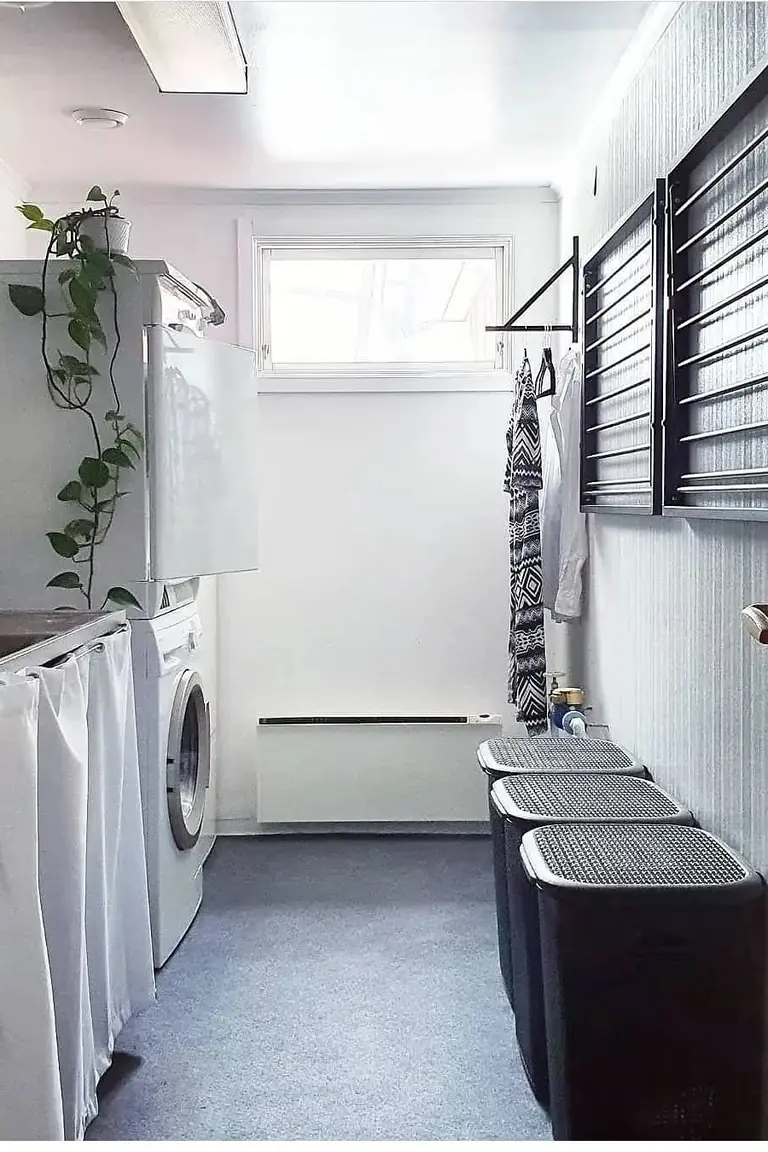
Delicates and shirts on hangers are what crowd a small laundry room’s floor. A wall mounted rack that folds flat gives them a drying home and vanishes when the load is done.
– Spot: a free wall section, clear of the machine doors and the walkway.
– Mount: screws into studs, at a height you can reach without a stool.
– Use: shirts, delicates, and school uniforms, straight from the machine.
– Renters: a tension rod in the same spot does the job with no screws.
4. Hang Floating Shelves for Daily Supplies
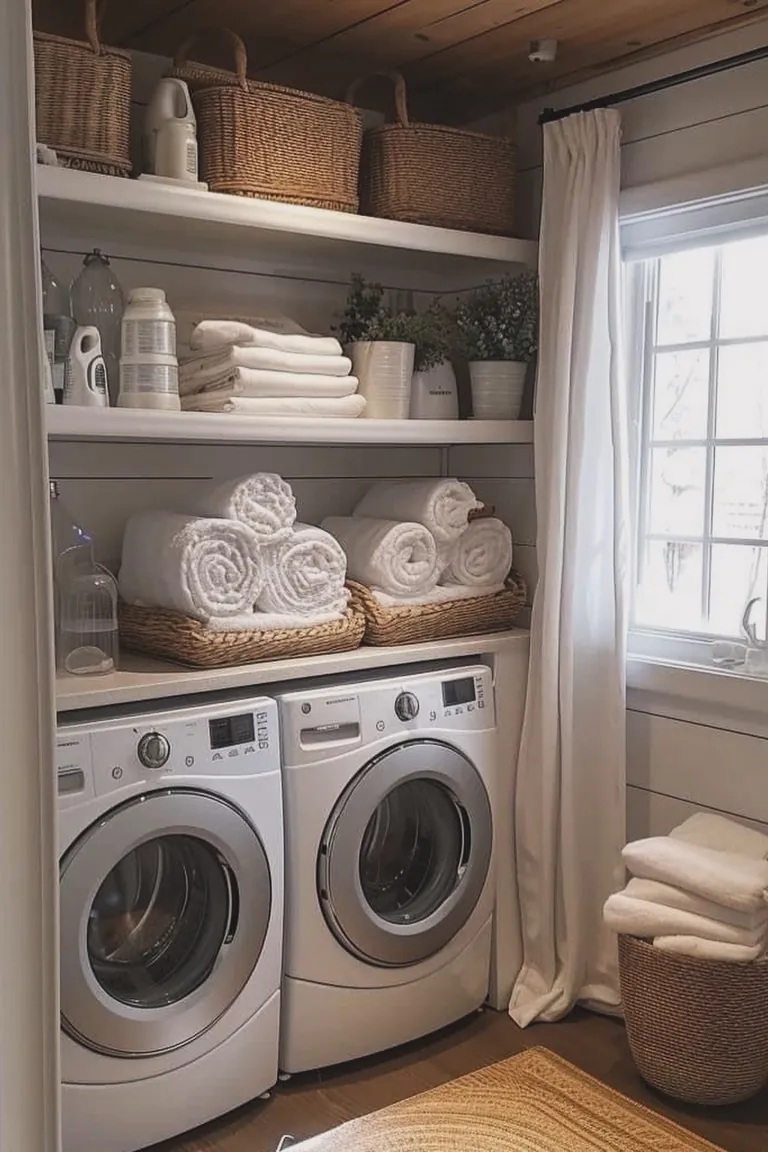
Floating shelves suit the odd corners cabinets cannot reach: beside a window, above a sink, over the folding spot. Keep them for the light, daily things.
On the shelf: one detergent, one softener, a small basket of pegs, a folded cloth.
Not on the shelf: bulk refills and heavy bottles, those live lower.
Style: oak or white shelves with woven baskets keep it calm, not cluttered.
Two shelves are plenty. A third starts a collection, not a system, and small rooms punish collections.
- ☑ Studs or strong anchors, checked before loading
- ☑ Daily items only, nothing heavy up high
- ☑ Clear of machine doors, vents, and outlets
- ☑ One basket per shelf to group the small things
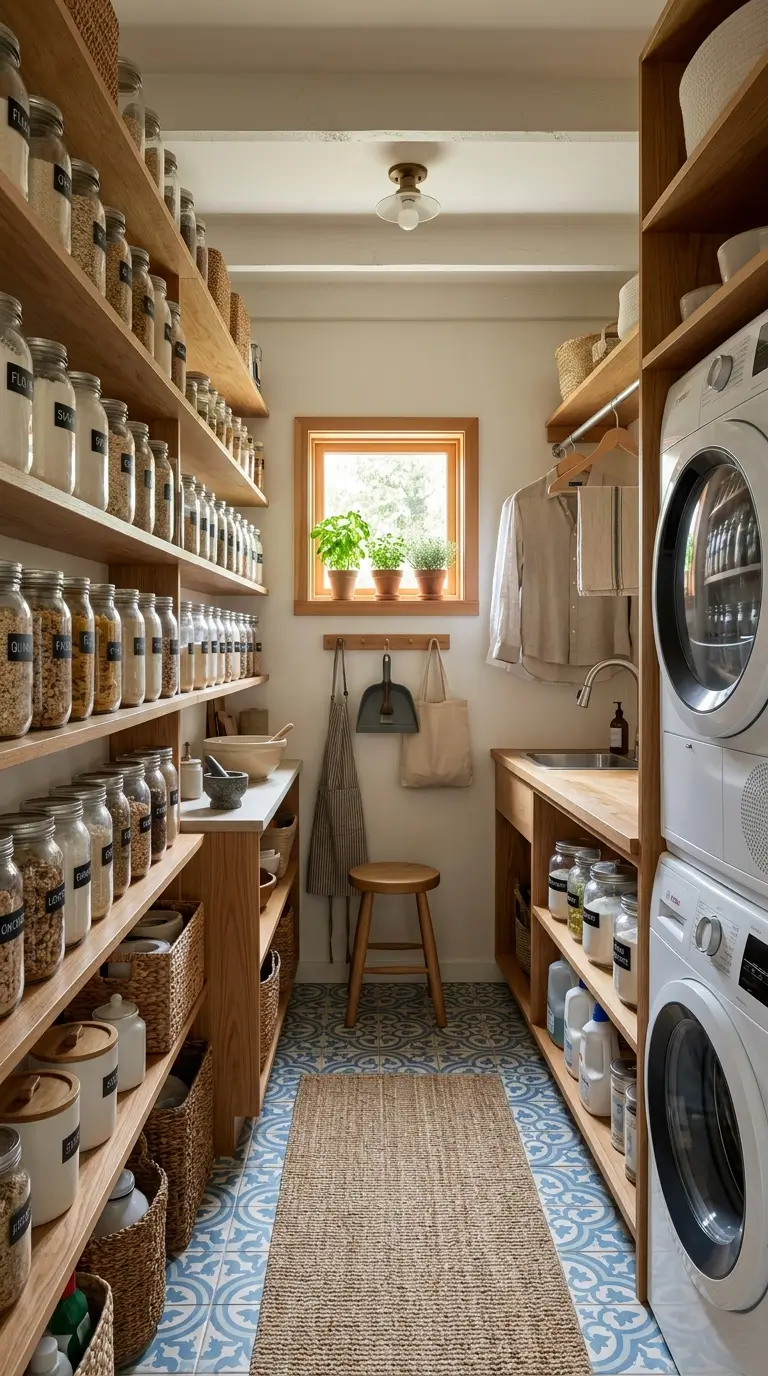
5. Give Every Category a Labeled Basket
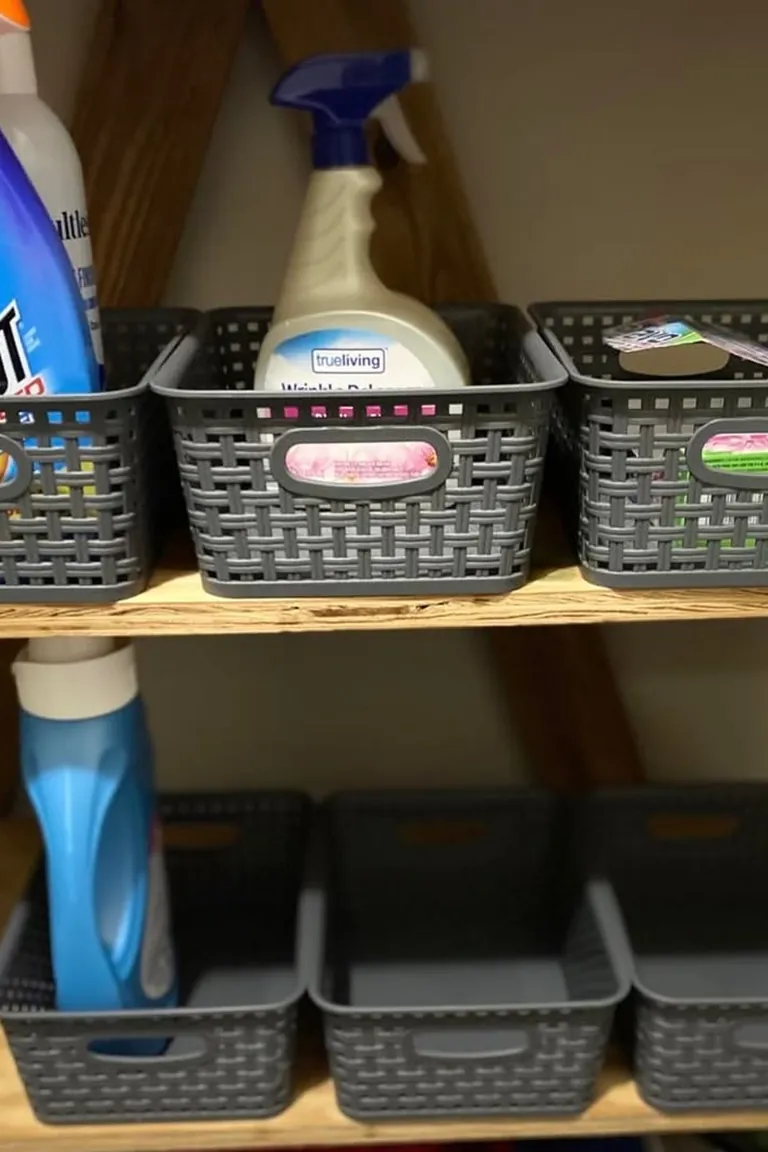
Open shelves fail when everything lands wherever it fits. Baskets give each category walls, and labels make the system survive other people doing laundry.
Group by job, not by bottle shape: wash, treat, fold, clean. One basket holds detergents, one holds stain treatments and pegs, one holds cleaning cloths and the lint brush. Same size baskets in a row look calm and stack the room’s small chaos into one tidy line. Labels face out, always, or nobody puts anything back.
Bottles and boxes landed wherever they fit, and nothing has a home.
One labeled basket per job, in a calm row, and everything returns itself.
6. Set Up a Three Section Sorting Station
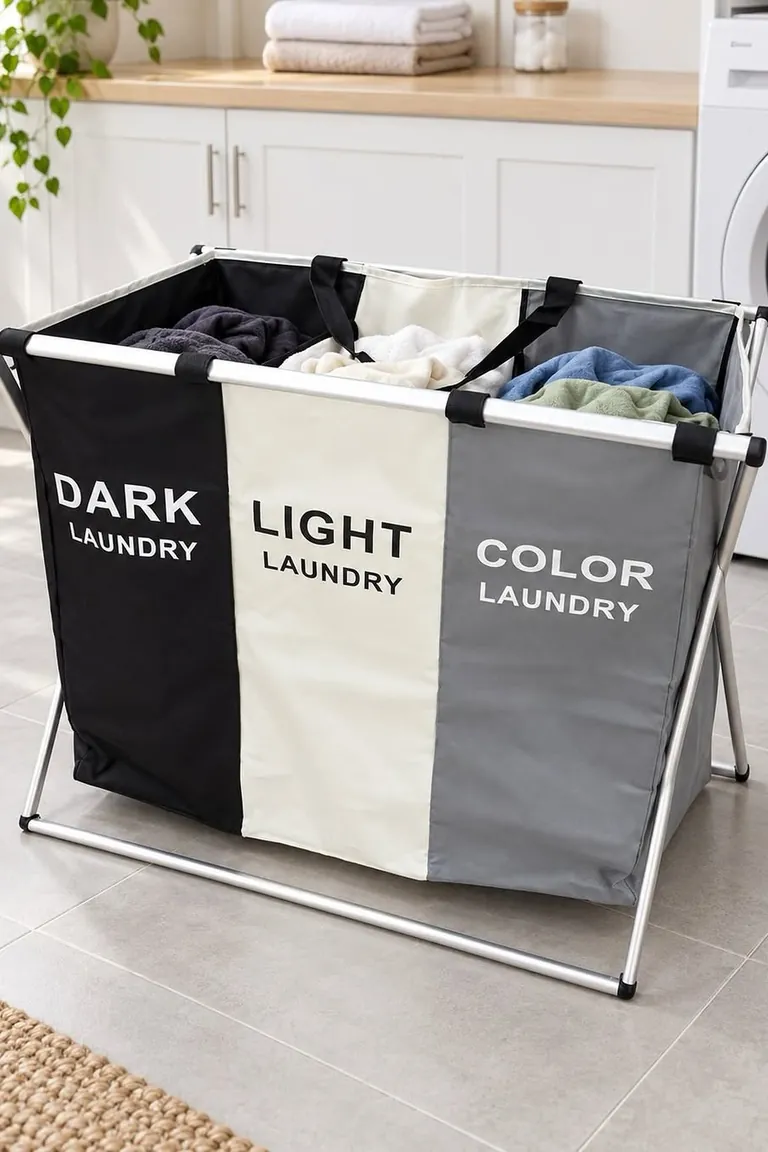
Sorting at the machine, in the dark, from one overflowing basket is how whites turn pink. A three section sorter by the door ends the guesswork for everyone in the house.
– Section one: lights and whites.
– Section two: darks.
– Section three: delicates and hand wash, in a mesh bag inside.
– Full section goes straight into the machine, no re sorting on the floor.
Sorting is where small laundry room organization is won, quietly, every single day of the week, one load at a time.
- ▸Lights: whites and pale colors, washed warm.
- ▸Darks: jeans, blacks, and deep colors together.
- ▸Delicates: mesh bag inside the third section, always.
7. Decant Detergents Into Clear Dispensers
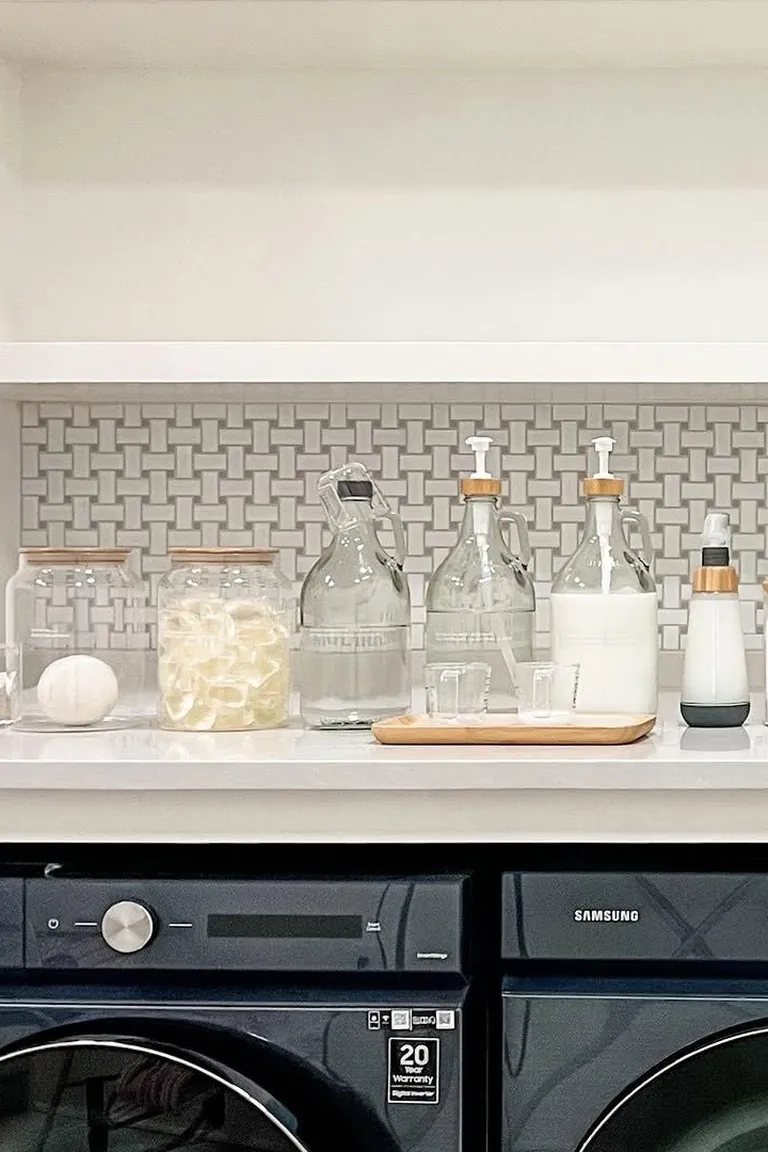
Brand bottles are tall, mismatched, and built for shop shelves, not yours. Decanting detergent and softener into clear, same size dispensers lines them up in half the space and shows you the level at a glance.
Keep the original labels’ safety facts: photograph the bottle before you pour, and write the product name and any warning on the dispenser. One rule never bends: never use drink bottles or food jars for laundry chemicals, and keep dispensers closed and out of children’s reach.
Use proper dispensers, write the product name and warnings on each one.
Never decant chemicals into drink bottles or food jars, ever.
8. Use the Back of the Door
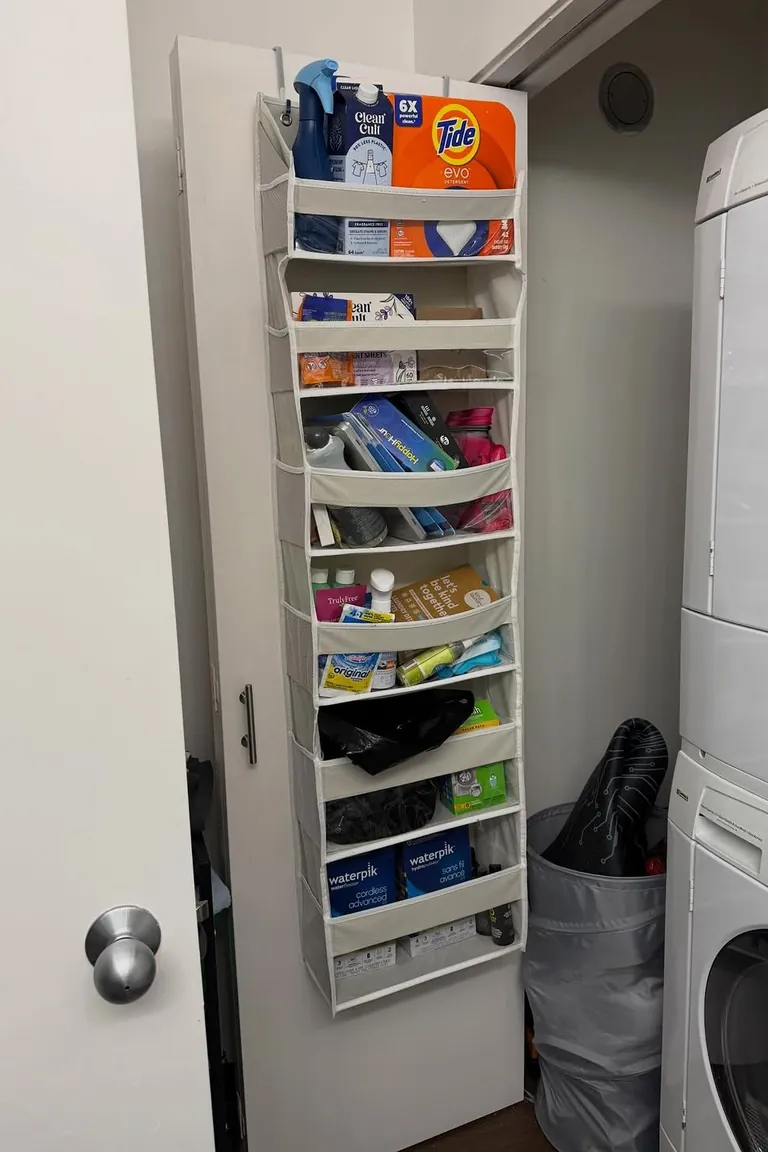
The back of the laundry room door is free storage nobody uses. A clear over the door organizer holds the small things that vanish into drawers: pegs, stain pens, sewing kit, batteries, the lint roller, spare cloths, and lost buttons.
1. Hang it on the inside of the door, and check the door still closes without scraping the frame.
2. Heaviest items go in the lowest pockets, light ones at the top.
3. Leave the machine’s own door swing and the room’s walkway completely clear.
- Hang it inside the door and test the close.
- Heavy items in the lowest pockets, light ones up top.
- Keep the walkway and the machine doors fully clear.
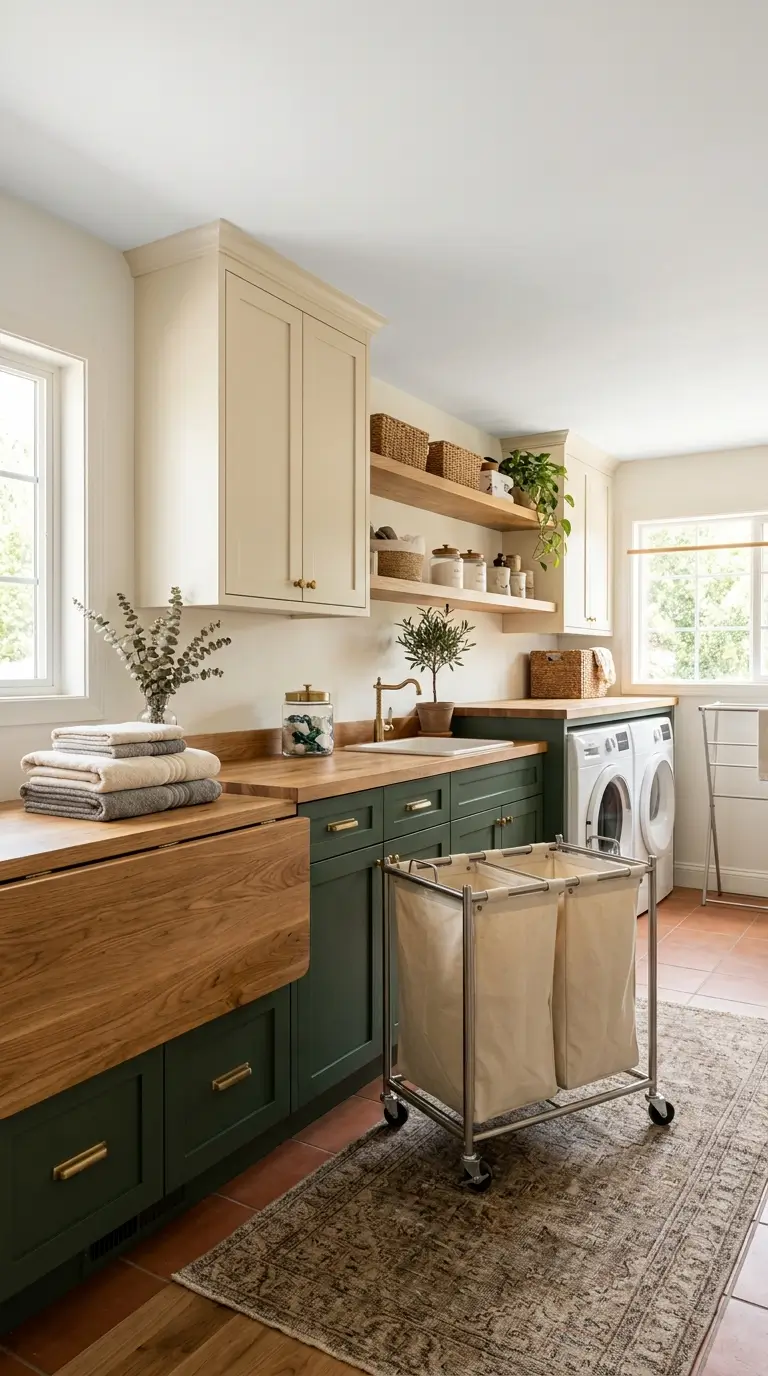
9. Add a Fold Down Surface for Folding
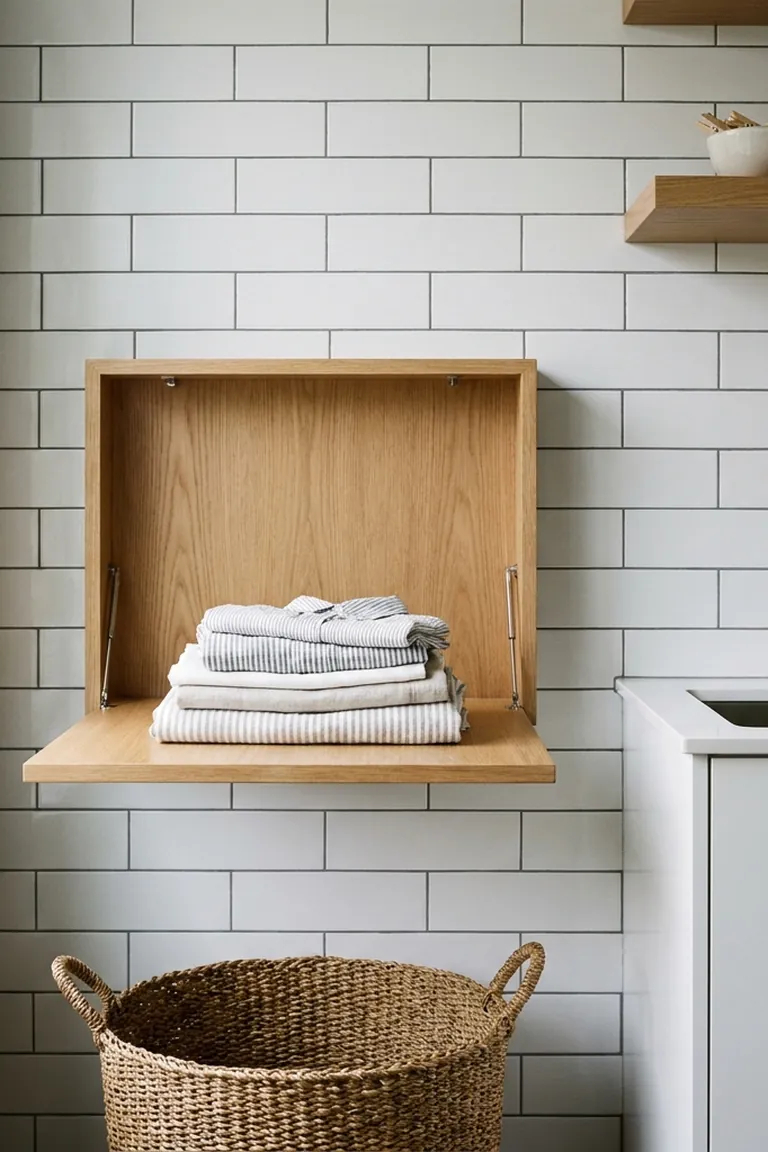
Folding on top of a warm dryer works until the load is towels. A fold down shelf or a wall mounted drop leaf table gives you a real folding surface that parks flat against the wall the rest of the day. Mount it at standing elbow height, on the wall opposite the machines if the room is narrow, and keep its swing clear of doors and the machines’ lids. When guests come, it folds away and the room breathes again.
Fold as you unload, and the pile never forms.
10. Hang Hooks and a Rail for Tools
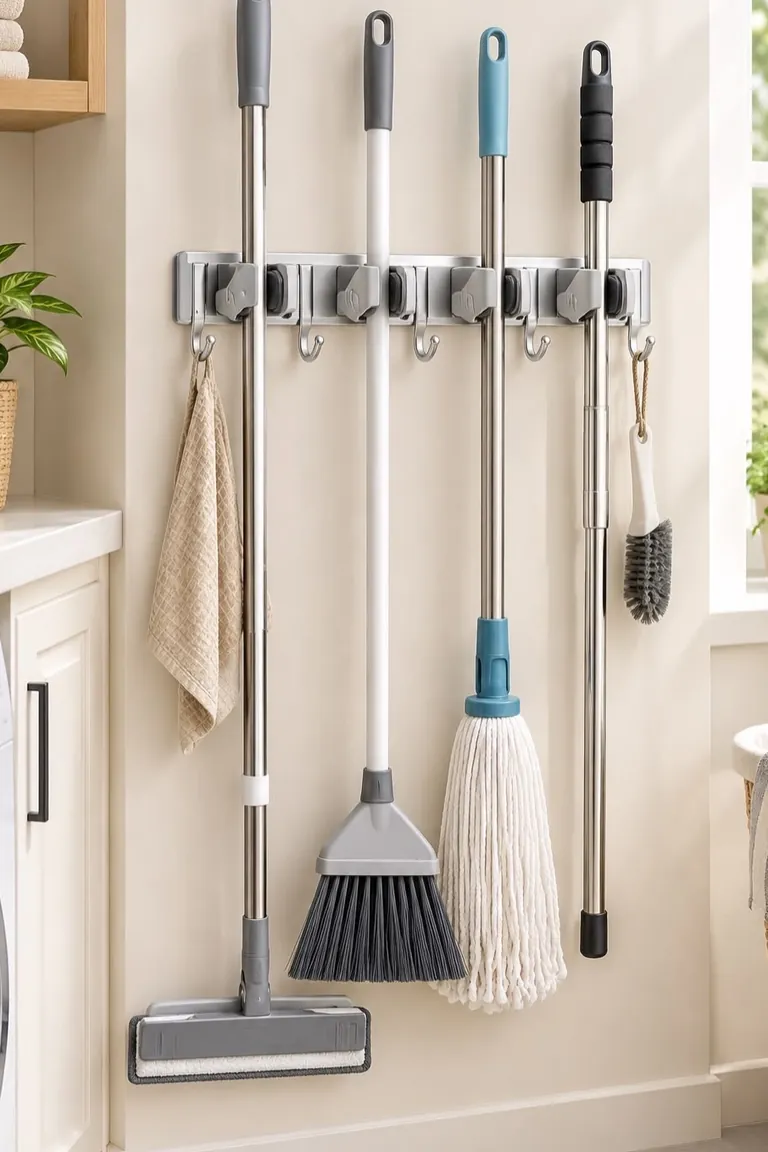
Shirts drip, hangers wander, and the broom lives wherever it fell. A short rail or a row of sturdy hooks on one wall gives all three a home: hangers ready for shirts straight from the wash, and cleaning tools off the floor.
Place hooks by job:
– By the machine: hangers and the drying shirts.
– By the door: broom, dustpan, and the mop, handles up.
– Small hooks: scissors, peg bag, and the lint brush.
Everything off the floor is floor you can actually mop.
| Hook zone | What hangs there |
|---|---|
| By the machine | Hangers and shirts drying straight from the wash. |
| By the door | Broom, dustpan, and mop, handles up and off the floor. |
| Small hooks | Scissors, the peg bag, and the lint brush. |
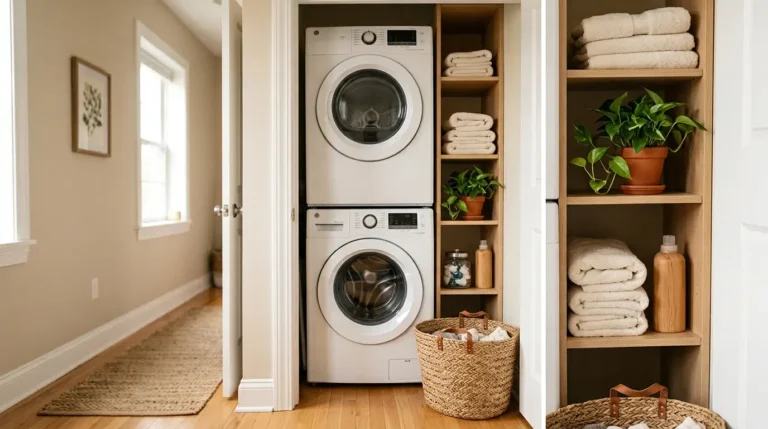
11. Stack the Machines to Free the Floor
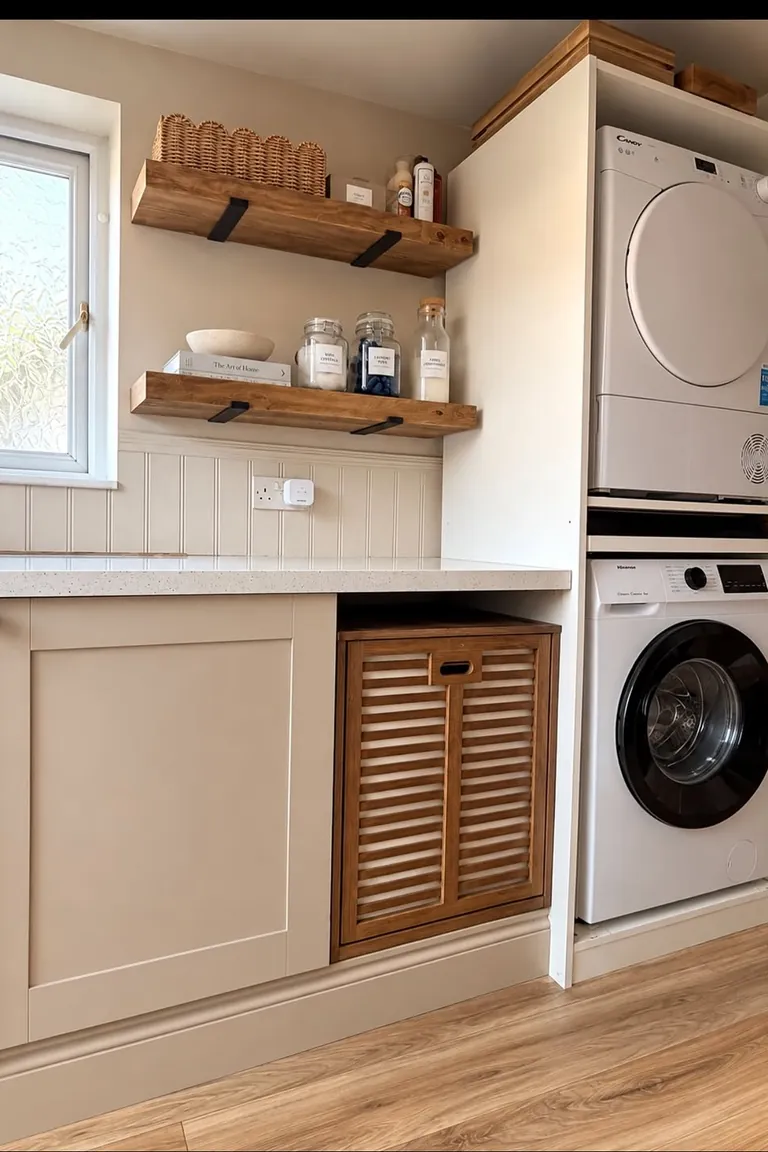
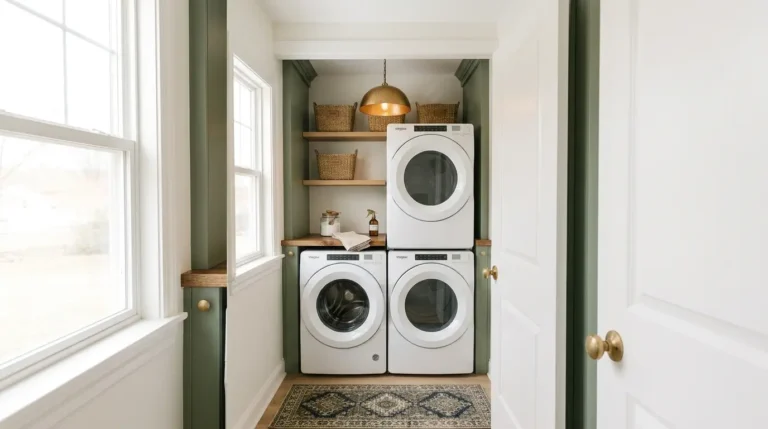
If your machines are stackable, stacking them is the single biggest space win a small laundry room offers. The floor they free fits the sorting station, the hampers, and room to stand.
Use the maker’s stacking kit, never a homemade frame, and check the plumbing and vent runs still reach before you commit. Controls land higher, so test the reach of the shortest person in the house first. Of all space-saving laundry solutions, this is the one that changes the room itself.
Two machines side by side eat the whole floor, and everything else piles on top.
Machines stacked with the maker’s kit, and the freed floor fits the sorter and hampers.
12. Choose Closed Cabinets Over Open Shelves
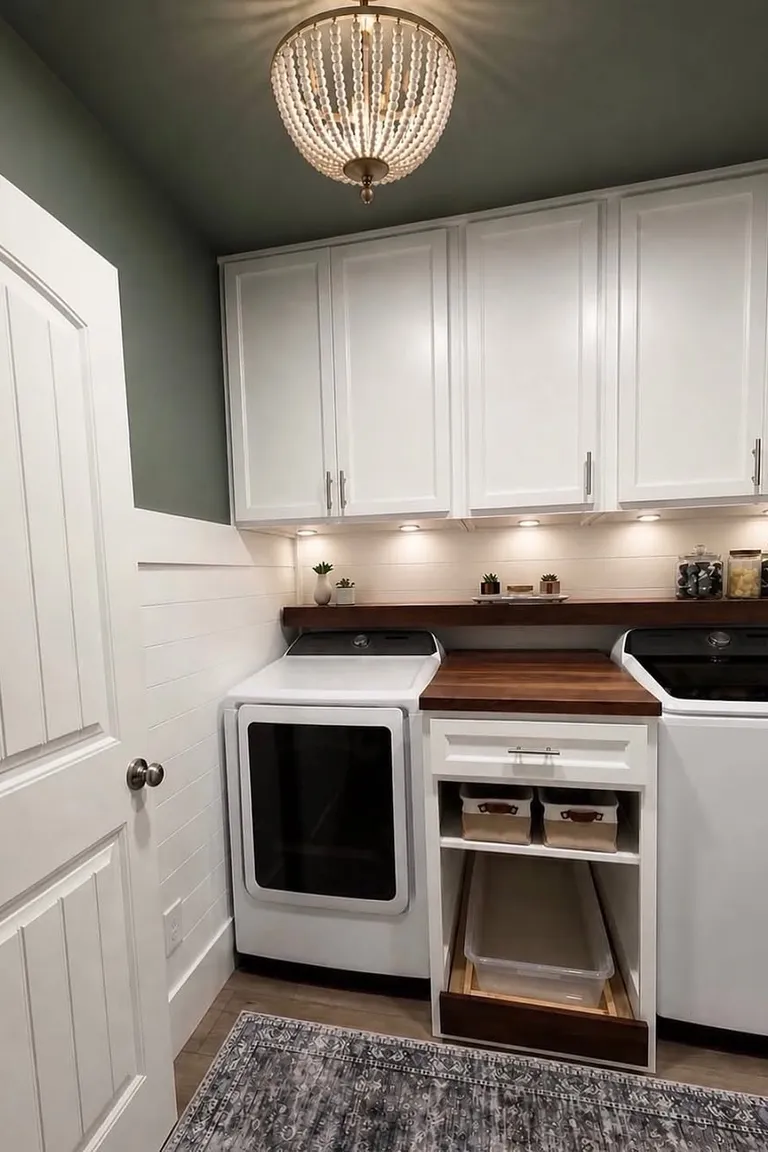
Open shelves show everything. Closed cabinets forgive everything. If your laundry room has one wall for storage, a closed cabinet beats three open shelves for calm, because laundry supplies are not decor, however tidy the bottles. It is the oldest of laundry room storage ideas, and still the best.
Inside, keep the same order as your wash routine: detergent at the front of the shelf you open first, treatments beside it, refills at the back. Cabinet doors also keep cleaning products away from small hands and pets between washes, which open shelves cannot promise.
Tip: Order the cabinet like your wash routine, front to back. The door closes on a system, not on a pile.
13. Hide a Pull Out Hamper in a Cabinet
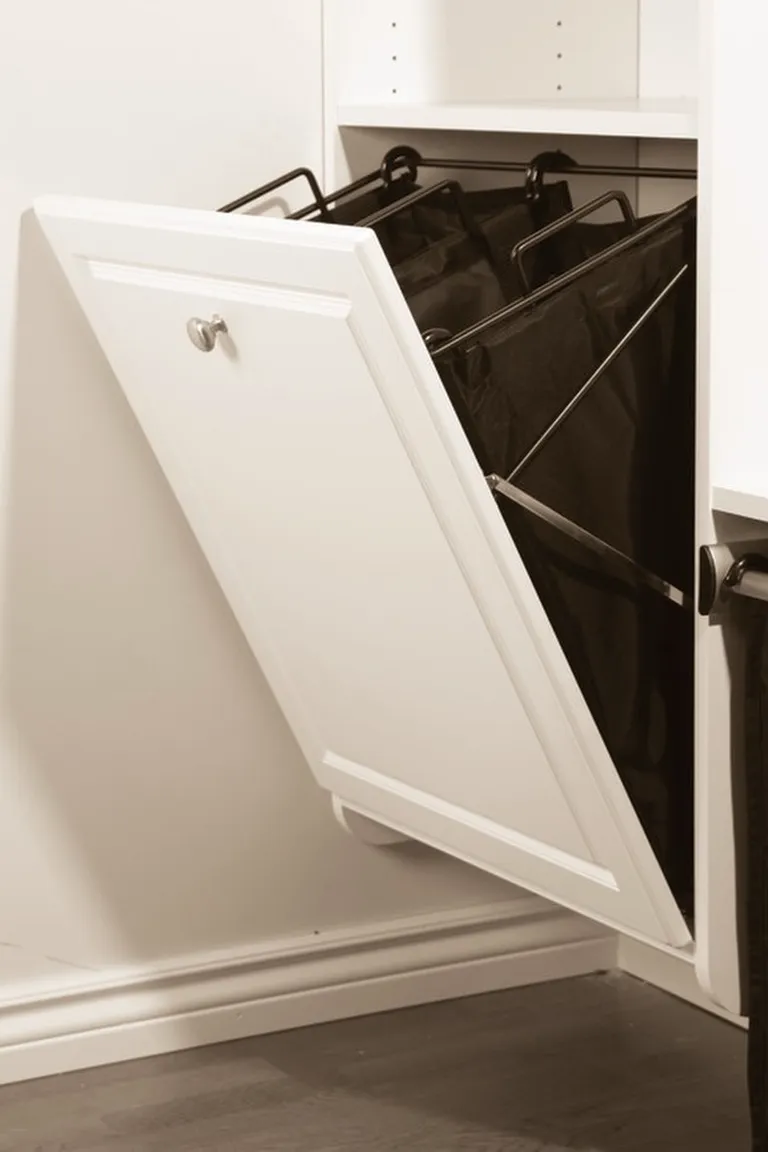
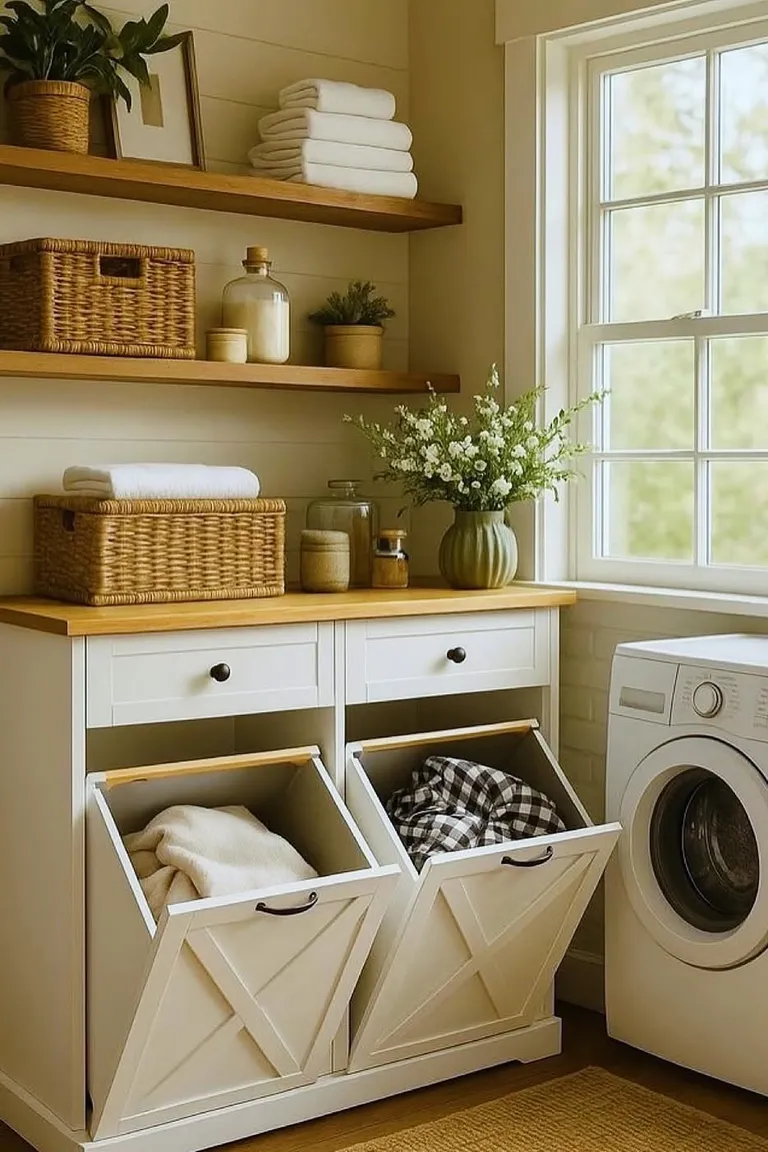
Hampers eat floor space and catch every stray sock in the house. A tilt out or pull out hamper built into a cabinet, or a simple hamper frame inside an existing cupboard, hides the laundry waiting room completely.
Liner: a washable bag inside, lifted out on wash day.
Air: a vented door or a mesh front, so damp clothes never sour.
Sort: two narrow hampers beat one wide one in a closet.
Closed door, hidden laundry, and the floor stays walkable.
14. Turn One Wall Into a Pegboard
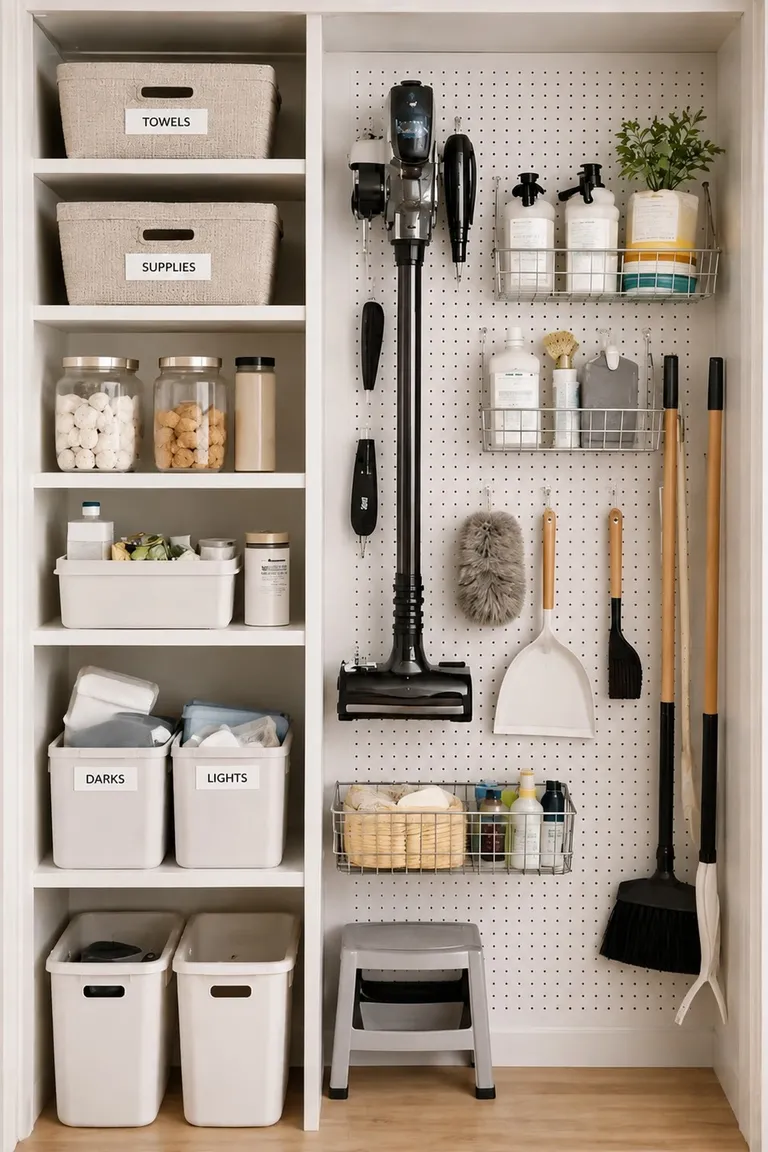
A pegboard turns one flat wall into adjustable storage that changes as your supplies do. Hooks, small baskets, and a narrow shelf hang anywhere on the grid, and nothing needs a cabinet’s depth.
– Top row: light tools, scissors, pegs, the stain chart.
– Middle: spray bottles on a small shelf, handles out.
– Bottom: the heavy items stay off pegboards entirely, they live on the floor shelf.
– Renters: a leaning board or a door hung frame avoids wall screws.
Rearrange it in minutes when a new bottle arrives.
- ☑ Light tools on the top row, spray bottles mid height
- ☑ Heavy items never hang on a pegboard
- ☑ One small basket for the tiny things
- ☑ Renters lean it or hang it on the door
15. Keep a Portable Caddy for Shared Laundry
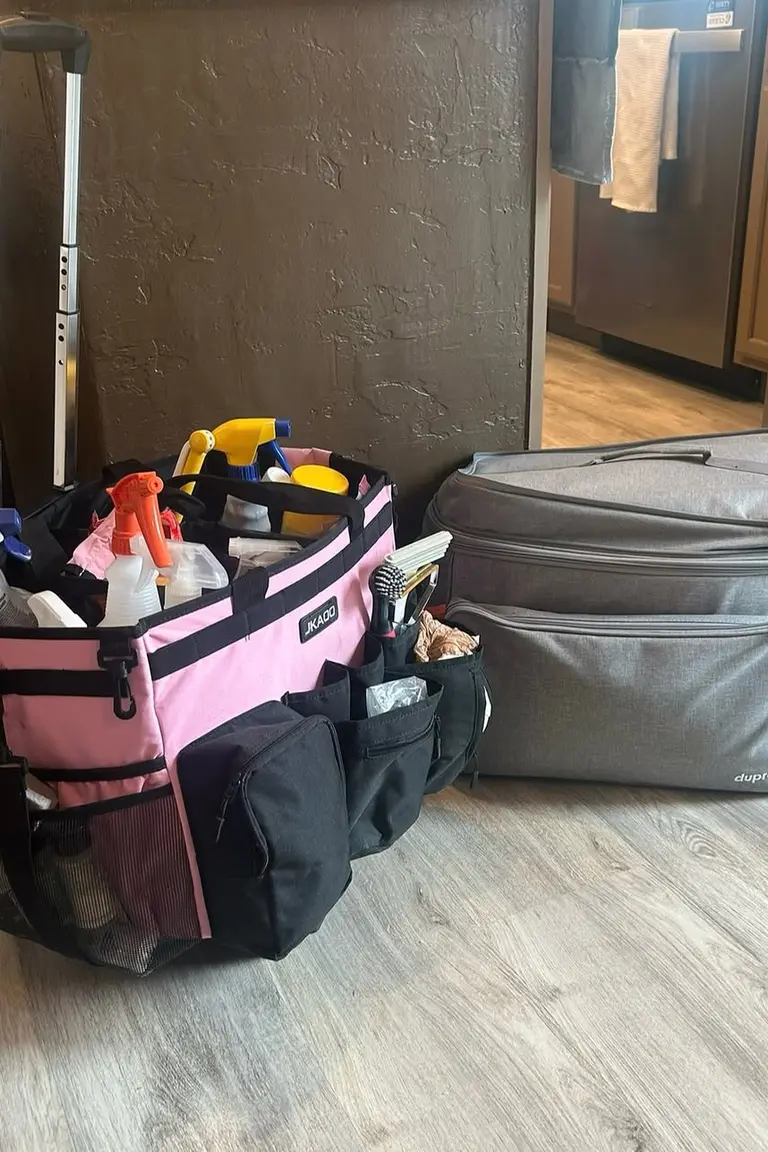
In shared laundry rooms and apartment blocks, your supplies cannot live by the machines. A handled caddy carries your detergent, softener, stain remover, and pegs down in one trip and brings them home again.
A caddy also stops the slow spread of your bottles across a shared room, where they walk away or get used by everyone.
– Size: one load’s worth, nothing you have not used in a month.
– Bottle rule: caps closed and bottles upright, in the caddy and in storage.
– Home spot: one shelf at home where the caddy always parks.
16. Double Cabinet Space With Risers
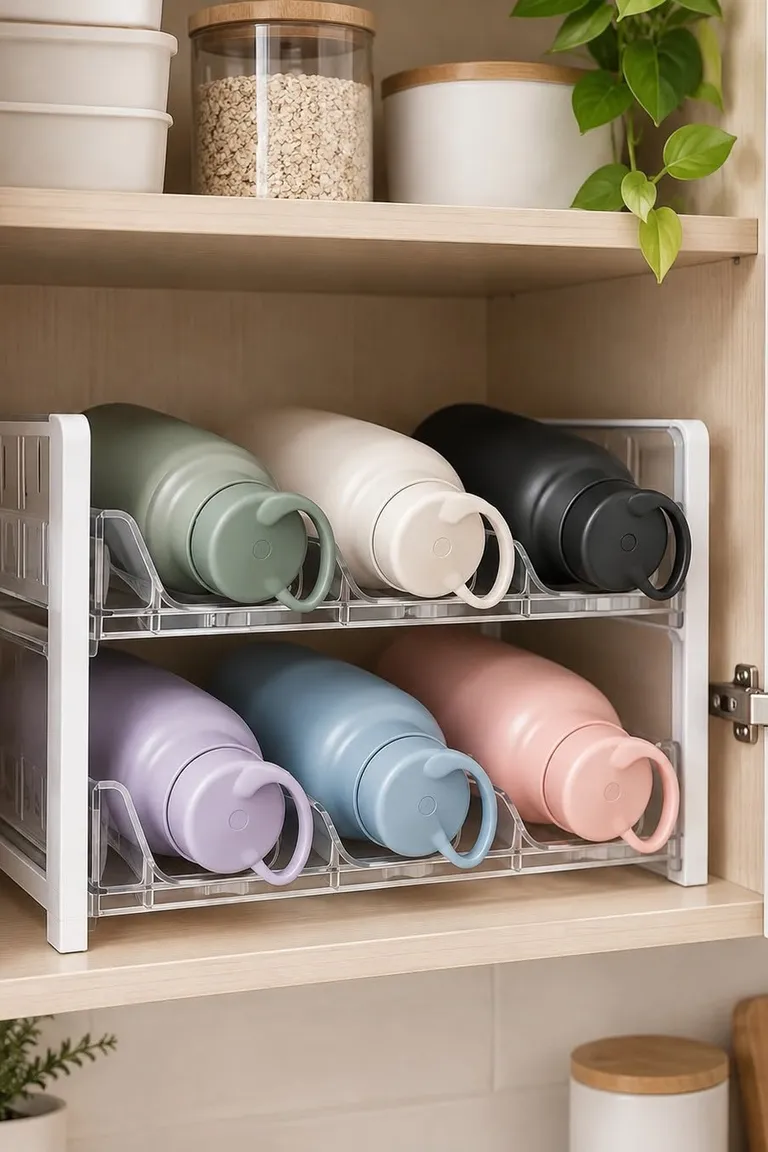
Most laundry cabinets waste the top half of every shelf. A simple riser or a second tier inside the cabinet doubles the storage without touching the cabinet itself.
Measure the cabinet’s inside height before buying anything, and keep one hand’s clearance above the tallest bottle so nothing tips when you reach past it.
Riser shelf: bottles in two rows, short ones in front, labels visible.
Under shelf basket: clips under the shelf above, holding cloths and sponges.
Door rack: the cabinet door’s inside face carries small bottles and the peg bag.
- ▸Riser: two rows of bottles, short ones in front.
- ▸Under shelf basket: cloths and sponges in the dead space.
- ▸Door rack: small bottles ride on the door itself.
17. Create a Lost Sock and Lint Station

Every laundry room grows two piles nobody claims: single socks and lint. Give them one small station by the machines: a tiny basket for the socks, a small lidded bin for lint and pocket trash, and the rule that both get sorted during the last load of the week. Singles that find no partner in a month leave the house, no ceremony needed, and no drawer of shame.
It sounds small. It removes the two messes you see every single day.
One tiny basket for single socks and one lidded bin for lint, sorted weekly.
Let singles migrate to a drawer and lint collect on every surface.
18. Fit Tension Rods for Air Drying
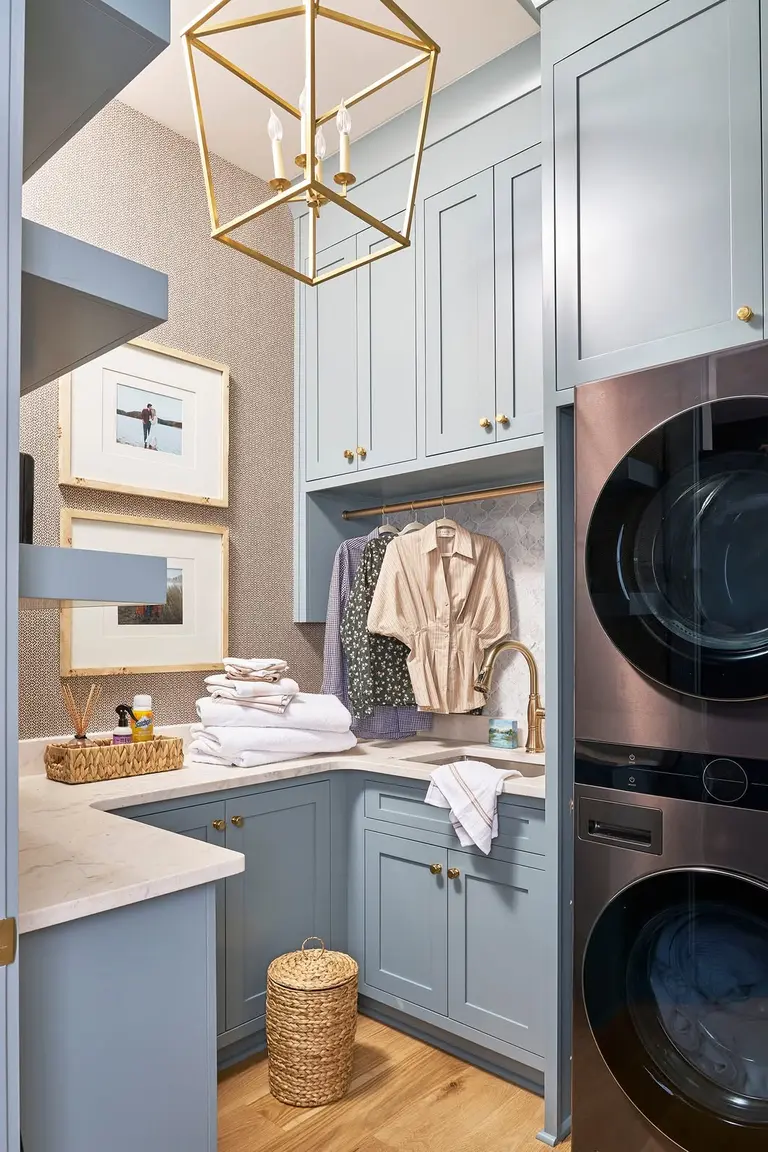
A laundry closet or the space under a high shelf hides a drying rack you already own: a tension rod. Fitted across the closet or between a shelf’s underside and the wall, it holds hangers of shirts and delicates while they dry.
1. Measure the span and buy a rod rated well above a load of wet shirts.
2. Fit it where drips fall safely, over the machine or a washable floor.
3. Space hangers a finger apart so air moves and nothing mildews.
- Measure the span, buy a rod rated above the load.
- Fit it where drips fall safely below.
- Space the hangers so air can move.
19. Park the Ironing Board on the Door
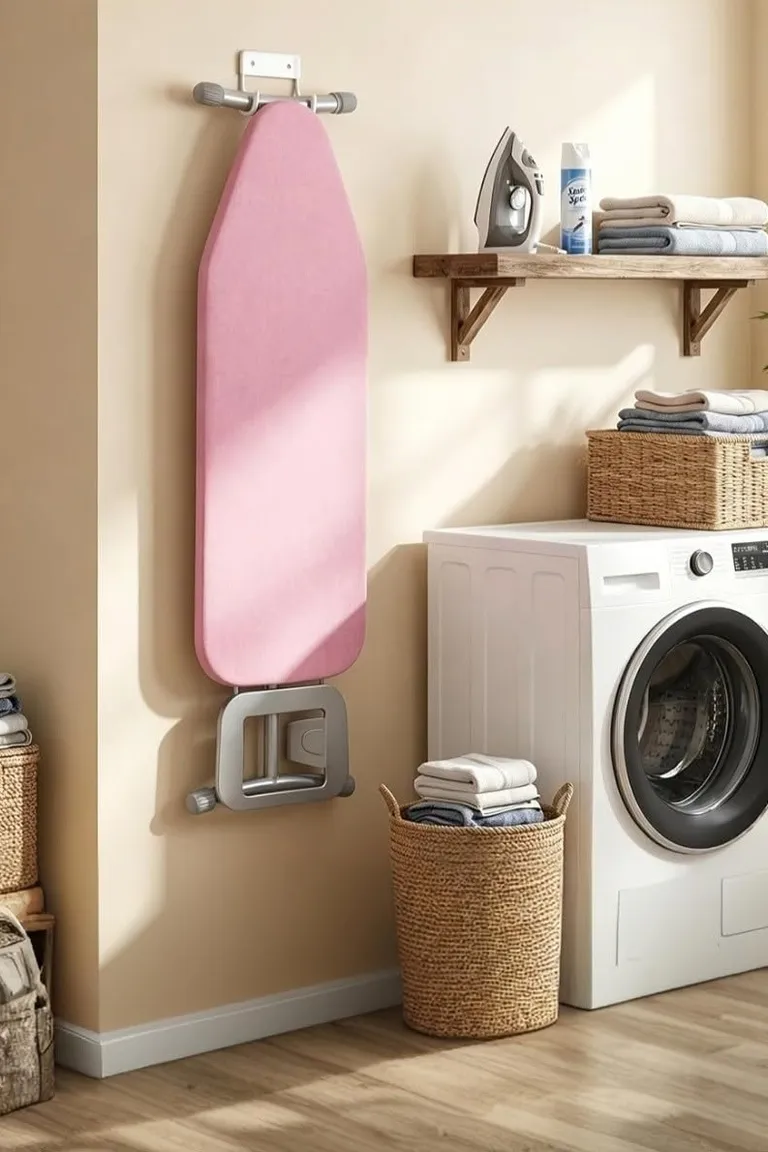
An ironing board leaning in a corner falls once a week and blocks the door the rest of the time.
Two door hooks or a door mounted holder park it flat on the back of the laundry room door, or inside the closet door, where it uses zero floor and zero wall. The iron itself lives on a heat safe shelf near the outlet, cord wrapped, never on the board.
No door space? A tabletop ironing board on the folding surface covers most clothes and stores in a drawer or on a hook.
20. Plan the Laundry Closet Layout
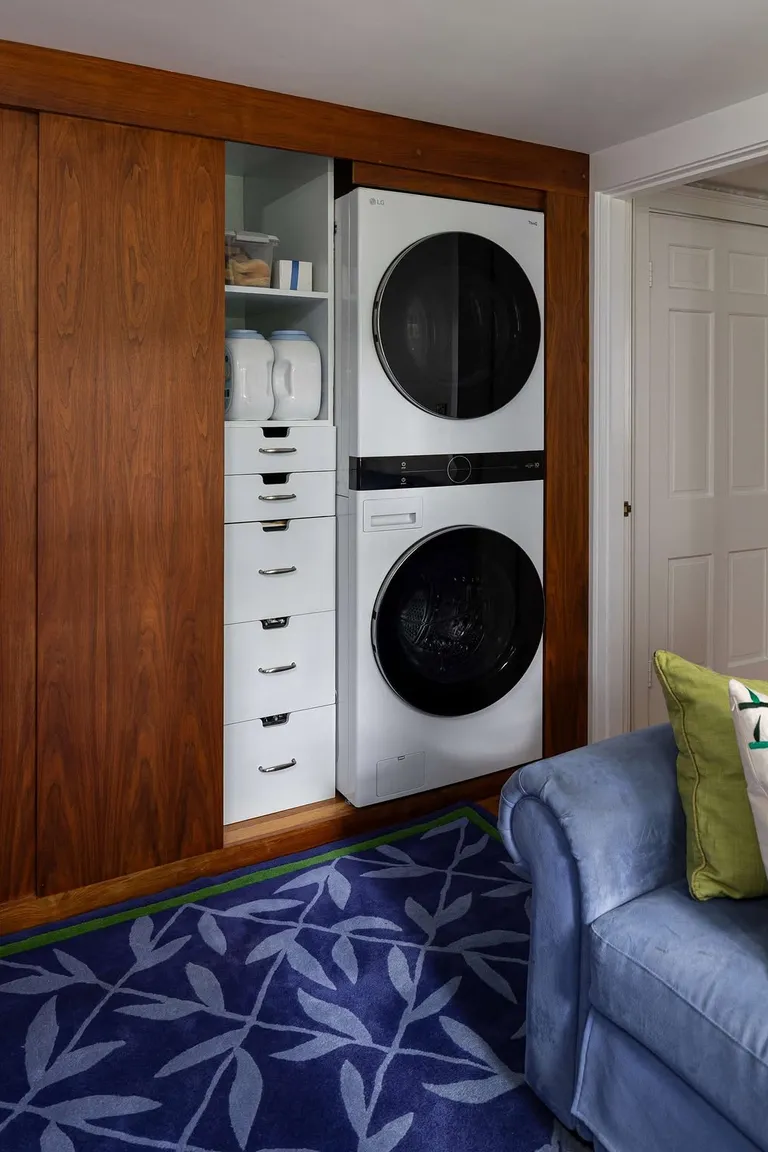
Laundry closet organization is a layout problem, not a storage problem. The closet fits the machines and little else, so every centimeter around them must work: shelves above, the cart in the gap, the door carrying what it can.
– Above: two shelves, daily items low, refills high.
– Beside: the slim cart or the sorting hamper, never both blocking the door.
– Door: hooks or an organizer, if the door’s swing allows.
– Floor: kept empty, so the machines can be pulled out for repairs.
| Closet zone | What lives there |
|---|---|
| Above the machines | Two shelves, daily items low and refills high. |
| In the gap | The slim cart, or the hamper, never blocking the door. |
| On the door | Hooks or an organizer, if the swing allows it. |
21. Store Cleaning Products High and Safe
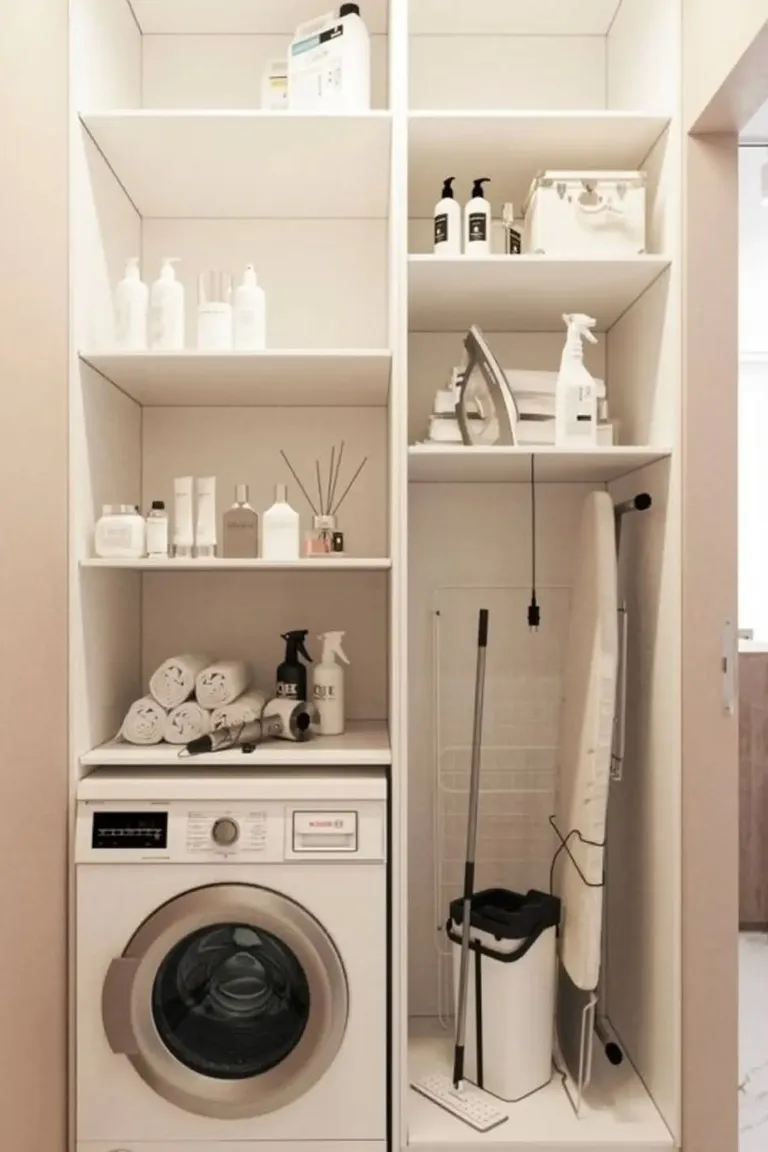
The safety rules come before the style ones. Cleaning products, bleach, and pods belong up high or behind a closed, latched door, where children and pets cannot reach them, in every laundry room, always.
High shelf: bleach, pods, and strong cleaners, in their original containers.
Low shelf: heavy detergent bottles, stable and easy to lift.
Never: chemicals above the machines’ heat, or food containers reused for products.
Pods look like sweets to small children. Treat them like medicine and store them like it too.
22. Keep It Working With a Weekly Reset
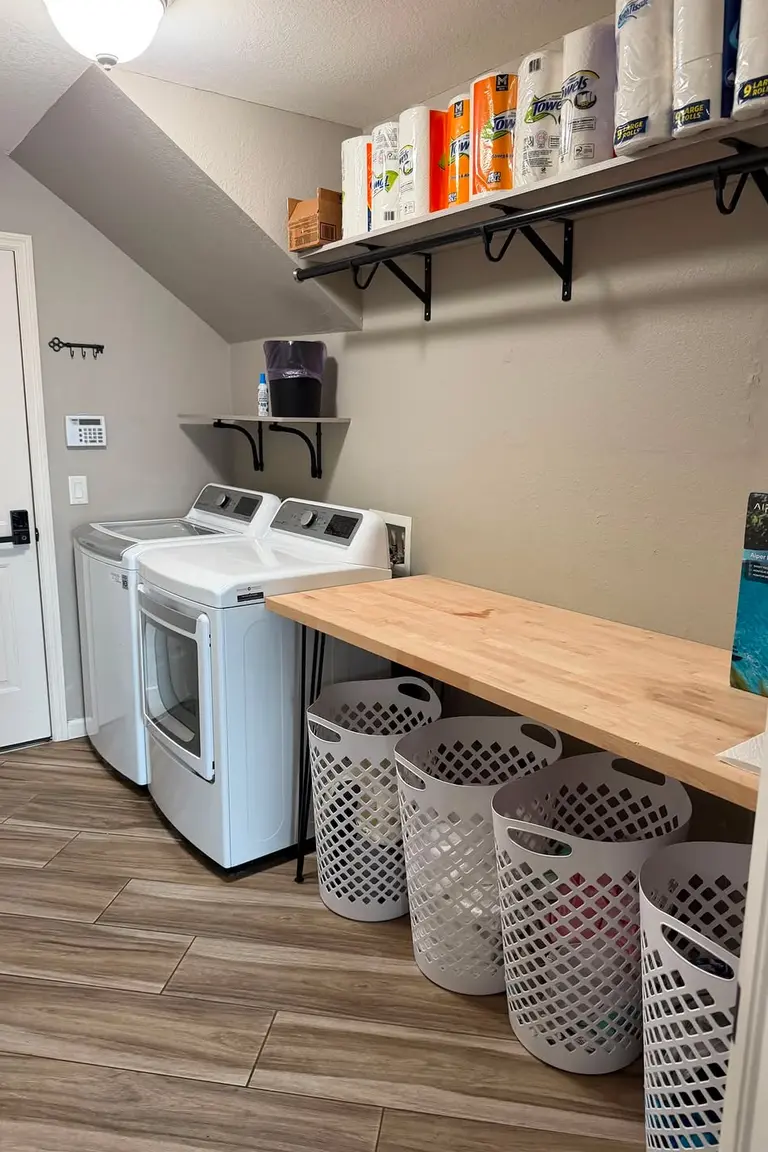
Systems fail without a reset. Ten minutes once a week keeps the room at the standard you set today: bottles back in their baskets, the cart home, the folding surface empty, the floor clear.
Do it while the last load runs. Wipe the machine tops, empty the sock basket’s hopeless cases, check the detergent level before it surprises you, and take the trash out. Organized laundry room ideas only work if the room gets its ten minutes, and ten minutes is a kind price for a room that stays calm.
Warning: The reset is the system. Skip it three weeks running and the room returns to piles, however good the shelves are.
Final Thoughts
A small laundry room does not need more space. It needs every bottle, basket, and shirt to have a home, and ten minutes a week to send them back to it. If you take one thing from these small laundry room organization ideas, let it be this: use the walls, the gaps, and the doors before you wish for a bigger room. Start above the machines this weekend, one shelf at a time, and save this list to your laundry board for the next idea.