20 Modern Kitchen Curtain Ideas You’ll Want to Copy Now
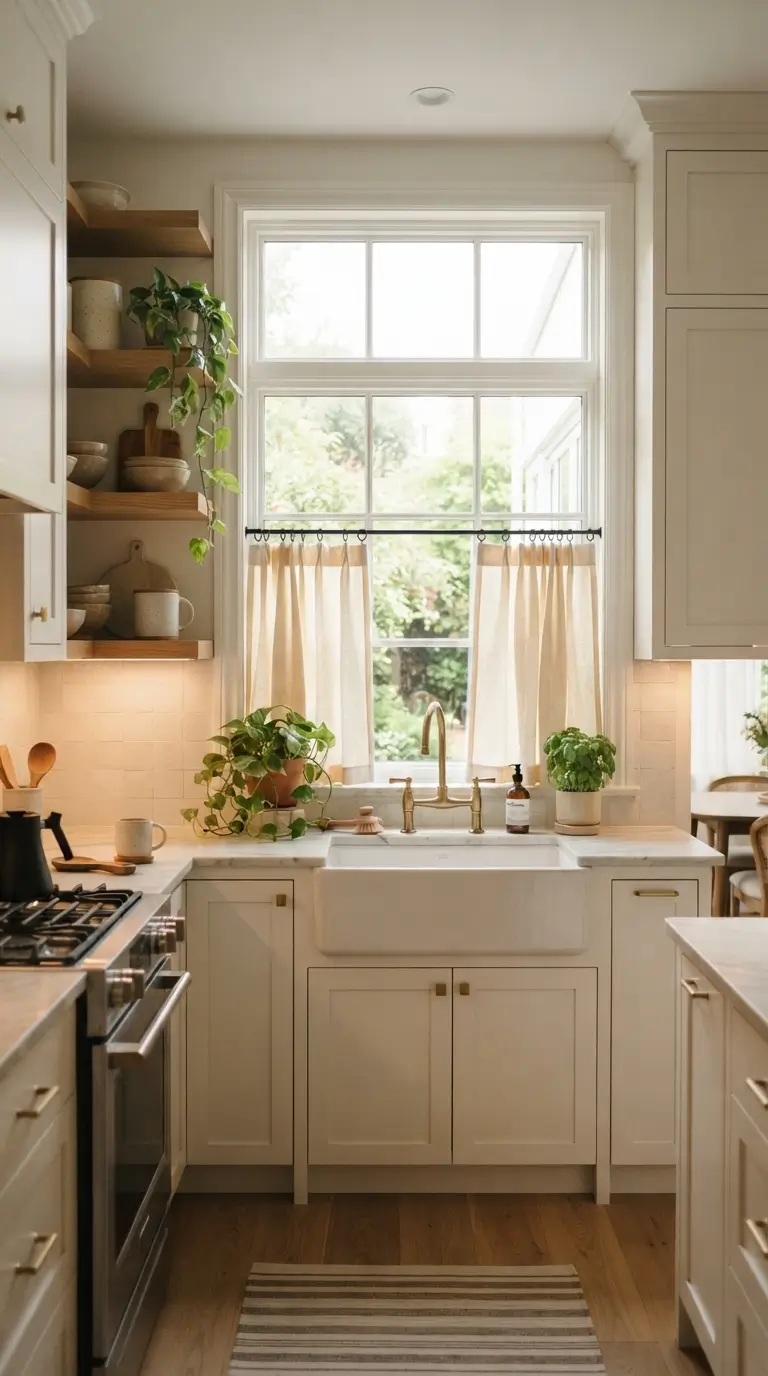
A kitchen feels twice as calm when the window light comes in soft and clean, and the counters stay bright.
Heavy drapes ruin that fast. They drink up steam, hold cooking smells, and turn a small window into a dark hole. Long panels near a sink or a stove get splashed, fade in the sun, and crowd the worktop.
Good modern kitchen curtain ideas solve all three problems. The fabric filters light without blocking it, the length stops at the sill or just below it, and the style fits the room you already have.
This list covers café curtains for privacy at sink level, linen that softens hard cabinets, Roman shades for a tidy finish, and bold color picks for plain white kitchens. Each idea notes the kitchen it suits and one practical tip, so you can match a curtain to your window, your budget, and the way you cook.
1. Sheer Linen Café Curtains
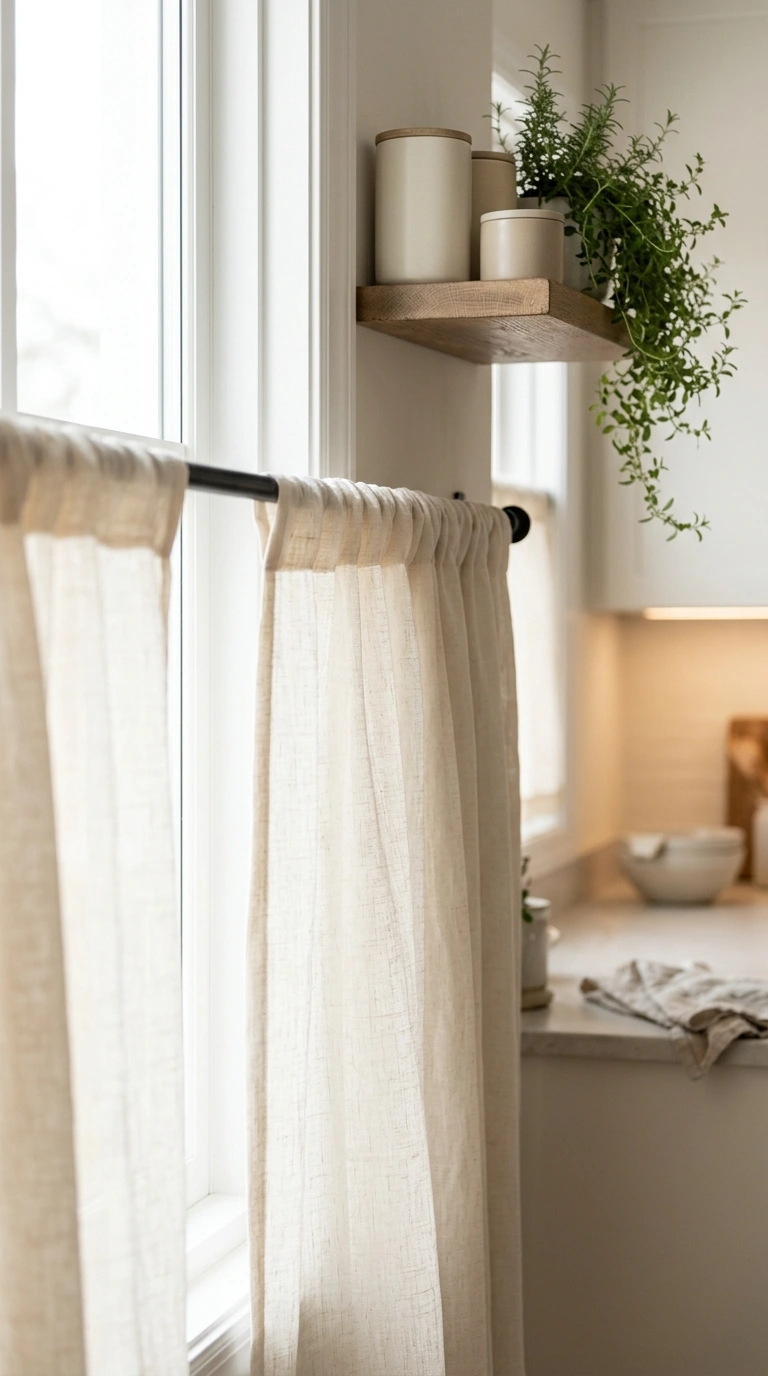
Privacy only where you need it is the whole trick here. Café curtains hang on the lower half of the window and leave the top half bare. You get privacy where people can see in at sink level, and daylight still pours in over the top. Sheer linen is the classic fabric for this job.
It blurs the view, softens hard tile and steel, and goes in the wash without fuss. A slim tension rod inside the frame means no drilling, which renters will care about.
- Rod spot: midway up the frame, or just above the sink sight line
- Fullness: one and a half times the window width, for soft folds
2. Black Metal Rod With White Linen Panels
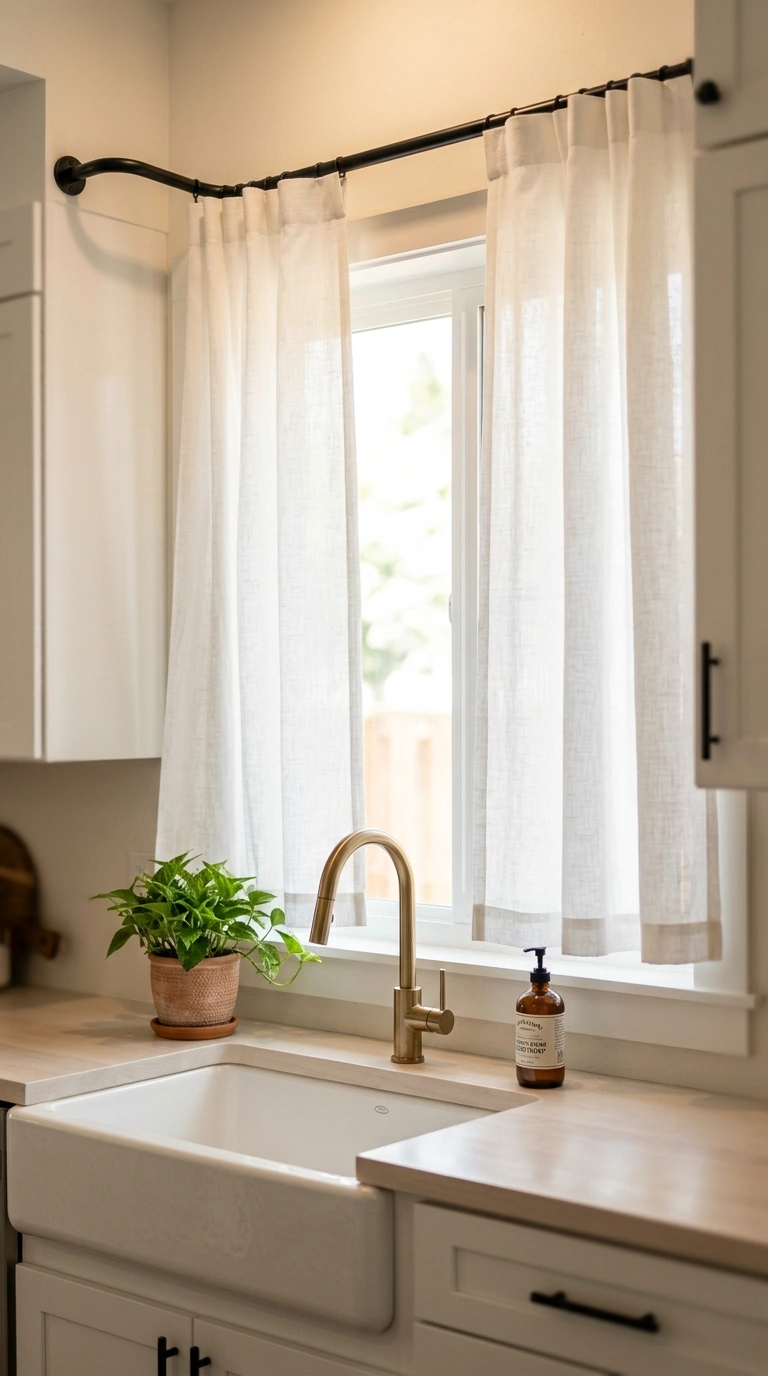
White panels on their own can look plain. The black rod is what gives them shape.
Matte black hardware shows up in a lot of modern kitchens, in handles, taps, and light fittings. A black rod ties the window into that set, and plain white linen keeps the look light.
Hang full panels on a tall window, or café length panels above a sink. Linen with a slight weave reads softer than flat cotton and hides small creases between washes.
Keep the rod slim. A thick rod swallows a small window and steals the light you wanted.
💡 Quick Tip
Repeat the black in one more place, a cabinet handle set, the tap, or a light fitting, so the rod looks planned and not like an odd one out.
3. Ribbed Linen Curtains in Warm Ivory
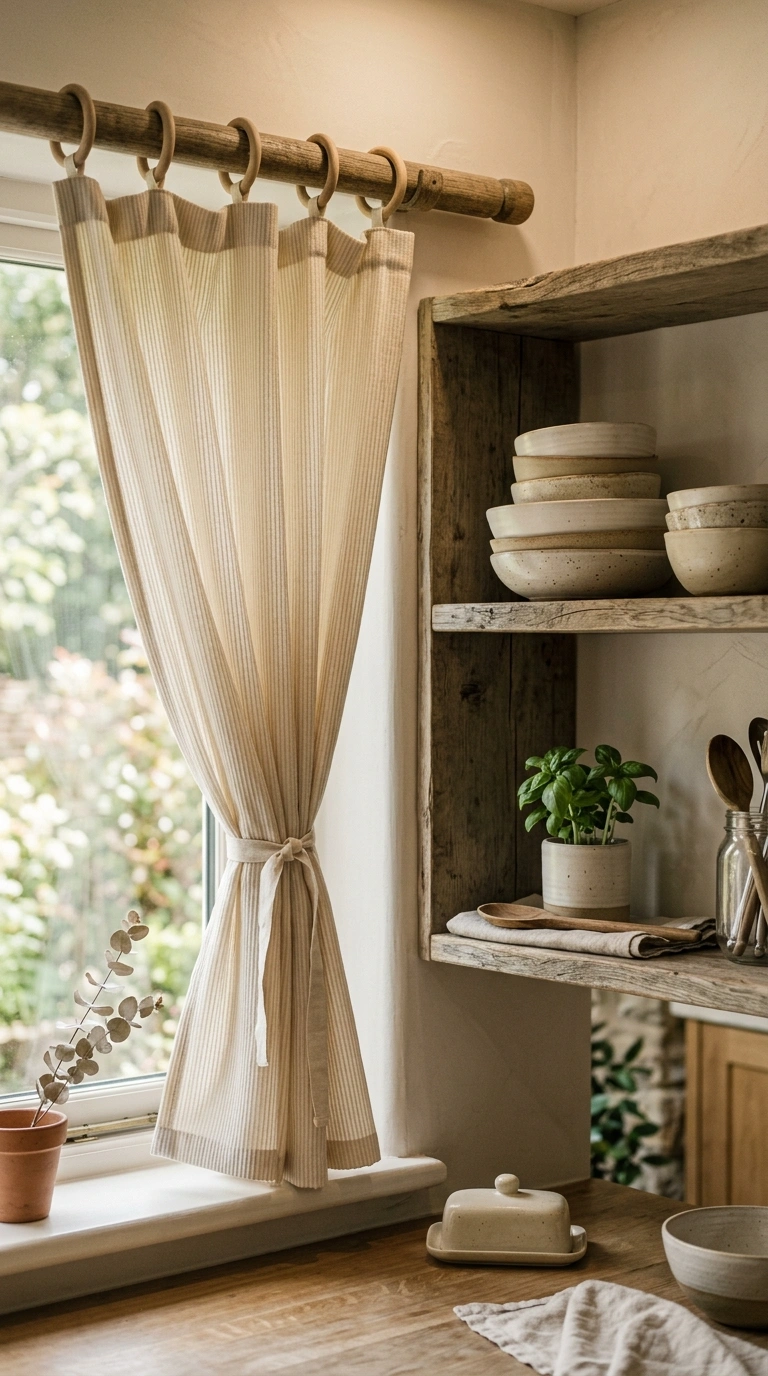
Plain ivory curtains can fall flat against plain ivory walls.
The ribbed weave fixes that. Fine raised lines run down the fabric and catch the light in thin stripes, so the curtain has depth in a single color. Warm ivory sits well with cream cabinets, oak worktops, and brass taps, where bright white can look cold. The texture also forgives daily life. Small splashes and crease marks blend into the ribs instead of showing on a flat surface.
- Best with: cream cabinets, oak worktops, brass taps
- Light effect: softens glare on bright windows
Hang them a little wide of the frame, so the ribs stay on show when the panels are open.
4. Boho Curtains With Macramé Trim
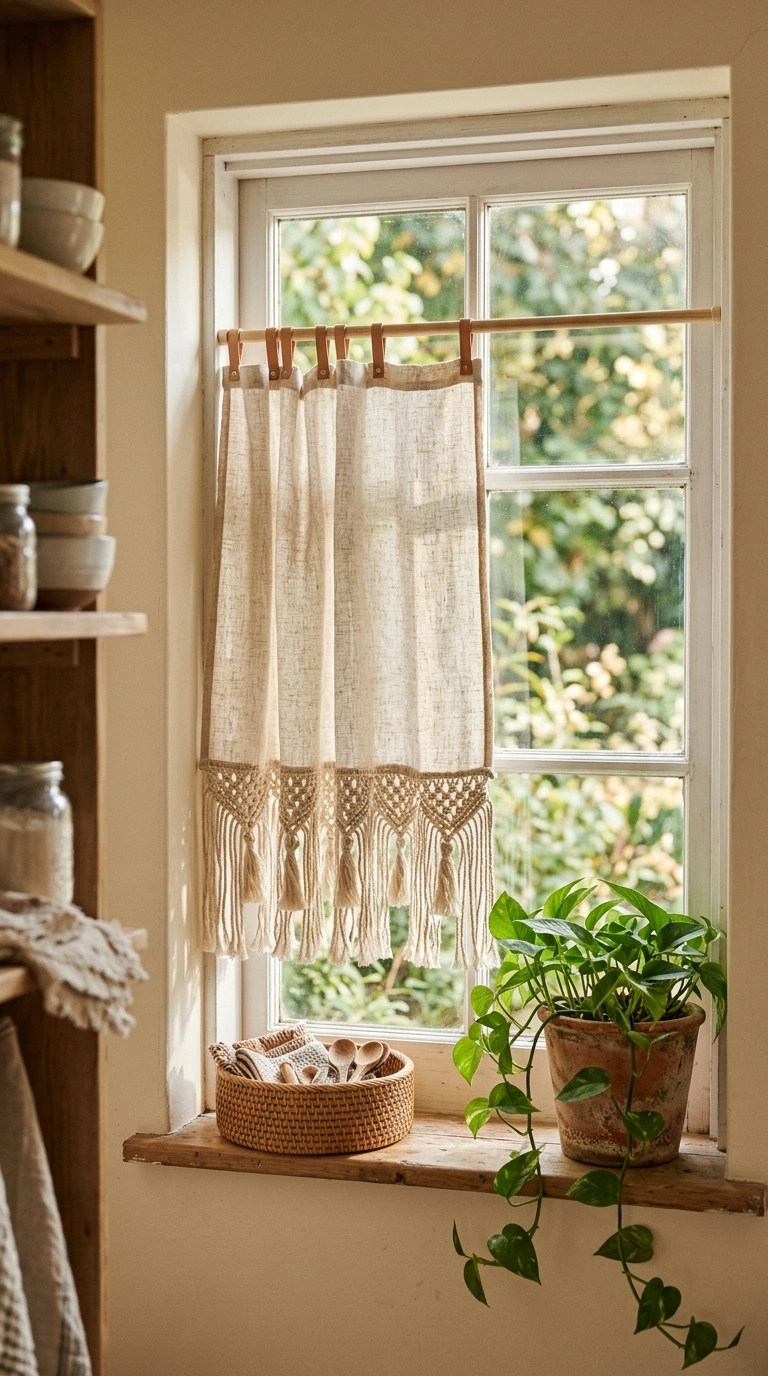
Some kitchens are all hard edges: steel, tile, stone, and glass.
A macramé trim gives the window one soft, handmade note without turning the room into a theme. Look for plain cotton or linen panels with the trim along the inner edge or the hem, so the pattern stays at the border and the fabric stays simple. The look suits relaxed kitchens with open shelves, plants, and worn wood.
Keep any fringe well clear of the hob. Boho charm is not worth a fire risk near open flame.
Before you hang them
5. Roman Shade Layered With Side Panels
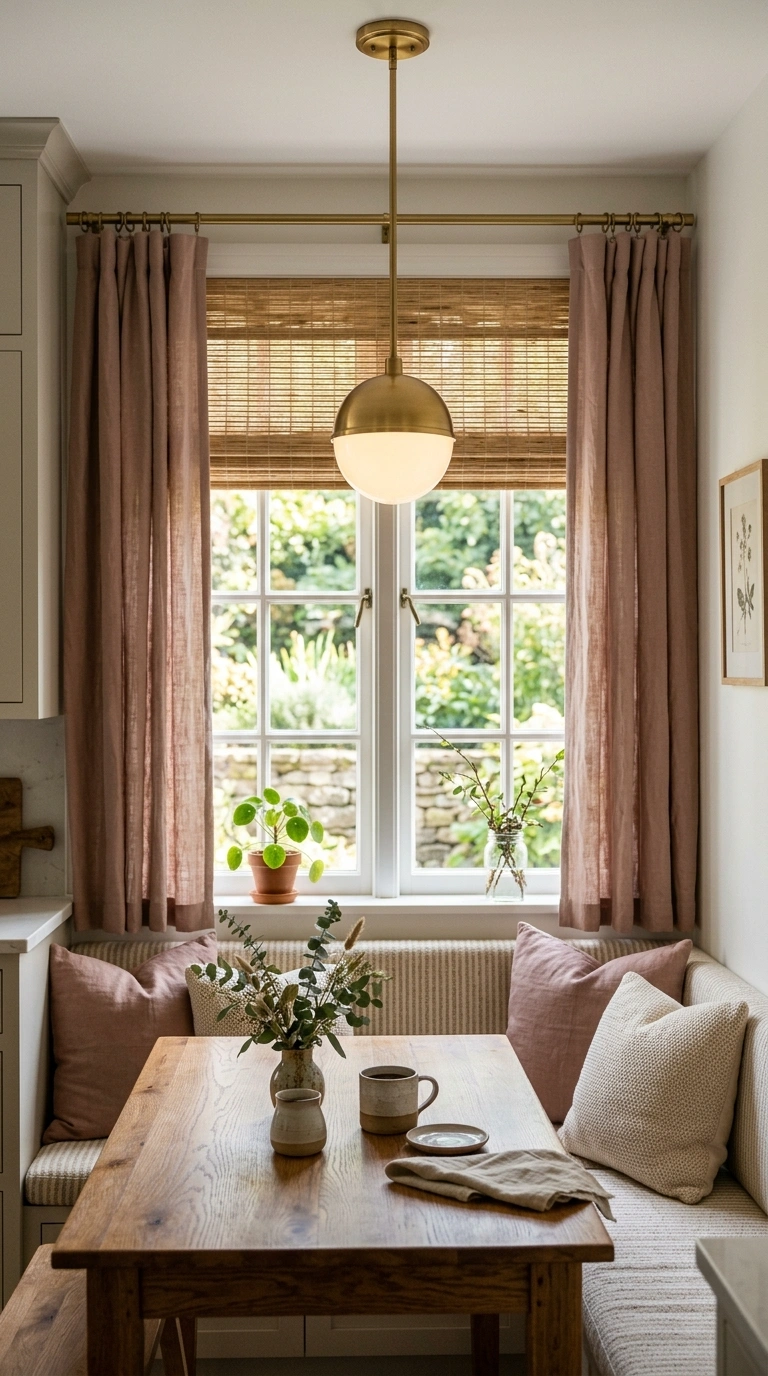
A Roman shade on its own can look a bit bare on a wide kitchen window.
Side panels fix the edges. The shade does the daily work, lifting for light and dropping for privacy, and two slim panels sit at the sides to frame the glass. The panels do not need to close, so they can be narrow and use far less fabric than full curtains.
Pick a washable cotton or linen blend for the shade, since it hangs closest to steam and splashes, and run the panels one shade deeper in color for a calm border.
This pairing suits wide windows and kitchen diners, where a single shade leaves the corners looking empty.
Wide window, one plain shade, and bare wall at both sides that makes the window look unfinished.
Shade still does the light and privacy work, slim panels frame the glass, and the whole window looks dressed.
6. Brass Grommet Curtains
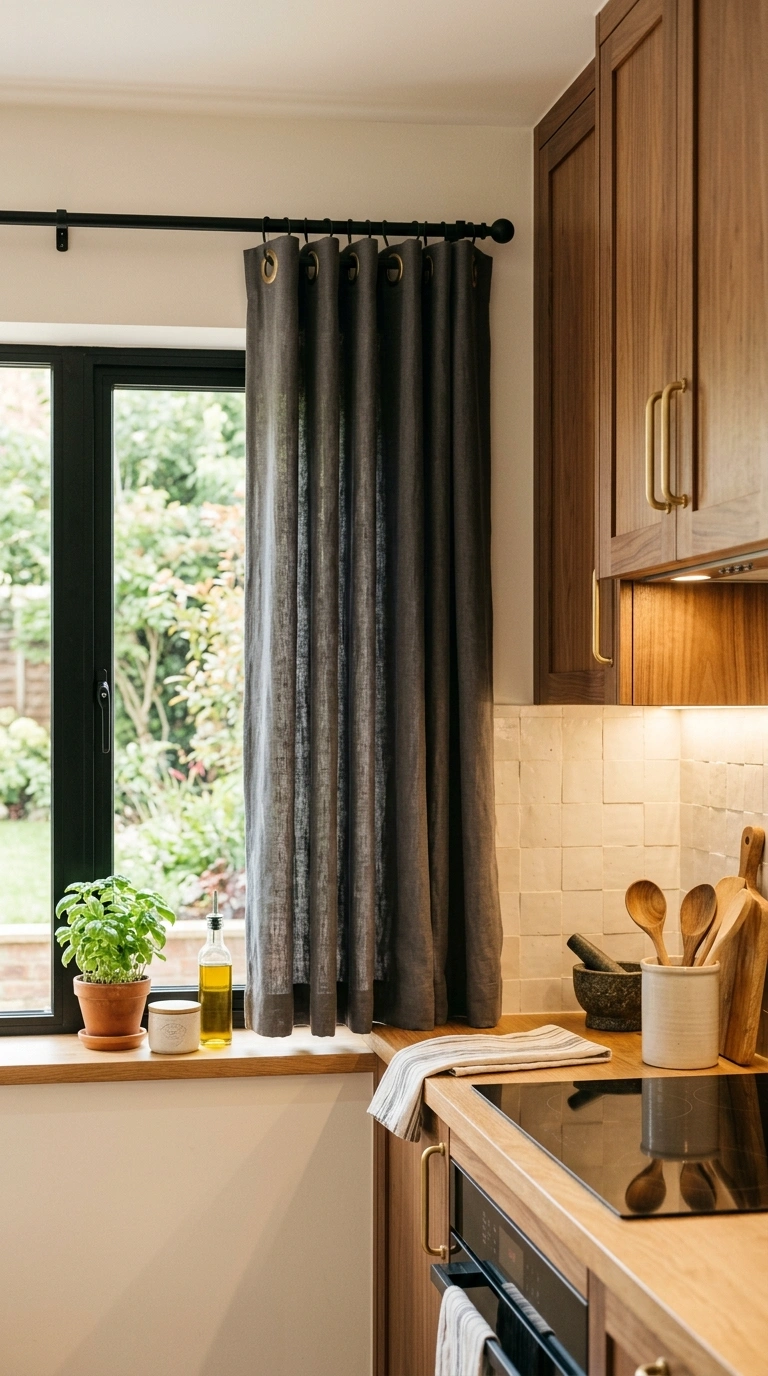
Curtains you open and close twice a day need a header that slides without a fight.
Brass grommets do that job. The metal rings are set into the top of the panel and run straight on the rod, so one pull moves the whole curtain. No pins, no hooks, no bunching at one end. Warm brass suits kitchens with brass taps, handles, or light fittings, and the big clean folds look modern on plain linen or cotton. Pick grommets a size up from the rod, so the rings glide and do not scrape the finish.
| Grommet top | Clip rings |
|---|---|
| One pull and the rings glide along the rod | Rings can stick, tilt, and bunch at one end |
| Even, wide folds with a clean modern line | Softer, gathered folds with a casual line |
| No pins or hooks to fit or lose | Clips fit any panel, no holes to set |
7. Thin Pinstripe Linen Curtains
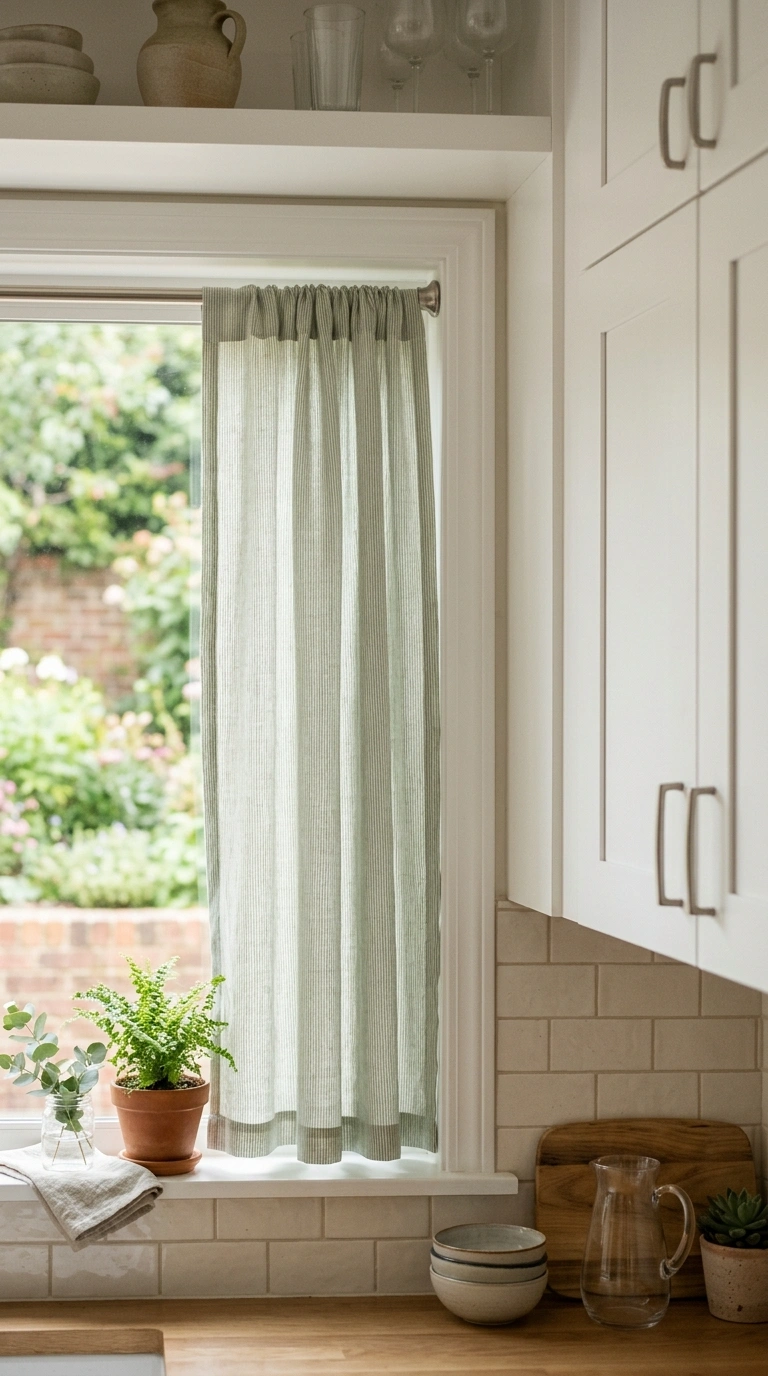
Thin stripes are a quiet way to make a small kitchen feel taller.
Pinstripes run down the panel, and the eye follows them up. Hang the rod close to the ceiling and let the panels stop at the sill, and the window reads longer than it is. Keep the stripe fine and low contrast, soft gray or muted blue on white or ivory linen.
A loud stripe will fight with tile and worktops. This is a pattern that stays in the background and still earns its place.
Pinstripe suits rentals too, since the pattern is calm enough to sit with any cabinet color.
Hang the rod high, close to the ceiling.
Keep the stripe thin and low contrast.
Match the stripe color to one small item, like the towels.
Wide, bold stripes that shout over the cabinets.
Panels that stop in the middle of the glass.
A second busy pattern on the same window wall.
8. Waffle-Weave Textured Curtains
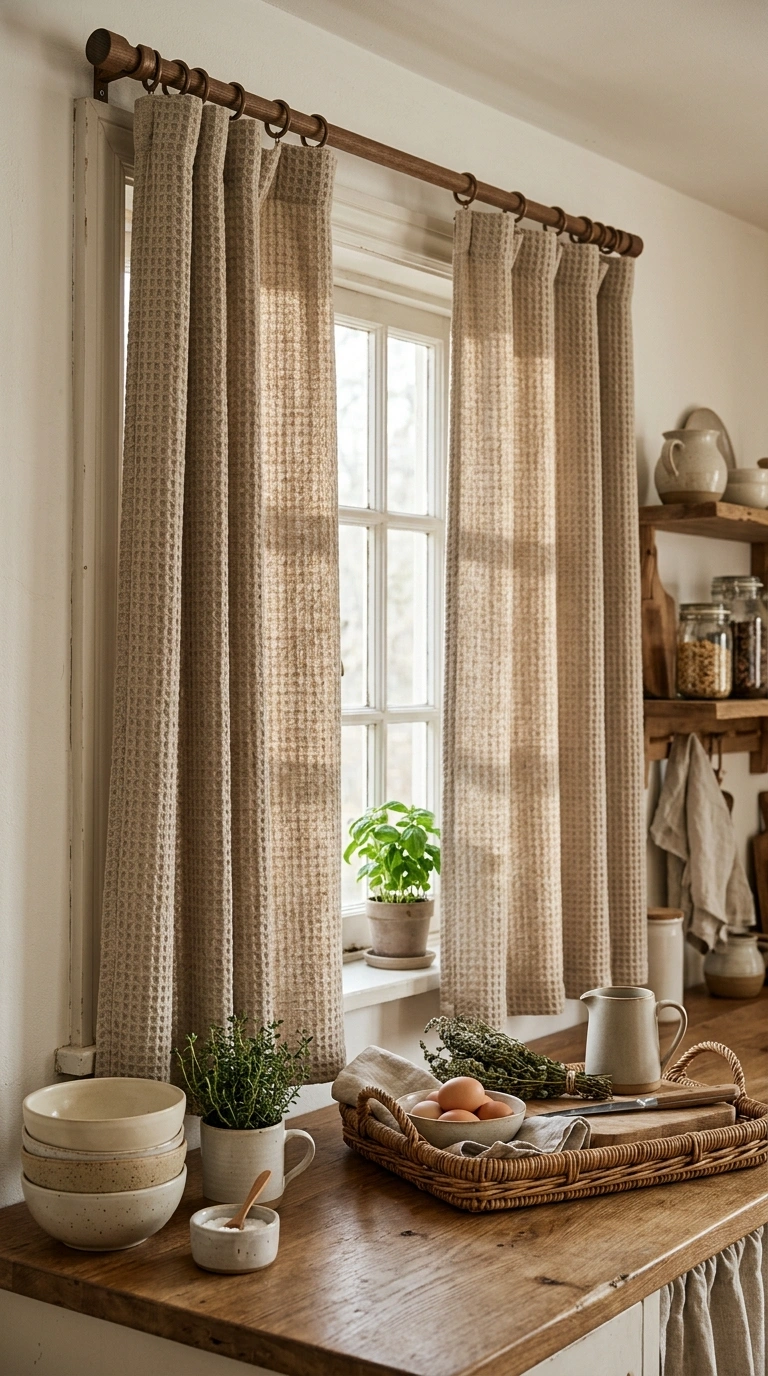
Hold a waffle weave panel up to the light and the small squares glow in a neat grid.
That woven texture gives a plain kitchen window depth without color or print. The fabric is mid weight, so it blocks more view than a sheer and keeps a soft look at the glass. It suits flat kitchens with smooth cabinets and plain tile, where every surface is hard and shiny.
One honest limit: the little pockets hold dust, so these panels want a shake outside and a wash more often than smooth linen.
Wash or steam the panels first, so the weave relaxes into even squares.
Hang the rod a few inches above the frame, so the texture starts high.
Space the folds with your fingers. The squares look best in even rows.
9. Sage Green Linen Curtains
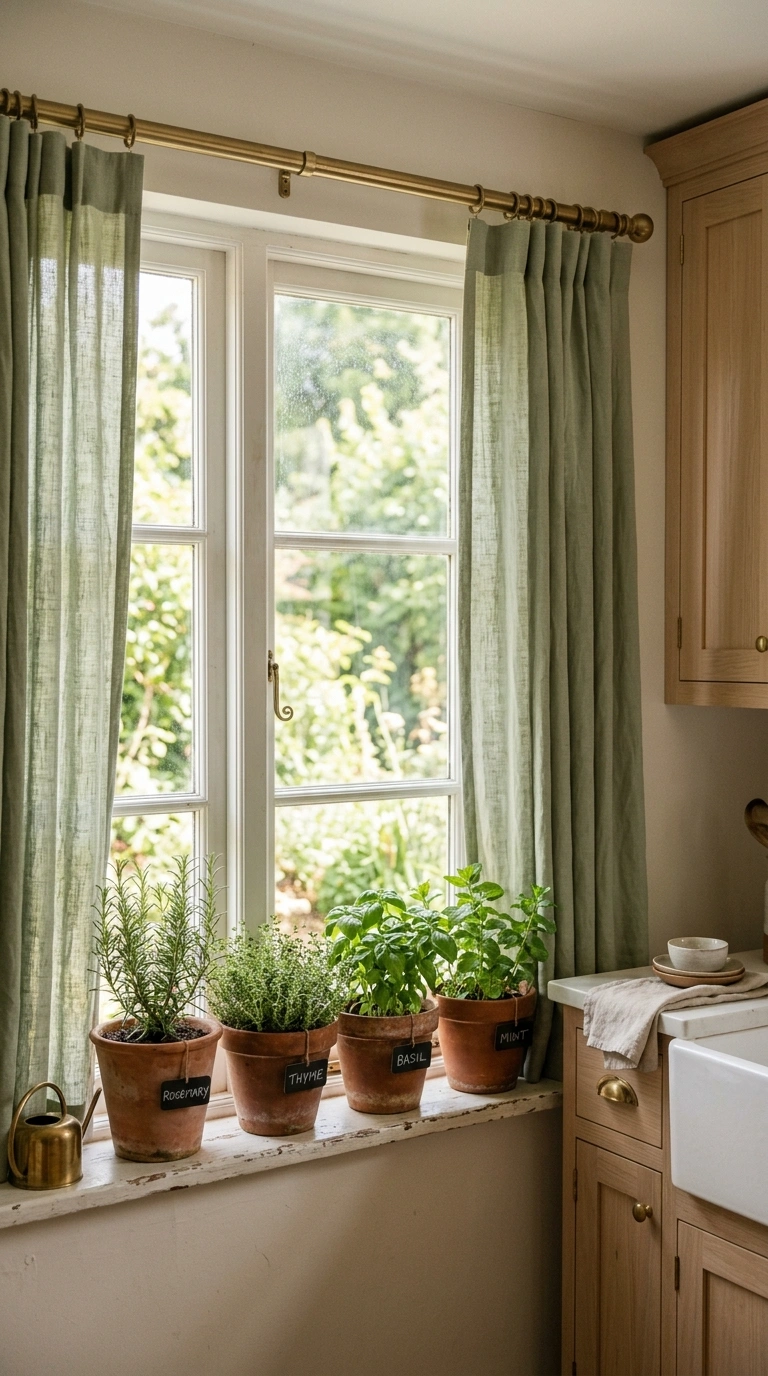
Sage is the color a lot of plain white kitchens are quietly missing.
It adds color without noise. Sage linen sits calm next to white walls, oak worktops, and brass or black hardware, and it softens the cold feel of steel and stone. The green reads like a plant that never needs watering, which is why it suits kitchens with herbs on the sill.
Keep the rest of the window simple. Sage is the note, so skip a second pattern on towels or seat pads nearby.
In north facing kitchens, pick a warm sage with more yellow in it, so the green does not turn gray by noon.
Sage works like a neutral in a kitchen. Pair it with wood, white, brass, or black, and let it be the only soft color at the window.
10. Two-Tone Color Block Curtains
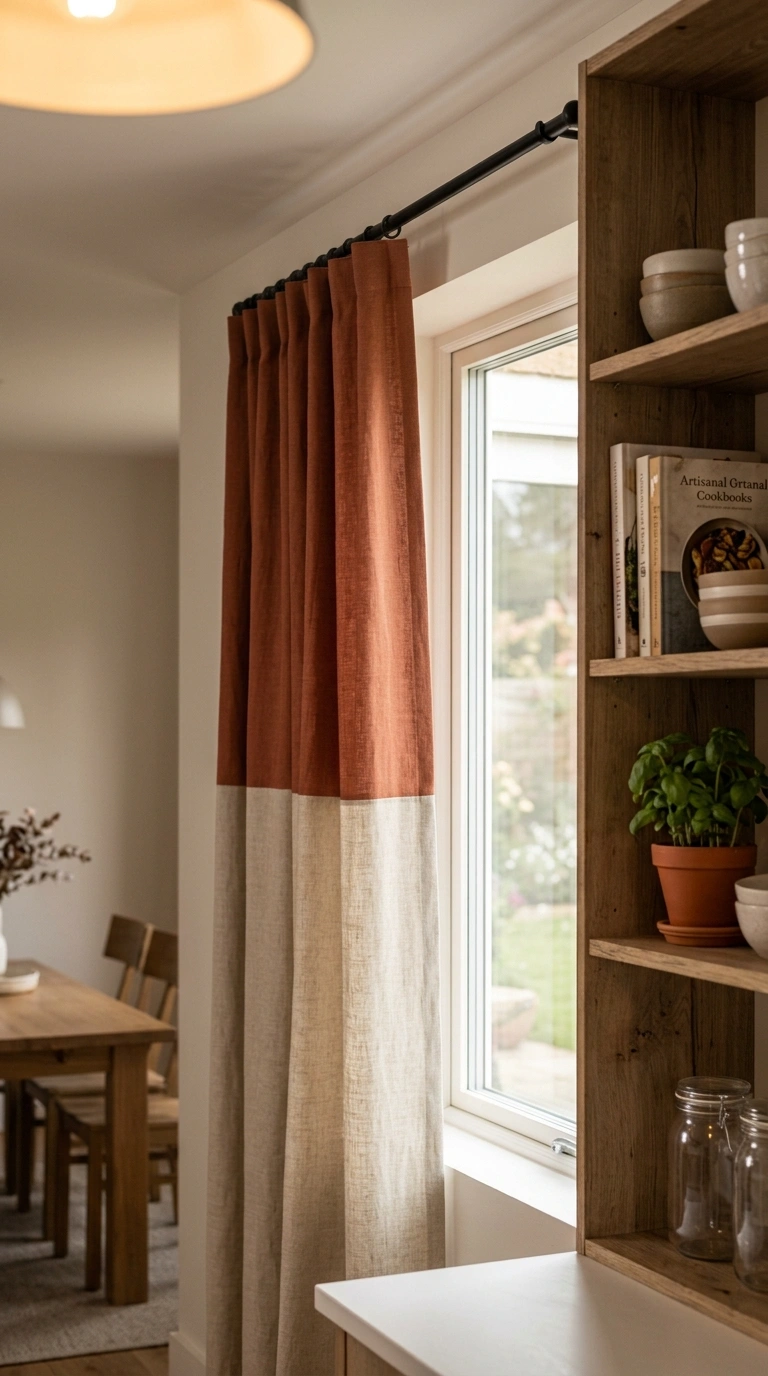
A color block curtain splits the panel into two clear zones of color.
Most have a light block on top and a deeper block below, and that split is practical in a kitchen. The light top keeps the window bright near the ceiling. The deeper lower block sits at splash height near the sink and the worktop, where marks show less on color than on white.
Pick the lower color from something already in the room, a cabinet paint, a stove front, or the floor, so the panel looks built in.
- ▸Top block: white or ivory, so the light stays high in the room.
- ▸Lower block: the deeper color, set at splash height near the sink.
- ▸Join line: line it up with the sill for a clean, straight split.
11. Sheer Voile With Blackout Roman Shade Combo
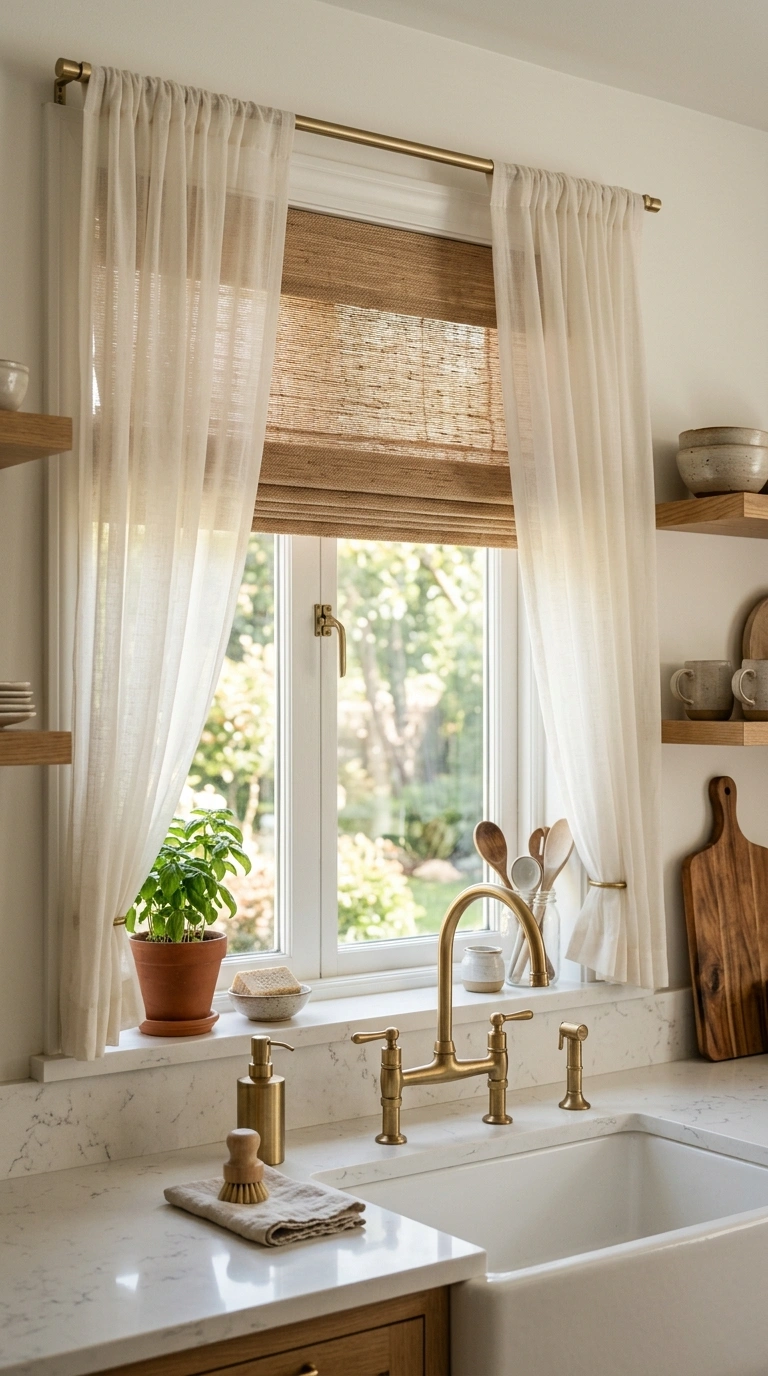
A kitchen that faces the street has two opposite problems in one day.
Voile solves the day half. The fine sheer takes the glare off worktops, blurs faces outside, and still lets you see the garden. The blackout Roman shade solves the night half.
Dropped down, it gives full privacy and blocks street light, which matters in kitchen diners and studio flats where someone sleeps in the same space. Fit the voile flat against the glass on a wire or a slim rod, and mount the shade on the frame above it.
One sheer panel only. Fine at noon, but at night, with the lights on, the room is on show to the street.
Voile softens the day, the blackout shade drops at night, and the kitchen stays private around the clock.
12. No-Sew Tea Towel Curtains
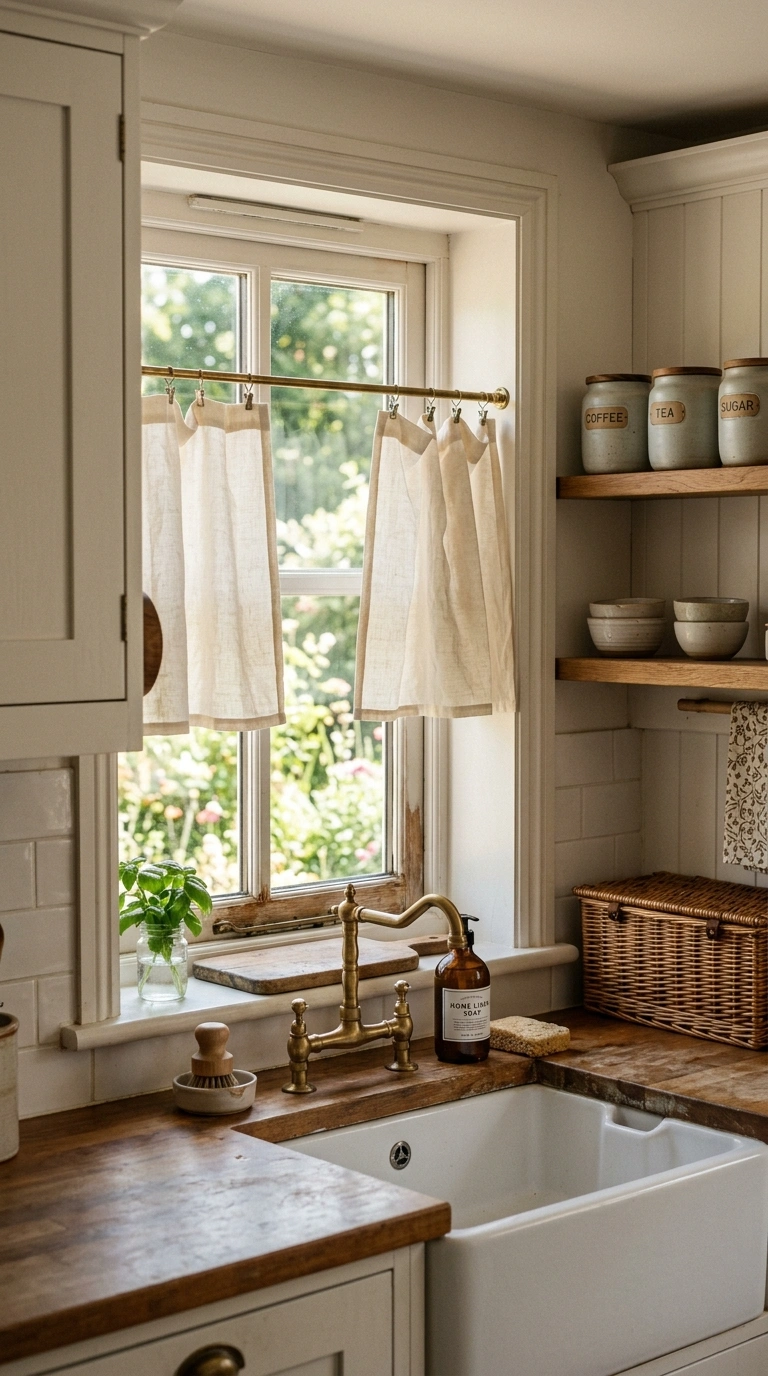
Two tea towels, one tension rod, and a row of clip rings can dress a kitchen window for the price of lunch.
Tea towels are sold in the right size by luck. Most are close to café panel length, and they come in stripes, checks, and prints that suit kitchens better than curtain fabric does.
Clip a ring along the top hem of each towel, slide the rings on a tension rod, and the window is done. Keep a second matching pair in the drawer. When one set goes in the wash, the spare set goes up, and the window never sits bare.
Pick two matching tea towels in washable cotton, in a stripe, check, or small print.
Clip five or six rings evenly along the top hem of each towel.
Slide the rings onto a tension rod and fit the rod inside the window frame.
13. Exposed Wood Curtain Rings
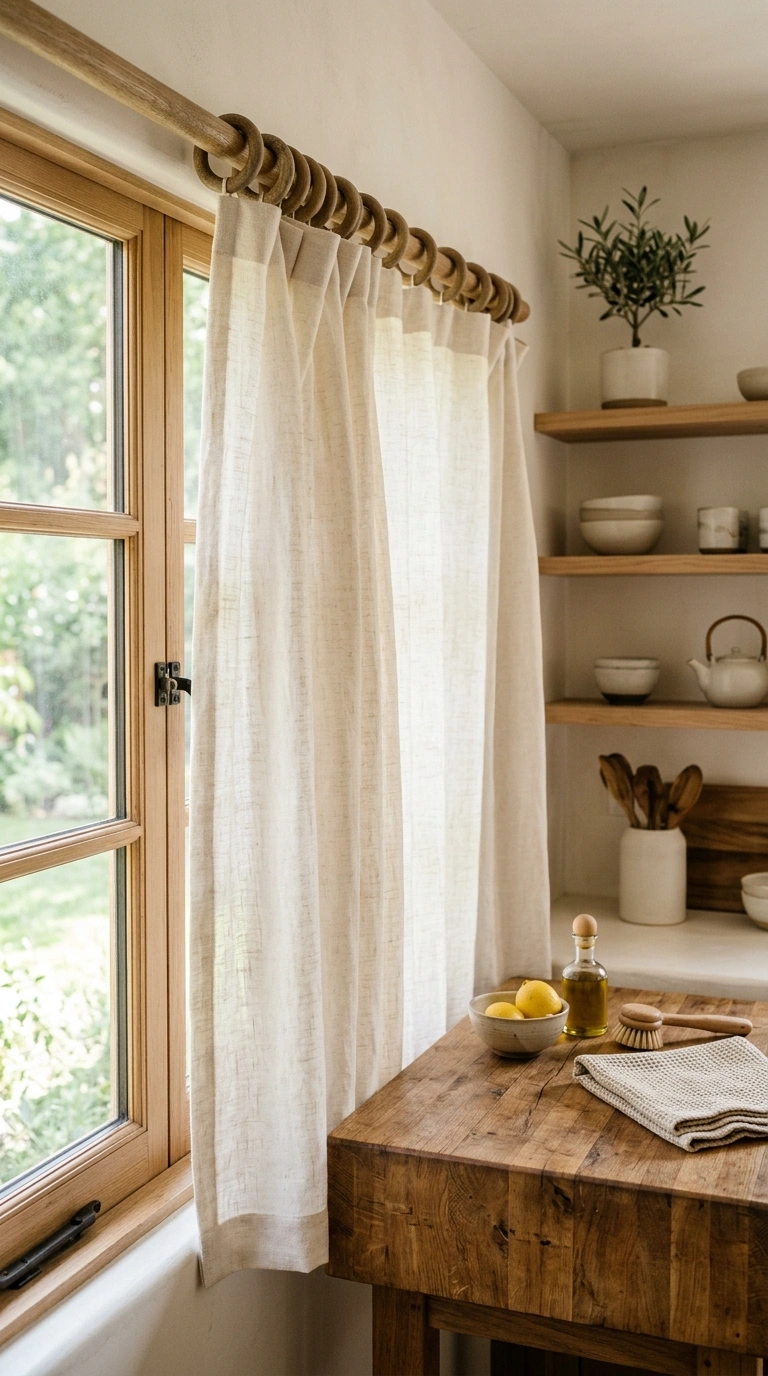
The rings are a small part of the window, and they change the whole feel of it.
Wood rings tie a curtain to the wood already in the room, the worktop, the open shelves, the stool legs. Run them on a wood pole for a soft, matched look, or on a black rod when you want contrast.
Because the rings sit proud of the panel, the curtain slides well and stacks in neat folds at the sides. Match the ring wood to your shelves by tone, light, mid, or dark, and the match will read as planned.
14. Warm Terracotta Linen Curtains
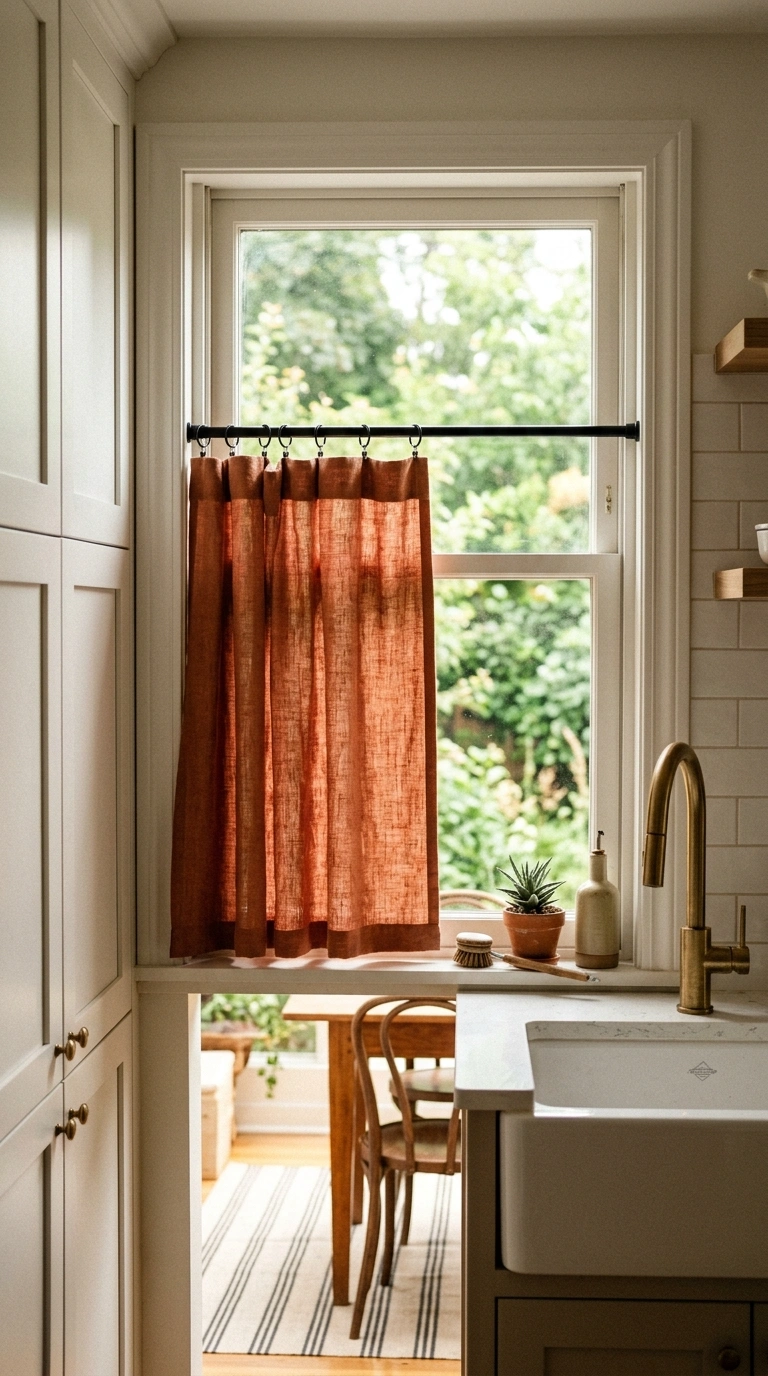
Cool gray and white kitchens can feel a bit cold by late afternoon.
Terracotta fixes that without a tin of paint. The warm clay color takes the chill off gray cabinets and white tile, and linen keeps the color matte and soft instead of shiny. It sits well with oak boards, clay pots, and black handles, so the window pulls the room together. When late sun hits the panels, the color deepens and the whole kitchen reads warmer.
Start with curtains only. If the room still feels cold after a week, add one clay pot or a wood board, not five new colors.
💡 Quick Tip
Hold a terracotta towel at the window for a day before you buy panels. If the color lifts the room at noon and at dusk, the curtains will too.
15. Charcoal Linen Curtains for Dark Kitchens
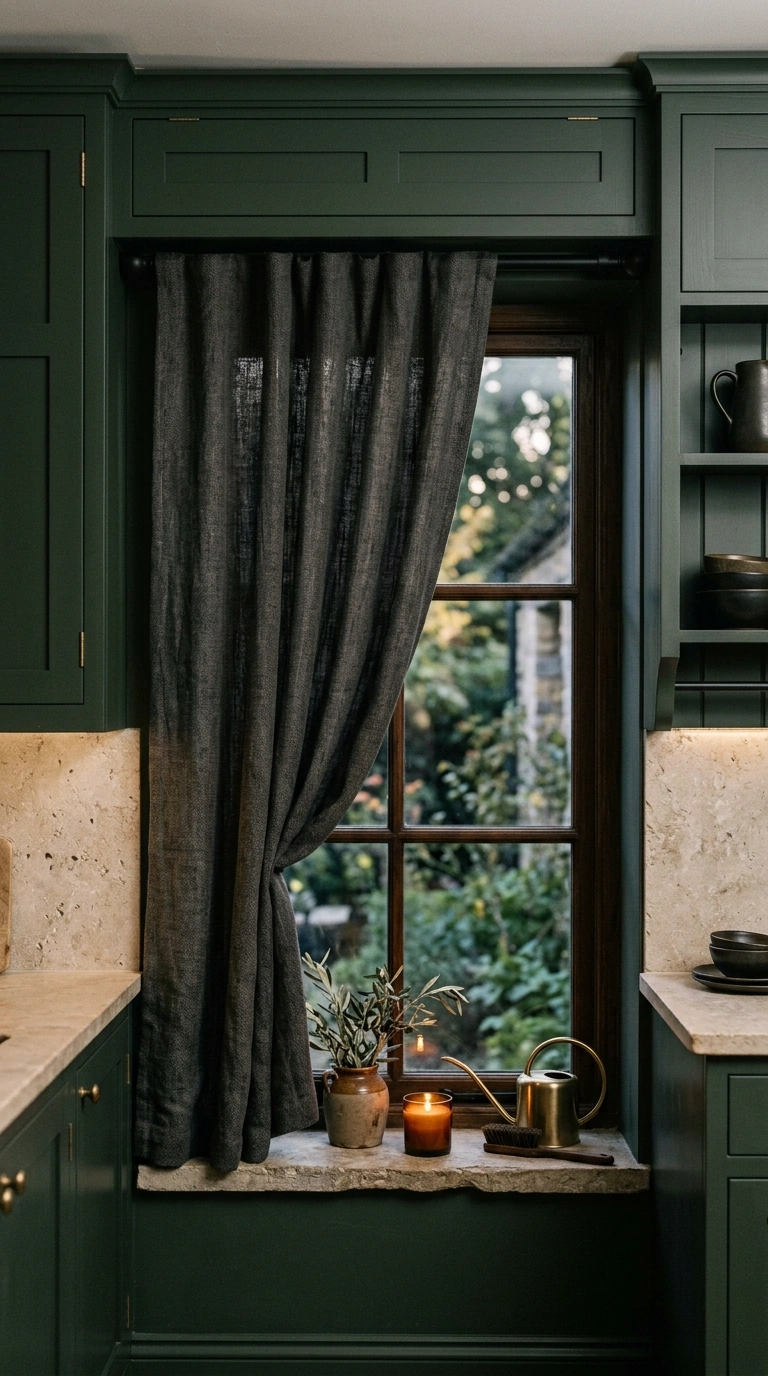
Dark kitchens do not need light curtains to save them. They need the right dark ones.
Charcoal linen joins the window to dark cabinets instead of fighting them. On navy, deep green, or black units, a pale curtain can look lost and cheap. Charcoal keeps the moody run of color going, and the linen weave stops the panel reading as one flat block.
Steel handles and a pale worktop give the contrast, so the window does not need to. One fair warning: flour dust and pale splashes show on charcoal, so these panels want a quick brush down more often.
✅ Do this
Match the charcoal tone to the cabinet tone.
Keep the worktop and sill items pale, for contrast.
Brush the panels down each week near flour zones.
🚫 Skip this
A second dark pattern at the same window.
Shiny black fabric next to matte cabinets.
Charcoal in a dark, low light kitchen with no pale surface nearby.
16. Pinch Pleat Header Curtains
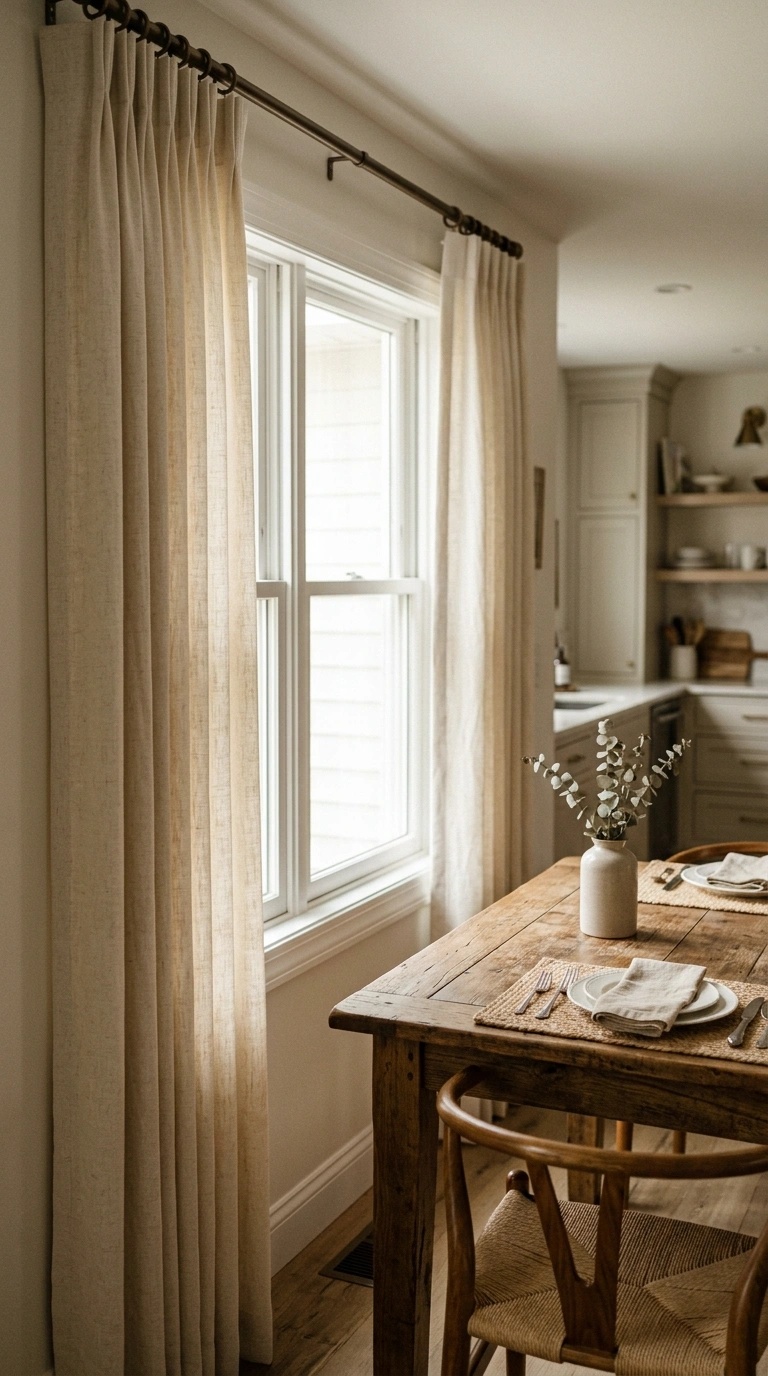
Pinch pleats are the header you see in dining rooms and hotels, and they earn their keep in a kitchen diner.
The fabric is pinched and stitched at the top, so the folds fall in even, deep lines and stay that way. The look is tailored, less soft than loose linen, and it suits kitchen diners where the window sits in view of the table.
Pleats use more fabric than a flat panel, and most need hooks and rings, so the cost runs higher. Wash day is also slower, since the hooks come out first.
Before you order
17. Tie-Back Curtains for Over-Sink Windows
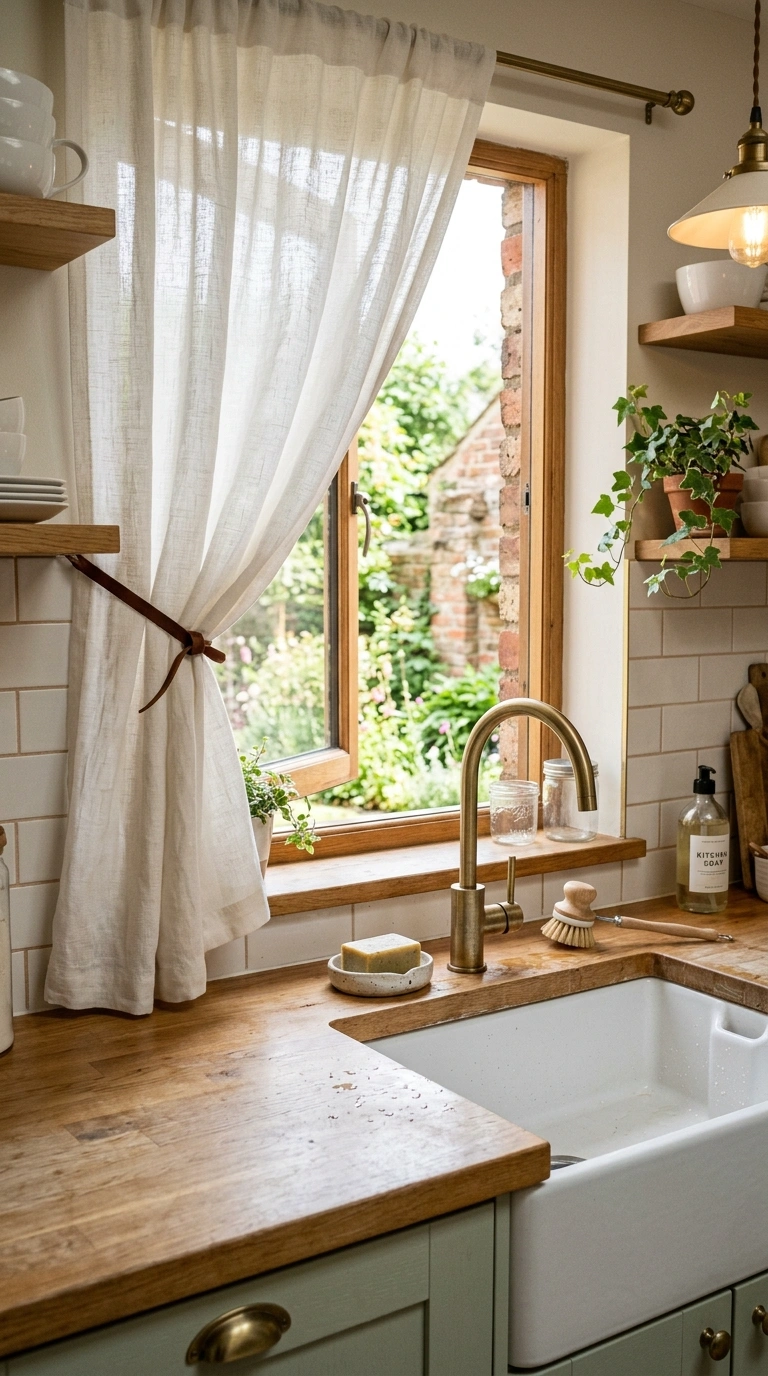
The window over the sink is the one window in the house that gets splashed every single day.
Tie-backs solve that by pulling the panels up and out to the sides. The fabric sits clear of the tap arc and the washing up bowl, and the glass stays open while you work. Fit the ties at sill height or a bit higher, and use fabric ties for a soft look or plain holdbacks for a clean one. Keep the panels short, café or sill length, and pick a fabric that washes well, since the lower edges will still catch spray.
18. Small-Scale Block Print Curtains
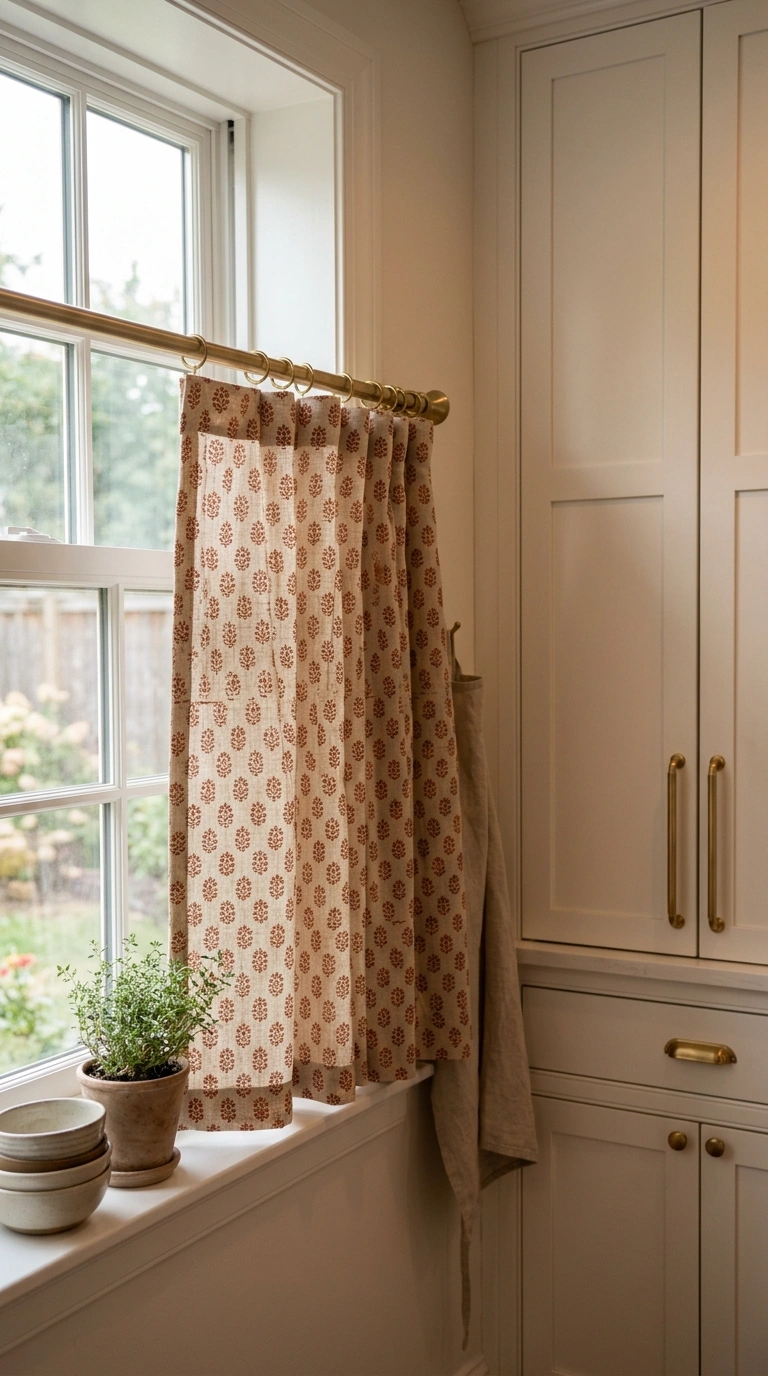
Big prints can take over a small kitchen. Small block prints behave better.
Each motif is small, about the size of a coin or a thumbprint, and the pattern repeats in neat rows. The hand stamped look has tiny wobbles in it, and that is part of the charm.
On white or natural cotton, a block print in one or two colors gives a plain kitchen pattern without a fight. Keep nearby towels and seat pads plain, so the small print is the only pattern talking at the window.
| Small block print | Large floral print |
|---|---|
| Coin size motifs in neat, close rows | Wide motifs that repeat less often |
| Suits small kitchens and short panels | Suits tall windows with plain walls around them |
| Reads as soft texture from across the room | Becomes the main color note of the room |
19. Double-Layer Sheer and Solid Curtains
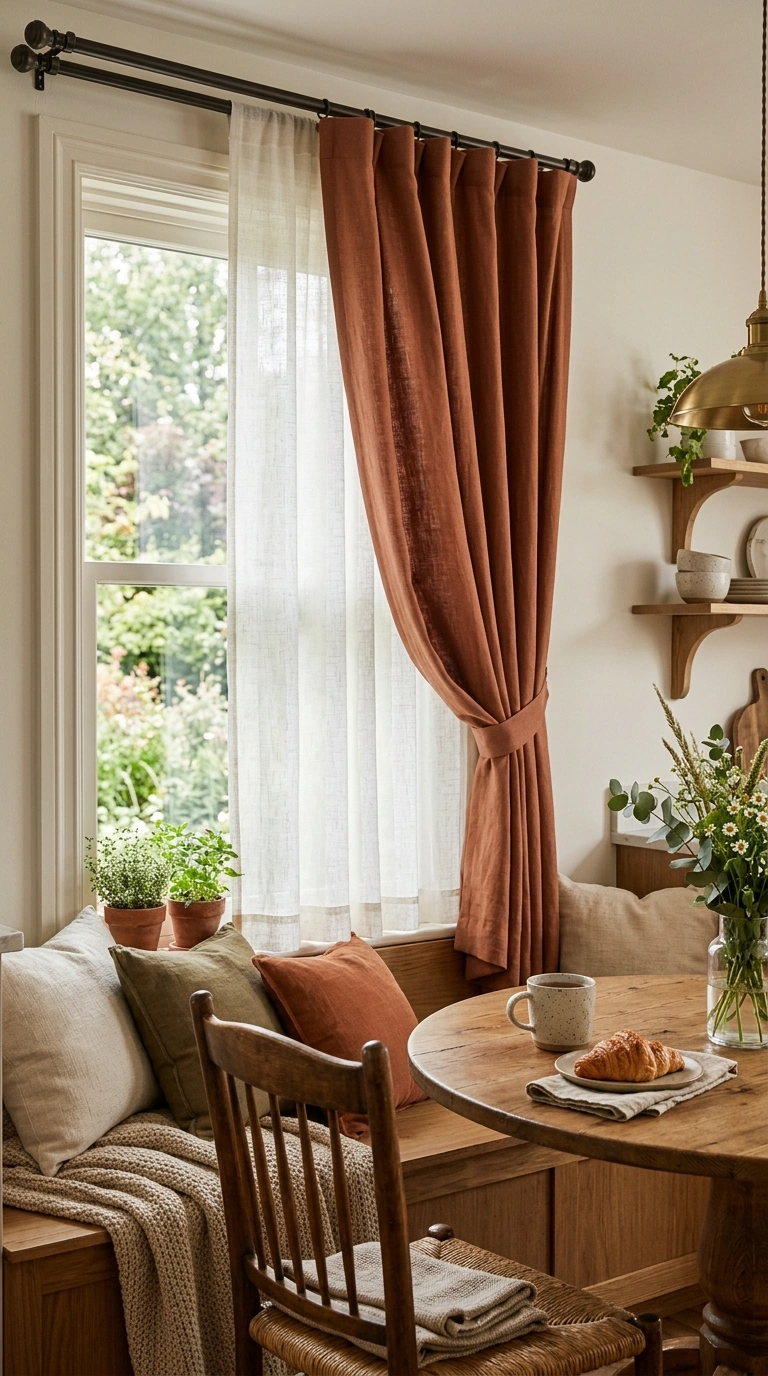
One curtain rarely does both jobs: soft light at breakfast and full privacy at night.
A double layer splits the work. The sheer hangs at the glass and stays closed all day, giving soft light and a blur on the view. The solid panel hangs on the room side.
Open it in the morning, close it at night, and the kitchen is private. A double rod or a twin track holds both without a tangle. The cost is two sets of curtains, but each set can be simple and washable, and you replace one layer at a time when it wears.
Sheer layer for the day, solid layer for the night. Fit a double rod once, and the window stops being a daily compromise.
20. Warm White Linen With Exposed Seams
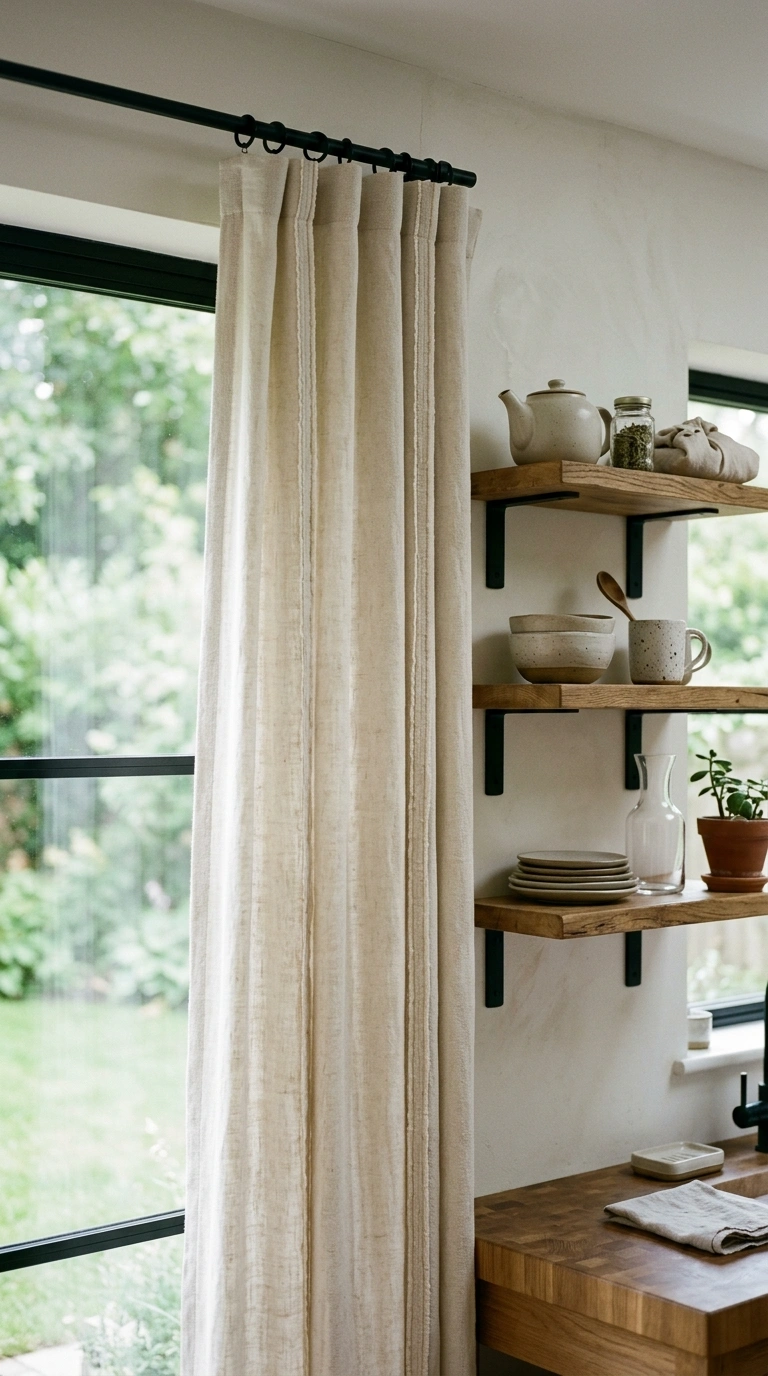
The seams are the decoration here. Everything else stays quiet.
Warm white linen keeps the window soft and plain, and the exposed seams add the detail. You can see the stitch lines running down the panel, and the natural slubs in the linen catch the light in small flecks. It suits pared back kitchens with wood, stone, and plain walls, where one busy pattern would spoil the calm.
Warm white also sits kinder next to skin tones and wood than blue white does. The honest cost: white near a stove shows marks, so pick a washable linen blend and accept a regular wash cycle.
⚠️ Watch out
Grease film settles on white fabric near a stove faster than you expect. Wash these panels each month, or hang them at a window away from the hob.
Conclusion
The right curtain is the one that fits your window, your light, and the way you cook. Short panels and café curtains keep sink windows private and bright. Linen and waffle weave soften hard cabinets. A Roman shade, a color block, or one bold color gives a plain room its note.
Start with the window you see most, measure it well, and pick a washable fabric. Good modern kitchen curtain ideas are mostly that: light fabric, honest length, easy care. Save the ideas you like on Pinterest, and order one fabric sample before you commit to a full set.
Choosing the right curtains: five quick checks
Before you buy
FAQs
What fabric works best for kitchen curtains near a stove or sink?
A mid-weight linen or cotton-linen blend holds up well near heat and moisture while still looking soft. Avoid delicate sheers directly over a stove, since they sit closer to steam and grease. A washable linen curtain in a solid color also makes cleanup easier over time.
How long should modern kitchen curtains be?
Café-style curtains covering only the lower half of the window work best over a sink, since they keep fabric away from water and dishes. For a breakfast nook or dining-adjacent window, a full-length curtain that grazes the floor adds a more finished look. Choose length based on how close the window sits to daily kitchen tasks.
What color curtains make a small kitchen feel bigger?
Light, warm tones like ivory, soft greige, or pale sage keep a small kitchen feeling open and airy. Hanging the rod slightly above the window frame and letting curtains fall close to the floor also creates the illusion of height. Avoid heavy, dark fabric in an already dim, small kitchen.
Can I mix patterns and solid curtains in one kitchen?
Yes, as long as the color palette stays consistent between the pieces. A small-scale block print paired with solid linen panels elsewhere in the kitchen can look intentional rather than mismatched. Keep the pattern limited to two or three colors that repeat throughout the space.
Are grommet curtains a good choice for a kitchen?
Grommet curtains work well in kitchens because they open and close easily, which matters near a sink or stove where you need quick access to light. The even, structured folds also give a clean, modern look. Choose a sturdy fabric so the grommets do not stretch or sag with daily use.